Diagnostic Guide
Why Is There Water Around My Indoor AC Unit?
Water around an indoor AC unit may involve a clogged drain, overflowing pan, thawing coil, condensate pump, or another nearby leak.
Short answer
What it usually means
Air conditioners normally make condensate as the indoor cooling coil removes moisture from the air, but that water should collect in a pan and drain away. Water around the indoor unit usually means the condensate is not draining normally, the pan or an optional condensate pump is not managing it, ice has formed and then melted, or water is coming from another nearby source. A clogged drain is common, but the puddle alone cannot prove the cause.
Where the water normally goes
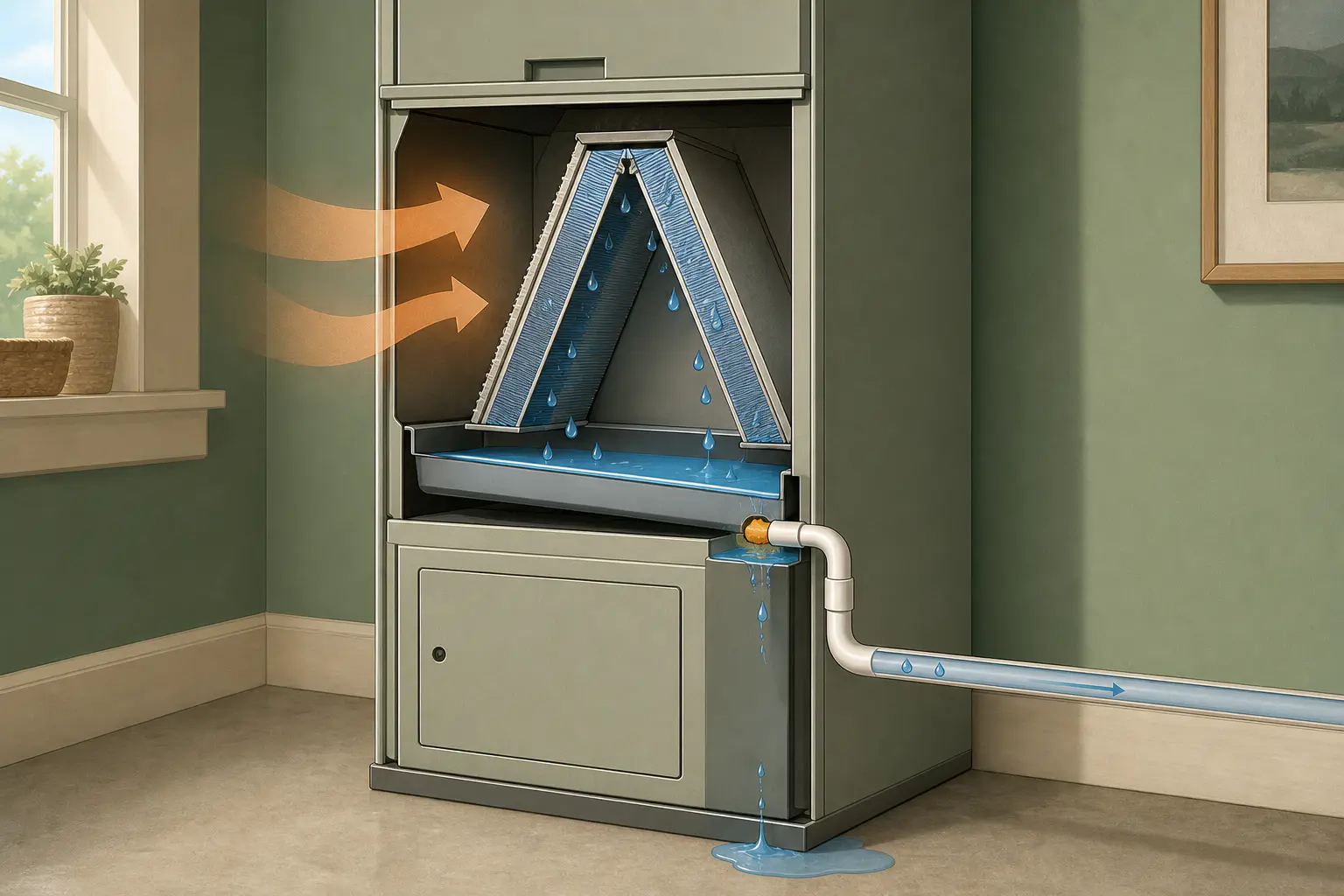
During cooling, warm indoor air passes across the cold evaporator coil. When the coil surface is below the air's dew point, water vapor condenses on it. That liquid is normal condensate—not water circulating through the supply ducts. The equipment is designed to collect it in a drain pan and move it away through a condensate line or, in some installations, a condensate pump.
A small amount of water inside the intended drainage path can therefore be normal. A puddle on the floor, water running out of the cabinet, a secondary pan that keeps filling, or dampness that returns each cooling cycle is not the intended result. It means the drainage path, equipment operation, or source of the water needs to be identified.
Indoor units are arranged differently. The cooling coil may be part of an air handler or mounted with a furnace, and pans, drains, switches, and pumps vary by installation. Use the visible pattern as a clue rather than assuming your system matches a generic diagram.
Common reasons water collects around the indoor unit
Several causes can create the same puddle, and more than one can occur together. Start with timing and the first wet location rather than assuming every indoor-unit leak is a clogged drain.
- 1The condensate drain line is clogged
Dust, debris, biological buildup, or sludge can restrict a condensate line. Water then backs up in the primary pan or reaches a secondary pan instead of draining normally. ENERGY STAR includes condensate-drain inspection in professional maintenance because a plugged drain can damage the home and affect humidity. This guide does not cover why a line repeatedly clogs; that recurring-maintenance intent remains a separate topic.
- 2A drain pan is full or overflowing
The primary pan receives water from the coil. Some installations also have a separate auxiliary or secondary pan intended to catch water if the primary path fails. The exact arrangement varies. A visibly full accessible pan suggests that water is arriving faster than it is leaving, but it does not show whether the cause is a blockage, slope, pump, pan, or equipment problem.
- 3A pan is cracked, rusted, damaged, or displaced
A pan can corrode, crack, shift, or fail to direct water toward its outlet, particularly as equipment ages. Plastic and metal pans fail differently, and some primary pans are hidden inside the cabinet. Water leaking through a damaged pan may appear before a visible pan looks full, so external inspection cannot rule the pan in or out.
- 4A frozen evaporator coil is thawing
Ice on the cooling coil can melt after the compressor stops and release a larger amount of water than the drainage system handles at once. Restricted airflow from a dirty filter is one possible contributor; other airflow or refrigeration-system problems require testing. Water after shutdown, weak airflow, or safely visible frost are clues, not a refrigerant diagnosis.
- 5A condensate pump is not moving water
Some units cannot drain by gravity and use a small condensate pump. A failed pump, blocked tubing, stuck switch, loss of power, or a full pump reservoir can allow water to accumulate. Not every system has a pump, and opening or bypassing one can expose electrical parts or defeat overflow protection.
- 6A drain connection is loose, disconnected, or not draining correctly
A separated fitting, damaged pipe, poor slope, or installation problem can release water before it reaches the intended outlet. The visible line may also pass through walls or ceilings where the problem is hidden. Do not cut a line or pull on fittings to test them; a technician can inspect drainage and confirm the correct arrangement for the equipment.
- 7Humid conditions are creating a high condensate load
An AC can produce more condensate when it is cooling air with a larger moisture load. A properly functioning drainage system should handle normal operation, so humidity may explain why the problem appears during certain weather without explaining why water escapes. Persistent high indoor humidity may also deserve its own evaluation.
- 8The water is coming from somewhere else
Indoor HVAC equipment is often near plumbing, a water heater, a whole-house humidifier, a floor drain, or piping. A roof or attic leak can travel down framing and appear around a unit below. Water can also follow tubing, wire, or cabinet edges, making the puddle location different from the source.
Is the water actually coming from the AC?
The most useful observation is where water first appears. A puddle directly below a pan outlet during cooling may fit a condensate problem; a wet trail from above, a pipe that becomes wet with fixture use, or staining that grows after rain may fit another source. Drying only the safely accessible floor can make the next wet path easier to see.
Water can travel before it becomes visible, so none of these patterns proves the source. Share the timing, photographs, and nearby systems with the professional who investigates.
If the wet trail begins at a nearby hot-water tank or its piping, use the water-heater leak-source guide to compare top connections, valves, relief discharge, condensate, and a possible tank-body leak.
| Observation | May be more consistent with |
|---|---|
| Water appears during or shortly after cooling | Condensate drainage or thawing ice |
| An accessible drain or pan area is visibly wet | A pan, drain, connection, or pump problem |
| Water appears after the AC stops, with weak airflow or frost clues | A thawing frozen coil |
| A wet trail begins above the HVAC cabinet | A roof, plumbing, humidifier, or other overhead source |
| Water follows nearby fixture or water-heater operation | A possible plumbing or equipment leak |
| Staining expands after rain | A possible roof or building-envelope leak |
Could a frozen coil be thawing?
A cooling coil can accumulate frost or ice when its operating conditions are abnormal. When that ice melts, the pan may receive a sudden load or water may reach places it normally would not. Possible clues include weak supply airflow, cooling that seems abnormal, frost on safely visible external tubing or cabinet surfaces, and water that becomes noticeable after cooling stops.
Those clues do not identify the cause of the icing. A dirty filter is a reasonable homeowner check, but coil contamination, blower or duct airflow, controls, and refrigerant-system performance may also be involved. Do not open the coil cabinet, chip ice, apply heat, or handle refrigerant. Turn the system off at the thermostat from a dry location and arrange HVAC evaluation when icing is suspected.
If the filter media itself is damp, stained, or soaked, use Why Is My AC Filter Wet? to compare equipment-adjacent filters with return-grille filters before assuming thawing ice reached it.
How this differs from other AC moisture problems
The location of the first visible moisture defines the most useful starting guide. Water around the equipment points toward condensate collection and drainage; wet registers, humid rooms, and attic duct surfaces require different comparisons.
If the home feels clammy or readings stay high while cooling, use Why Is My House Humid With the AC Running? for the broader indoor-moisture pattern. Humid conditions can increase condensate production but do not excuse overflow.
If water is falling from or appearing around a supply register in a room, see Why Is Water Dripping From My AC Vent? to distinguish register condensation from drain, roof, and plumbing sources.
If moisture is only beading on the room-side register, start with Why Is My AC Vent Sweating? for the surface-condensation pattern.
If droplets are forming on the outside of ducts in an attic, use Why Is My AC Ductwork Sweating in the Attic? for attic dew point, insulation, and jacket conditions.
If water is beading across the metal equipment cabinet itself, use Why Is My Air Handler Sweating? to distinguish cabinet condensation from a pan, drain, or thawing-coil leak.
What you can check safely
First decide whether water is actively spreading or approaching electricity. If the area is dry enough to observe safely, make only external checks and record what changes with operation.
- Note whether water appears while cooling runs, just after shutdown, after rain, or when nearby plumbing or equipment operates.
- If water is spreading, turn the HVAC system off at the thermostat only when the control and your path to it are dry and safe.
- Inspect the filter if it is designed for normal homeowner access; replace it according to its instructions if clearly dirty or overdue.
- From outside the cabinet, look for a visibly full accessible pan, a wet drain connection, or an obviously separated external line without touching or moving anything.
- Note whether a condensate pump is present and whether its reservoir area is wet; do not open, power, or bypass the pump.
- Visually compare nearby plumbing, the water heater, a humidifier, overhead piping, and the area above the unit.
- Photograph the first wet location, water depth, any safely visible frost, and the same area after the system is off.
Why recurring water should not be ignored
Water can damage flooring, drywall, ceilings, insulation, cabinets, and nearby stored items. Repeated wetting can also create conditions that support microbial growth on susceptible materials. A puddle does not prove mold is present, but it does justify correcting the source and drying affected materials promptly where that can be done safely.
An overflow switch may stop some systems before damage spreads, but not every installation has the same protection and a switch is not a substitute for drainage repair. Do not bypass a shutdown or repeatedly restart equipment that stops while water is present.
When to call an HVAC professional—or another trade
Call an HVAC professional when water continues accumulating, a pan repeatedly fills, the drain appears blocked or disconnected, a condensate pump is not operating, coil icing is suspected, water returns after the visible area is dried, or cooling and airflow are abnormal. A technician can inspect the coil area, pans, drains, pump, switches, airflow, and equipment operation without assuming the first puddle identifies the failure.
Call a plumber when the water follows nearby fixture, supply-pipe, drain, or water-heater operation. Call a roofer when staining or wetness follows rain or traces toward the roof. A humidifier or other accessory may require its installer or an HVAC professional. When the source is unclear, give the first professional your timing notes and photographs so they can separate the systems.
Get prompt help when water is near electrical components, actively damaging a ceiling or floor, or coming from a source you cannot safely observe. Do not touch wet equipment. If there is smoke, sparking, or a burning odor, leave the immediate area and contact emergency services or the appropriate qualified professional from a safe location.
Sources
- Condensate Capture Potential MapU.S. Department of Energy
- Heating and Cooling Maintenance ChecklistENERGY STAR
- AC Leaking Water? Find Out Why and What to DoTrane
- Troubleshoot an Air ConditionerCarrier
- A Brief Guide to Mold, Moisture and Your HomeU.S. Environmental Protection Agency