Diagnostic Guide
Why Is My AC Filter Wet?
A wet AC filter may involve condensate overflow, thawing ice, condensation, air leakage, or another local water source. Filter location is the first clue.
Short answer
What it usually means
An HVAC air filter normally should not be wet. Moisture may reach it from condensate overflow near the indoor unit, water released as a frozen coil thaws, condensation around a cold or leaky filter rack, or a separate roof, plumbing, spill, or return-grille moisture source. The first question is where the filter sits: a filter beside the air handler has different plausible water paths than one behind a return grille across the house. Replace genuinely wet or damaged disposable media, but do not treat a new filter as the repair—the moisture source still needs to be found.
Filter location changes the list of likely moisture sources
Residential filters sit on the return side, before air reaches the blower and cooling equipment, but not in one universal place. Some slide into a rack beside an air handler or furnace. Others sit behind a wall or ceiling return grille, potentially many feet from the equipment.
Water escaping a coil pan may reach a nearby rack in some arrangements, but it cannot simply travel backward to every distant grille. A wet grille filter across the house should prompt inspection of that opening and surrounding wall or ceiling—not an automatic diagnosis of a clogged condensate line.
| Filter location | Moisture paths worth comparing |
|---|---|
| Rack beside or below the indoor unit | Nearby pan or drain overflow, thawing water, cabinet condensation, or another local equipment-room leak |
| Rack in return duct near the air handler | Condensation at a cold or poorly sealed rack, return-side air leakage, or water traveling from nearby equipment |
| Filter behind a wall return grille | A local plumbing leak, spill, wall-cavity moisture, or condensation at that return opening |
| Filter behind a ceiling return grille | A roof/attic/plumbing source above the grille, local condensation, or water entering the return opening |
| Several return-grille filters are damp | A broader humidity or enclosure condition may deserve comparison, without proving humidity is the only cause |
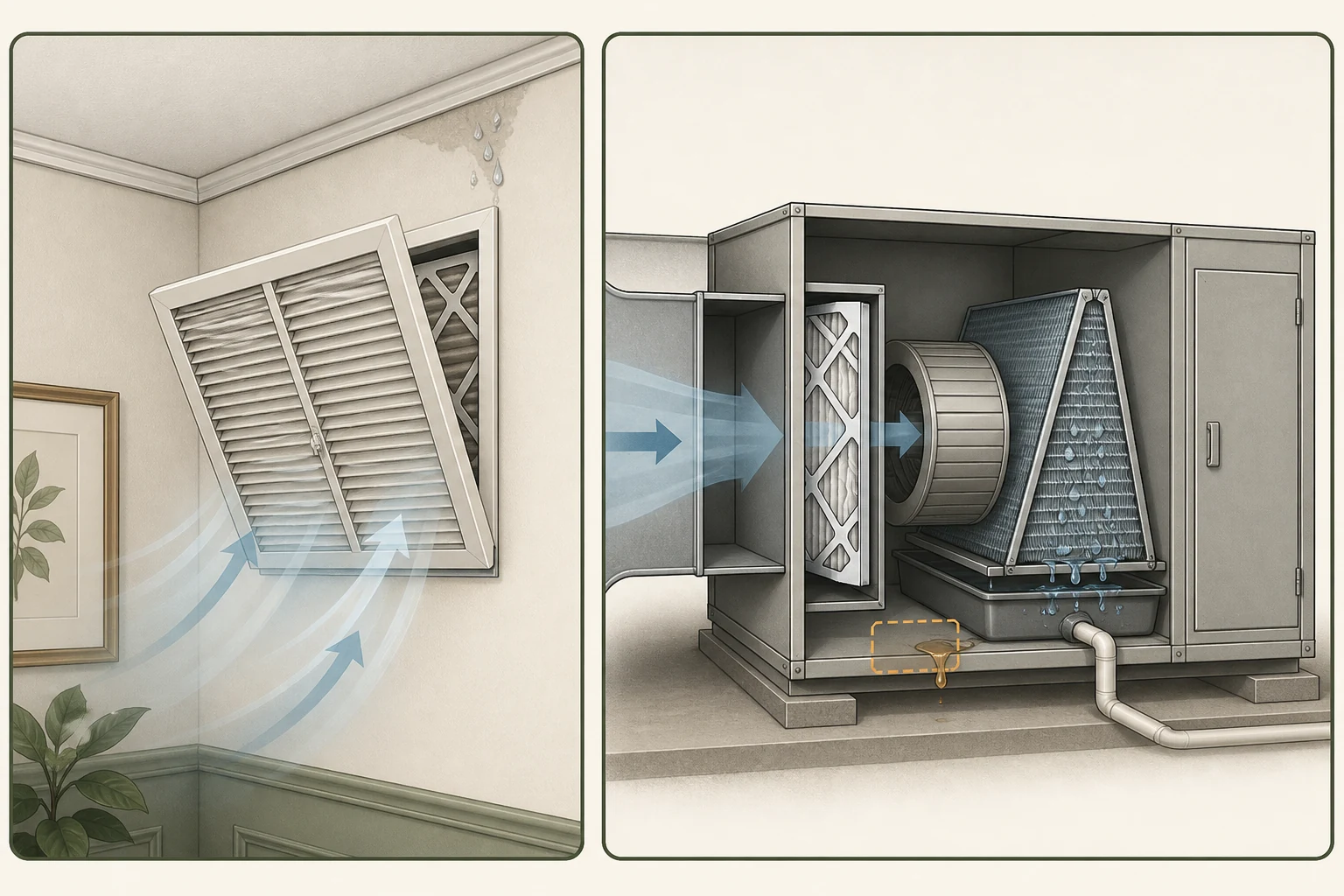
Common reasons an AC filter becomes wet
A wet filter shows where moisture ended up, not necessarily where it began. Trace the first wet surface and the operating pattern before assigning a cause.
- 1Condensate is overflowing or not draining normally
Moisture normally condenses on the indoor coil, collects in a pan, and leaves through a drain or optional pump. A clogged line, damaged pan, displaced component, or failed pump can let water escape. This path is more plausible for an equipment-adjacent filter than a distant grille filter.
- 2A frozen evaporator coil has thawed
Ice can melt after cooling stops and release more water than the normal path handles at once. A severely dirty filter can restrict airflow, but blower, coil, duct, control, or refrigerant problems may also contribute. A wet filter does not prove it caused the icing.
- 3Condensation is forming near the filter rack
Humid air can condense on a surface below its dew point. Moisture on a cold rack, cabinet surface, or nearby duct may wick into filter media. High humidity increases condensation potential but does not explain every wet filter.
- 4Humid air is leaking around the return side
A poorly sealed slot or return connection can pull humid air from an attic, crawlspace, garage, or wall cavity. That air may promote condensation on colder surfaces. A technician may need to compare leakage, insulation, pressure, and temperature.
- 5Water is coming from another nearby source
A roof leak, pipe, water heater, humidifier, appliance, cleaning event, or spill can wet the filter area. Water may travel along framing, ducts, piping, or the floor, so rain timing, fixture use, and the highest wet point matter.
- 6A return grille is exposed to local moisture
A damp ceiling, wall cavity, utility area, or spill may wet a grille filter without any failure at the indoor coil. Evaluate the moisture where that particular filter lives.
Where is the filter wet?
Use only the normal homeowner-access opening, with the system off according to its instructions. The wet pattern can narrow the path but cannot diagnose a hidden component.
| Wetness pattern | What it may suggest |
|---|---|
| One edge or corner is wet | Localized dripping, wicking, a rack seam, or water entering from one nearby surface |
| The side nearest the indoor unit is soaked | Equipment-side water, pan/drain overflow, or thawing water may deserve closer evaluation if the rack is adjacent |
| The entire filter feels uniformly damp | Broader humid-air exposure, widespread condensation, or saturation after water pooled nearby |
| A return-grille filter far from the unit is wet | A local ceiling, wall, roof, plumbing, spill, or return-opening source may be more plausible than equipment condensate |
| The filter is bowed, collapsed, or pulling out of its frame | Moisture damage and airflow restriction; the media should not be reused |
| A new filter becomes wet in the same place | The underlying moisture path is still active and needs evaluation |
When the filter gets wet can narrow the path
Wet only during cooling
Condensate, cold-surface condensation, or blower-driven humid-air leakage becomes more relevant. Note water at a pan, drain, seam, or rack edge.
Wetter after the AC shuts off
Melting ice may be releasing water, especially with weak airflow or safely visible frost. Do not open the coil cabinet or chip ice.
Wet after heavy rain
Compare roof, attic, wall, or exterior-water sources, especially for a ceiling return or equipment below the roof.
Wet mainly during very humid weather
Condensation or humid-air leakage may be involved, but humidity is not proven to be the only cause.
Wet repeatedly after replacement
A new filter does not stop an active leak, overflow, condensation path, or icing problem. Repeated wetting warrants evaluation.
Is it safe to keep running the AC—and should the filter be replaced?
Do not keep operating indefinitely with a saturated, sagging, or damaged filter. Wet media can deform or restrict airflow. If water is spreading, ice is suspected, airflow is weak, or electricity is threatened, stop the system at the thermostat only from a dry location and arrange service.
Replace genuinely wet, stained, collapsed, contaminated, or damaged disposable media with the correct type after the source is controlled or during safe troubleshooting. Do not wash a disposable filter. Follow manufacturer instructions for reusable media and reinstall it only when fully dry. Changing a filter does not repair a drain, pan, air leak, roof leak, or icing condition.
What you can check safely
Keep the investigation external and specific to the filter's location. Photographs of the filter, rack, and first wet point are more useful than opening equipment.
- Identify every filter and whether each one is at a return grille or beside the indoor equipment.
- Note which face, edge, corner, or section is wet before discarding damaged disposable media.
- Check for safely visible water near the indoor unit, drain connection, accessible pan, filter rack, return grille, wall, or ceiling.
- Observe whether supply airflow has weakened or the filter has bowed, collapsed, or pulled away from its frame.
- From outside closed equipment, note any frost or ice on safely visible tubing or cabinet surfaces; do not expose the coil.
- Record whether wetness follows cooling, shutdown, heavy rain, nearby fixture use, a spill, or humid weather.
- Use a hygrometer as one clue rather than treating one reading as the diagnosis.
- Photograph the area and note whether a correctly installed replacement filter becomes wet again.
How a wet filter differs from other AC moisture problems
Start with what is actually wet. Each moisture location changes the useful first questions.
If water is collecting on the floor, cabinet, pan, pump, or drain area, use Why Is There Water Around My Indoor AC Unit? for the broader equipment-drainage investigation.
If the home feels sticky or measured humidity stays elevated while cooling, use Why Is My House Humid With the AC Running? for the whole-house comfort and moisture pattern.
If moisture is beading on a room-side register, start with Why Is My AC Vent Sweating? to examine register temperature, boot insulation, and local air leakage.
If water is falling from or appearing around a supply register, use Why Is Water Dripping From My AC Vent? to compare condensation with roof, plumbing, and drainage sources.
If droplets coat the outside of ducts in the attic, use Why Is My AC Ductwork Sweating in the Attic? for the separate insulation, vapor-jacket, and attic dew-point problem.
When to call an HVAC professional—or another trade
Call an HVAC professional when a replacement filter becomes wet again, water is visible around the equipment, a pan repeatedly fills, drainage looks abnormal, airflow is weak, icing is suspected, or the source remains unclear. A technician can compare filter placement, return sealing, temperatures, airflow, coil drainage, pumps, and controls.
Call a roofer when wetness follows rain or begins above a ceiling return. Call a plumber when it tracks fixture use, piping, a drain, or water heater. A building-envelope professional may help when humid unconditioned air is entering the return system.
Get prompt help for material damage, saturation, flooding, or water near electrical parts. Smoke, sparking, arcing, or burning odor requires distance and emergency or qualified electrical/HVAC help.
Sources
- HVAC Proper Installation of FiltersU.S. Department of Energy Building Science Education
- Where Is the Air Filter in My HVAC System?Trane
- Condensate Capture Potential MapU.S. Department of Energy
- Heating and Cooling Maintenance ChecklistENERGY STAR
- Troubleshoot an Air ConditionerCarrier
- Biological Contaminants and Indoor Air QualityU.S. Environmental Protection Agency
- Should You Have the Air Ducts in Your Home Cleaned?U.S. Environmental Protection Agency