Diagnostic Guide
Why Is My Air Handler Sweating?
An air handler can sweat when humid air reaches a cold cabinet surface. Learn how to distinguish condensation from drainage, thawing ice, and other leaks.
Short answer
What it usually means
An air handler can sweat when its cabinet surface becomes colder than the dew point of the humid air around it. Water vapor then condenses into a film or droplets on the outside of the metal cabinet. Humid attic, garage, or crawlspace air; missing or damaged cabinet insulation; air leakage at seams; unusually cold equipment conditions; or a drainage problem that only looks like sweating may be involved. Surface droplets do not prove a refrigerant problem or a clogged drain, so first distinguish condensation on the cabinet from water leaking or pooling around it.
Why an air-handler cabinet can sweat
The air handler is the indoor HVAC assembly that moves air through the system and commonly houses or connects to the cooling coil, blower, filter arrangement, and condensate collection components. Configurations vary: the equipment may be vertical or horizontal, combined with a furnace, installed in a closet, or placed in an attic, garage, basement, or crawlspace.
During cooling, parts of the air handler and the air passing through it become cold. If the exterior cabinet surface falls below the dew point of the humid air touching it, water vapor changes into liquid on the metal. It is the same basic reason an iced drink becomes wet on the outside. Heat alone does not cause sweating; the surrounding air must contain enough moisture, and the cabinet surface must be cold enough relative to that air.
A few transient beads during unusually humid conditions do not identify a failure. Persistent, dripping, or damaging moisture deserves investigation because humidity, insulation, air leakage, airflow, and drainage can overlap. Droplets show where water formed or arrived—not which condition caused it.
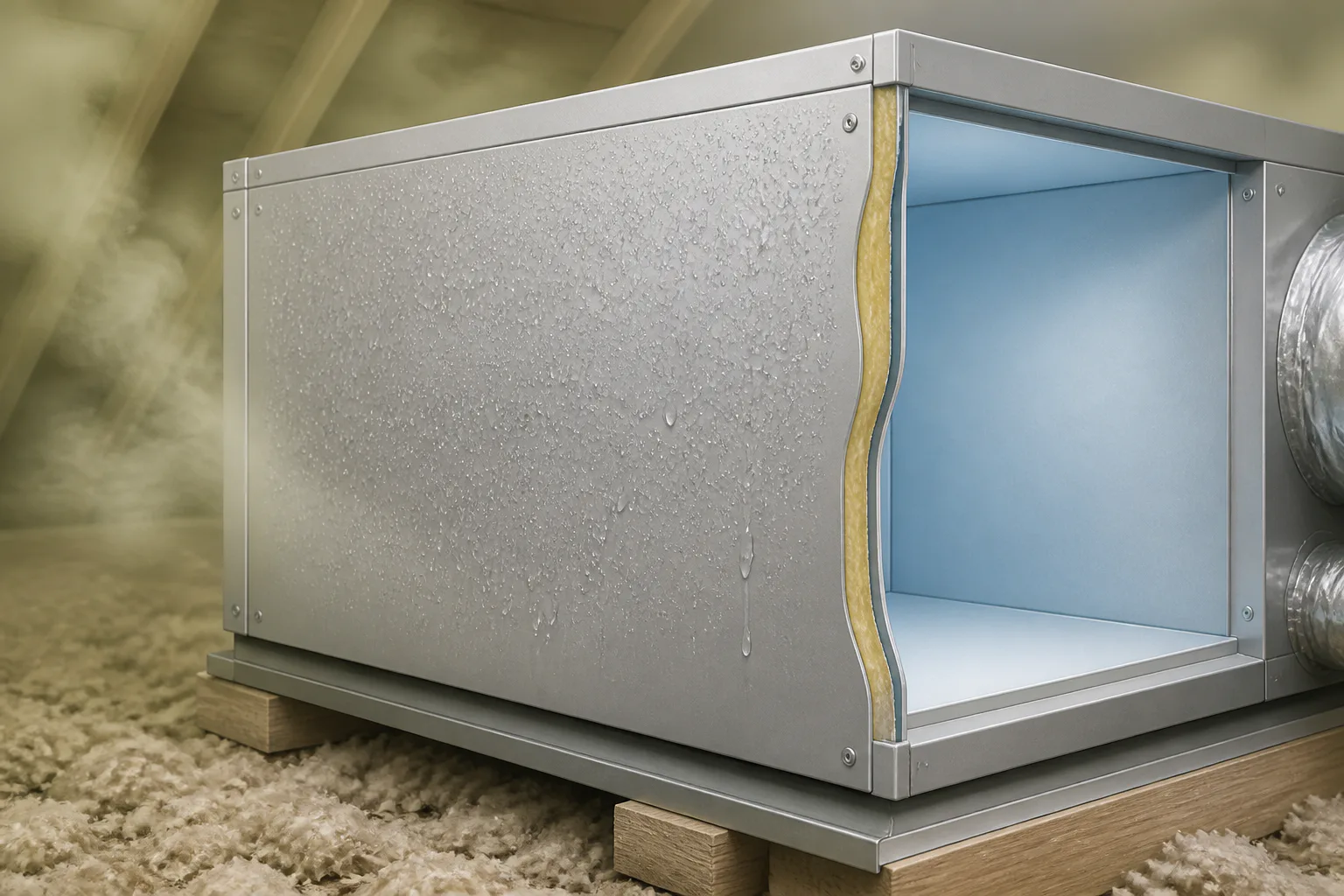
Is the cabinet sweating, or is something leaking?
True cabinet sweating often looks like a thin film or many small droplets distributed over a cold panel. A leak is more likely to create a concentrated trail, drip, or puddle beginning at a fitting, pan edge, drain line, pump, pipe, or surface above the equipment. These patterns are useful clues, but water can travel along sheet metal, insulation, framing, and piping before it becomes visible.
Notice whether the cabinet becomes damp while cooling runs, whether water continues after it warms, and whether it appears after rain, plumbing use, or icing.
If water is pooling under the unit or begins at the pan, pump, or drain, use Why Is There Water Around My Indoor AC Unit? to focus on condensate collection, drainage, thawing ice, and nearby leaks.
If the filter media is damp or soaked, see Why Is My AC Filter Wet? because filter position changes which moisture paths are plausible.
| Observation | May fit more closely |
|---|---|
| Fine droplets or a damp film across a cold cabinet panel | Surface condensation or ‘sweating’ |
| Water concentrated at a drain connection, pan edge, or pump | A condensate-management problem |
| A larger amount appears after weak cooling, frost, or ice | A frozen coil thawing or overflowing drainage |
| Wetness tracks from above or follows rain or plumbing use | A roof, building, or plumbing leak |
| Moisture is on filter media rather than the cabinet | A wet-filter problem whose source depends on filter location |
Common reasons an air handler sweats
Several conditions can create the same wet-cabinet appearance. Temperature, humidity, airflow, pressure, and drainage measurements may be needed to separate them.
- 1Humid air is contacting a cold cabinet
A higher surrounding-air dew point makes condensation on a cool surface easier. This matters in an unconditioned attic, garage, or crawlspace, where outdoor moisture and building leakage can expose equipment to humid air. The cabinet can sweat even though cold interior air is expected during cooling.
- 2Cabinet insulation is missing, damaged, displaced, or inadequate
Cabinet insulation reduces heat transfer between cold interior surfaces and the exterior. A gap, compressed section, loose liner, damaged panel insulation, or uninsulated transition can create a colder patch. Designs differ, so do not remove an energized panel to inspect insulation.
- 3Air is leaking at a seam, panel, gasket, or connection
A poorly seated panel, damaged gasket, seam, filter-slot gap, or duct connection can change which air reaches a cold surface. Condensation at one edge may make a sealing or insulation detail more relevant. Do not tape service panels shut; they must remain properly fitted and accessible.
- 4The surrounding space has an unusually high moisture load
A humid attic, damp crawlspace, open garage, water intrusion, or humid mechanical closet can raise the dew point around the cabinet. Lowering temperature is not the same as controlling moisture. A whole-house reading provides context but does not measure conditions at the equipment.
- 5Airflow is restricted or the coil is becoming abnormally cold
A severely dirty filter, blocked return, blower problem, dirty coil, or another airflow issue can contribute to unusually cold conditions and icing. That can alter cabinet temperatures and later create thaw water. Sweating does not prove restricted airflow.
- 6The evaporator coil is icing or another cooling-system problem exists
A frozen coil may accompany weak airflow, poor cooling, visible frost, or water after shutdown. Refrigerant-side problems can contribute, but cabinet droplets cannot reveal charge or leak condition. Repeated icing belongs with an HVAC technician, not DIY refrigerant work.
- 7A condensate problem is making the cabinet look sweaty
Cooling normally produces condensate that should collect and drain. An overflowing pan, leaking connection, blocked line, or failed optional pump can wet the cabinet from one point. Even beading differs from water tracking from a fitting, but neither pattern is foolproof.
Why the air handler's location matters
An air handler in a vented attic is surrounded by outdoor-like heat and humidity. The important condensation variables are the attic air's moisture content and dew point, the cabinet surface temperature, and the condition of insulation and seals. A hot attic may increase the cooling load, but heat without sufficient moisture does not create condensation.
A garage or crawlspace can also expose equipment to humid air. In a conditioned closet, heavy sweating may be more notable because surrounding air should generally be drier, though leakage, insulation, or indoor humidity can still matter.
If the equipment cabinet is wet and the attic ducts are also beading, compare the separate duct-surface problem in Why Is My AC Ductwork Sweating in the Attic?.
If living spaces feel clammy or measure persistently high humidity, use Why Is My House Humid With the AC Running? for the broader indoor-comfort and moisture-load pattern.
Is a little condensation normal?
It is possible for a small amount of transient condensation to appear when humid air meets an unusually cold surface. That observation does not automatically mean the equipment is failing. It also does not make recurring water harmless.
Investigate persistent beads, dripping, a growing puddle, saturated insulation, staining, corrosion, or moisture that returns. What matters is whether it recurs, spreads, damages materials, or accompanies poor performance.
Why persistent cabinet sweating matters
Repeated moisture can corrode the cabinet and wet insulation, drywall, wood, or flooring. Water may travel before a ceiling stain reveals it. Damp materials can support microbial growth, but condensation does not prove mold is present.
The electrical concern is more immediate when water reaches controls, wiring, disconnects, or other energized parts. Do not touch wet HVAC electrical equipment. A damp exterior panel is not permission to open the cabinet and trace the water inside.
Match the guide to the wet HVAC surface
The HVAC moisture cluster separates the location and behavior of the water because each observation changes the likely path.
For condensation on a room-side register, use Why Is My AC Vent Sweating?.
For droplets falling from or around a supply register, use Why Is Water Dripping From My AC Vent?.
What you can observe safely
The most useful homeowner work is identifying the moisture pattern without entering the cabinet or creating an attic hazard.
- Determine whether fine droplets cover the cabinet or whether water begins at a fitting, pan edge, pump, pipe, seam, or surface above it.
- Note whether the whole cabinet sweats or only one panel, access edge, duct connection, refrigerant-line entry, or lower corner.
- Look for a puddle, wet insulation, corrosion, ceiling staining, or water trails without touching electrical parts.
- Observe whether nearby supply ducts also sweat and whether the filter itself is dry, damp, collapsed, or overdue for replacement.
- Note weak airflow, poor cooling, unusual runtime, or safely visible frost on an exterior line or component; do not remove panels to find ice.
- Record the equipment location, outdoor weather, available indoor humidity reading, and whether moisture appears only during cooling or after shutdown.
- Take dated photographs from a stable, safe viewpoint so a technician can compare where the moisture begins and how the pattern changes.
When to call an HVAC technician—or another trade
Call an HVAC technician when cabinet sweating is persistent, widespread, or heavy; insulation or panel sealing appears damaged; airflow is weak; ice is visible; cooling has changed; a pan or drain repeatedly overflows; or the source remains uncertain. A technician can compare cabinet and air temperatures, humidity, airflow, coil operation, insulation, panel fit, leakage, and drainage rather than guessing from droplets alone.
Call a plumber when the wetness follows nearby piping or fixture use. Call a roofer or building professional when water starts above the equipment, follows rain, or traces to the roof or enclosure. Share timing and photographs so the first professional can route the problem if another system is responsible.
Get prompt help when water is near wiring or electrical controls, breakers trip, the unit is icing heavily, substantial water continues, ceiling material is soft or sagging, or moisture is damaging the building. Persistent sweating deserves correction even if the air handler still cools the home.
Sources
- Moisture Control Guidance for Building Design, Construction and MaintenanceU.S. Environmental Protection Agency
- A Brief Guide to Mold, Moisture and Your HomeU.S. Environmental Protection Agency
- Condensate Capture Potential MapU.S. Department of Energy
- Measure Guideline: Air Sealing Mechanical Closets in Slab-On-Grade HomesU.S. Department of Energy Building America
- What To Do If the AC Evaporator Coil Is FrozenTrane
- What Is an Air Handler for HVAC?Carrier