Symptom Guide
Why Is My AC Vent Sweating?
Condensation on an AC vent usually means humid air is meeting a cold vent surface. Learn the common causes and what to check safely.
Short answer
What it usually means
An AC supply vent usually sweats when its metal surface becomes colder than the dew point of the humid air touching it. High indoor humidity can affect several registers, while one wet vent more often points toward a local gap, missing or compressed insulation, or humid attic/wall-cavity air reaching that boot. Restricted airflow or unusually cold operating conditions can contribute, but condensation on the register does not by itself prove an airflow or refrigerant problem. Surface beads are also different from water arriving through the duct, ceiling, or condensate system.
Why condensation forms on a cold supply register
Cooling air lowers the temperature of the metal register and the duct boot behind it. Air in the room contains invisible water vapor. When that humid air touches a surface colder than its dew point, some vapor changes to liquid and beads on the metal—the same basic process that wets the outside of a cold glass.
Condensation can result from a higher moisture level, a colder surface, or both. That is why wiping the grille dry does not identify the cause. The useful next step is to determine whether the moisture is forming across the register face, around the boot/ceiling joint, or arriving from somewhere else.
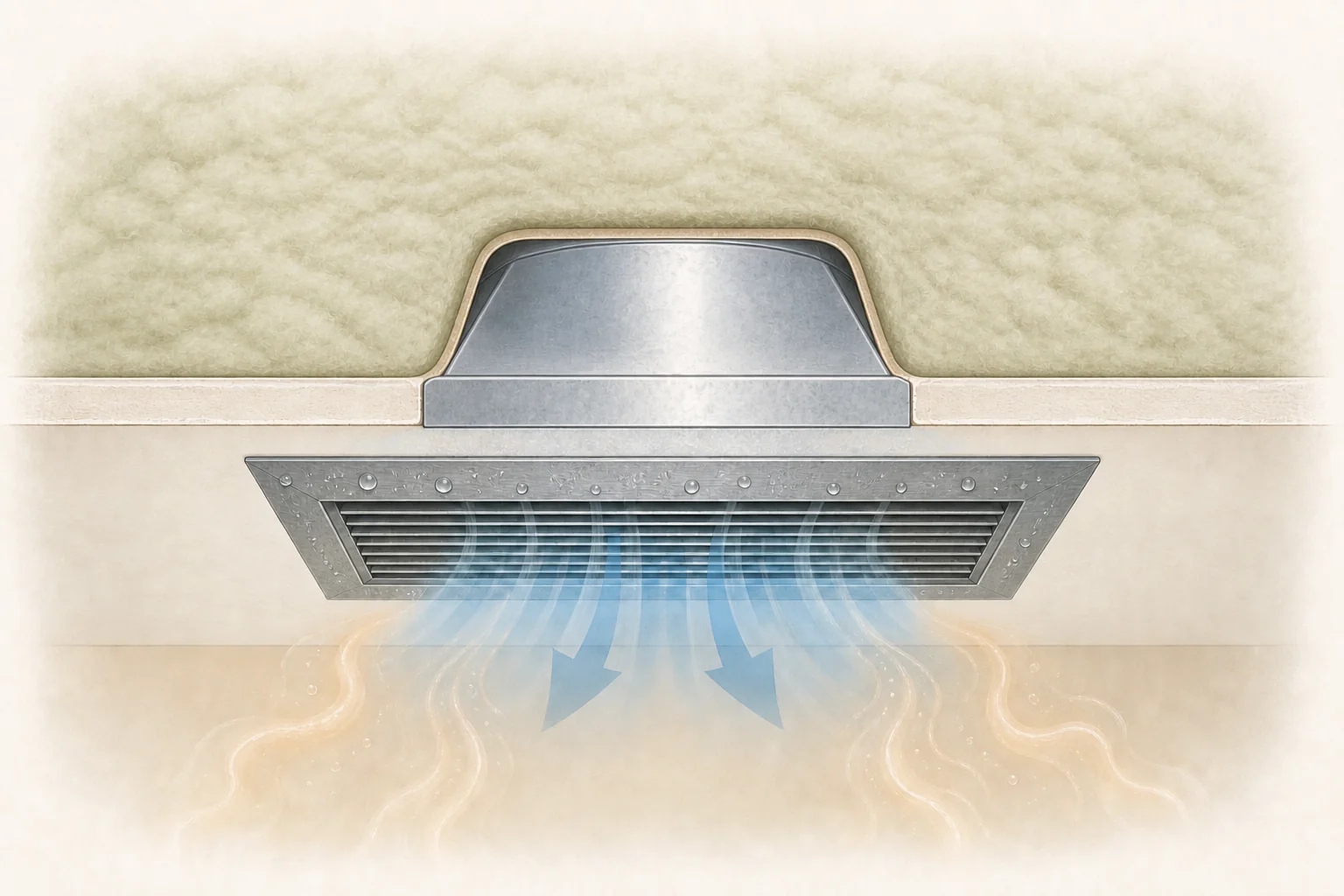
What if one vent sweats—or several do?
| Pattern | More useful clues |
|---|---|
| Only one register sweats | A local boot gap, damaged/missing insulation, nearby humid cavity air, or a localized duct condition is more plausible |
| Several registers sweat on humid days | Broader indoor humidity or a system-wide operating condition deserves attention |
| Only ceiling registers below an attic are wet | Boot sealing, insulation, and humid attic-air contact become more relevant |
| Beads form evenly on the metal face while cooling runs | Surface condensation is more consistent than a random roof or plumbing leak |
| The ceiling is wet but the register face starts dry | Water may be arriving around the opening from another source |
| Moisture continues when cooling has been off | Roofing, plumbing, or another non-condensation source needs consideration |
| Airflow is weak and frost or ice is visible safely elsewhere | An HVAC airflow or equipment evaluation is appropriate |
Common reasons an AC vent sweats
- 1Indoor humidity is elevated
More water vapor in the room raises the dew point, so a register does not have to be as cold before condensation starts. Cooking, showering, outdoor-air leakage, damp basements or crawlspaces, and HVAC moisture-removal performance can all affect conditions. Multiple wet vents and a clammy house make this broader path more relevant.
- 2Humid air leaks around the duct boot
The boot is the fitting behind the visible register. A gap between it and the finished ceiling or wall can let warm, humid attic or cavity air contact the cold metal. DOE guidance treats register boots that cross the building enclosure as air-sealing locations. The gap may be hidden behind the grille and does not establish whether the duct itself leaks.
- 3Insulation is missing, compressed, displaced, or wet
Insulation helps keep the outside surface of a cold boot or duct warmer and separates it from humid surrounding air. Gaps at joints, transitions, or the boot can leave small metal areas cold enough to condense. Insulation type and required repair depend on the actual assembly; do not pull apart an attic installation just to inspect it.
- 4Humid attic or wall-cavity air reaches the cold surface
A register at the boundary between conditioned space and a hot, humid attic or wall cavity has two air environments nearby. If the air barrier and insulation are discontinuous, cavity air can reach cold metal. This is related to—but not the same as—condensation distributed along attic duct exteriors.
- 5Airflow or operating conditions contribute to a colder register
A loaded filter, blocked return, closed registers, duct restriction, or equipment issue can change airflow and coil conditions. Those changes may contribute to colder surfaces or icing, but a sweating register alone cannot establish the cause. Avoid closing additional vents as a moisture fix; have abnormal airflow or temperature patterns evaluated.
Vent sweating is different from water dripping from the vent
Sweating means moisture forms on the room-side metal surface. Dripping means enough condensate has accumulated to fall, or water is arriving from the duct, ceiling, drain system, roof, or plumbing. Once water is falling, staining drywall, or emerging from a seam, the source list becomes broader.
Use the AC vent dripping guide when actual droplets fall into the room or the ceiling around the vent is wet.
How this differs from other HVAC moisture problems
If several registers are wet and the whole home feels clammy, start with why a house can stay humid while the AC runs.
If moisture coats the outside of duct runs in an attic, use the attic duct sweating guide for insulation, vapor-jacket, and attic dew-point clues.
If water is on the floor by the air handler, pan, pump, or drain, use the indoor AC unit water guide instead of treating it as a register-sweating problem.
What you can check safely
- Dry the register and note whether beads return only while cooling operates.
- Compare the affected register with vents in other rooms and on other levels.
- Observe whether moisture begins on the metal face, at one corner, or on the ceiling around it.
- Check whether the whole room feels clammy and record humidity over time with a basic hygrometer if available.
- Inspect the HVAC filter if it is safely accessible and replace it according to the equipment instructions when visibly loaded or due.
- Keep return grilles and supply registers unobstructed; do not close more registers to try to warm one vent.
- Photograph staining or condensation before wiping it so an HVAC professional can see the pattern.
Why repeated sweating should not be ignored
Repeated wetting can stain paint, soften paper-faced drywall, corrode metal, and reduce the performance of damp insulation. Moisture that remains on susceptible materials can also support microbial growth. Condensation does not prove mold is present, but it does justify correcting the moisture source and drying affected materials.
If the register is directly below an attic, ceiling stain, sagging material, or insulation that remains wet deserves timely evaluation. Water can travel along the boot and framing, so the visible stain may extend beyond the condensation point.
When an HVAC professional should evaluate the vent
Arrange HVAC service when condensation returns through ordinary cooling cycles, one boot appears poorly sealed or insulated, several vents are affected, airflow is weak, icing is suspected, or the problem continues despite reasonable humidity control. The technician can compare temperatures, airflow, duct/boot condition, insulation, and equipment operation rather than replacing parts from appearance alone.
A building-performance professional may be useful when attic/cavity air leakage or broader humidity appears central. Call a roofer when the pattern follows rain and a plumber when fixture use matches the wetness. Promptly address soft drywall, spreading damage, or water near electricity.
Sources
- Moisture Control Guidance for Building Design, Construction and MaintenanceU.S. Environmental Protection Agency
- Mold Course Chapter 2: Humidity and CondensationU.S. Environmental Protection Agency
- Air Sealing Duct Boots and Duct ChasesU.S. Department of Energy
- HVAC Sealed and Insulated Metal DuctsBuilding Science Education, U.S. Department of Energy