Diagnostic Guide
Why Is My AC Ductwork Sweating in the Attic?
Attic AC ducts sweat when humid air reaches a surface below its dew point. Learn how insulation, duct leakage, and other water sources fit in.
Short answer
What it usually means
AC ductwork in an attic usually sweats because the duct or its outer covering is cold enough to fall below the dew point of the surrounding humid air. Water vapor then condenses on the exterior as liquid droplets. High attic humidity, missing or damaged insulation, a compromised outer jacket, and gaps at duct joints or supports can contribute. That does not automatically mean water is leaking from inside the duct, and water near a duct can also come from an HVAC drain, roof, or plumbing source.
Why attic AC ducts sweat
Duct “sweat” is condensation. During cooling, supply ducts carry air that is much colder than the air in a typical vented attic. If the temperature at the duct's exposed outer surface or jacket falls below the dew point of the nearby attic air, water vapor changes into liquid on that surface. In plain language: cold duct surface plus sufficiently humid attic air can produce droplets.
The dew point is the temperature at which water vapor begins condensing as the air next to a surface is cooled. It changes with both temperature and humidity. That is why the same duct may stay dry on one day and become wet during more humid weather, even though the AC is delivering similar supply-air temperatures.
The water is forming from moisture in the air around the duct; it is not necessarily coming through the duct from inside. A cold supply duct is expected during cooling, but visible condensation that repeatedly wets the jacket, insulation, or nearby materials is not a condition to ignore. Persistent wetness needs investigation because several conditions—including an unrelated leak—can place water on or near the same duct run.
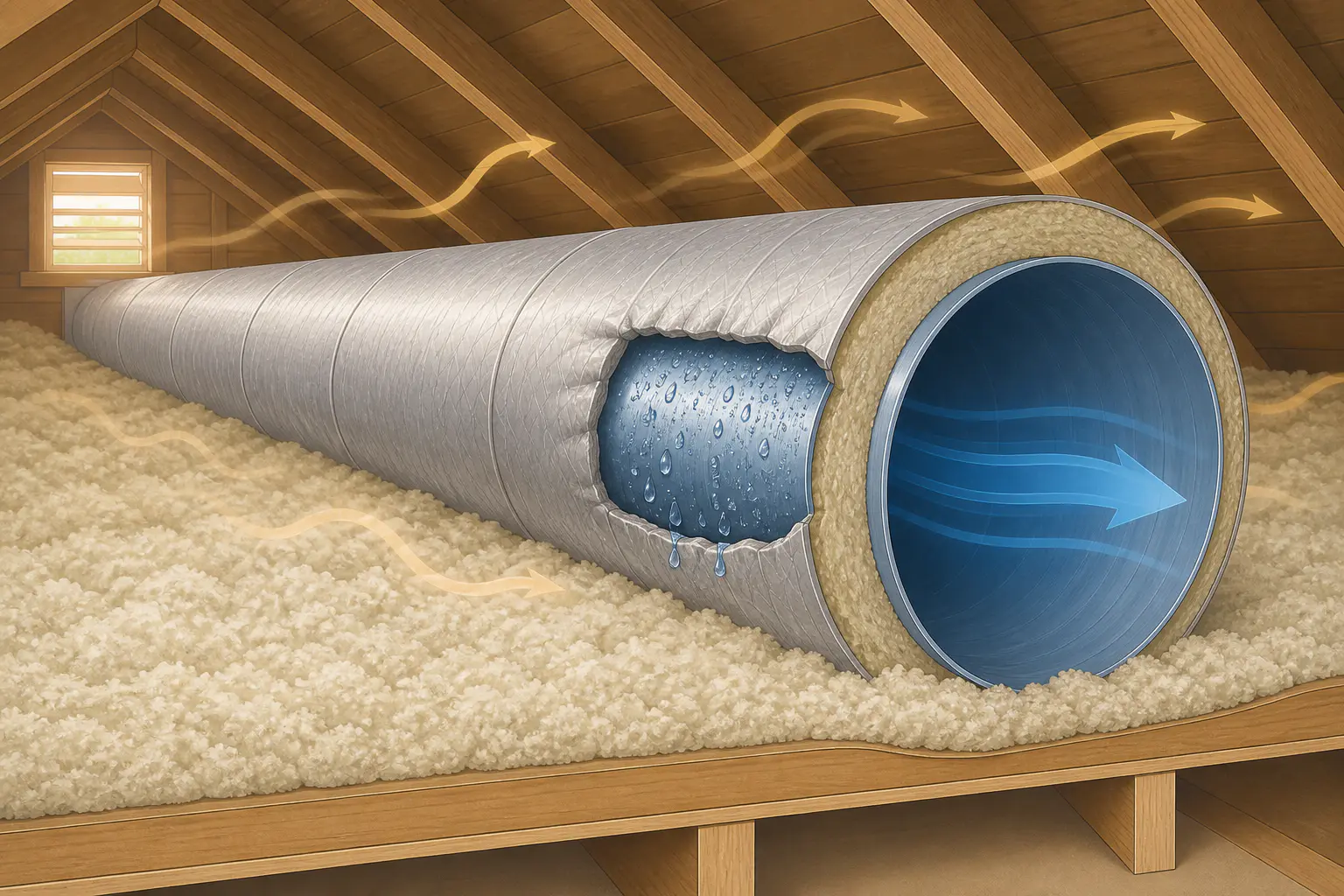
Common reasons ductwork sweats in an attic
More than one condition can be present. The wettest spot may identify where condensation becomes visible, but it does not by itself prove why the surface became cold or how humid air reached it.
- 1The attic air is very humid
Humid air has a higher dew point, so it can condense on surfaces that would stay dry in less humid conditions. Outdoor weather, roof or plumbing moisture, air moving from the house into the attic, and the attic's design can influence the moisture level. A humid attic increases condensation potential, but a humidity reading alone does not identify the duct defect or the original moisture source.
- 2Duct insulation is missing, damaged, compressed, or inadequate
Insulation slows heat transfer and helps keep the outer surface warmer than the cold air inside the duct. A bare metal section, thin coverage, a gap between pieces, a crushed area under a support, or insulation that has slipped away can create a locally colder surface. Wet insulation may also lose performance and make the cycle harder to break.
- 3The outer jacket or vapor-retarding layer is compromised
Many common insulated duct assemblies use an outer jacket that limits humid air and water vapor from reaching colder layers. A tear, open seam, poorly sealed end, or damaged section can let moist attic air contact a colder surface. Duct materials and jacket designs vary, so this is a relationship for a professional to inspect—not proof that every visible seam is defective.
- 4Air is leaking at a duct or connection
A supply-side leak can release cold conditioned air near a joint, transition, boot, or damaged section and lower nearby surface temperatures. A return-side leak can pull hot, humid attic air toward the HVAC system and affect comfort or moisture performance. Leakage can contribute to the conditions around a wet spot, but exterior droplets alone cannot show the leak direction or location.
- 5The duct surface is especially cold
Cold supply air is expected during cooling. Condensation depends on the temperature of the exterior surface relative to the surrounding air's dew point—not simply on whether the air inside feels cold. Airflow restrictions, equipment operation, and insulation condition can affect temperatures, but a cold duct does not automatically mean the AC is malfunctioning.
- 6There are gaps at joints, transitions, boots, or supports
Complex shapes are harder to insulate continuously. Elbows, takeoffs, plenums, boots, hangers, and transitions may have compressed insulation or small coverage gaps that create a cold bridge. A localized wet patch at one of these details can guide an inspection, but cutting open the jacket to look for the cause can worsen the moisture barrier and should not be a casual DIY check.
Is the duct sweating, or is something actually leaking?
Condensation often appears as beads or a damp film spread across a cold exterior surface, especially while the AC runs. A concentrated stream, a wet trail arriving from above, or water that appears when cooling is off makes another source more plausible. Water can travel along framing, duct jackets, insulation, pipes, or fasteners, so the first visible wet spot may be some distance from the source.
Use timing and distribution as clues rather than diagnoses. Dry the safely visible area only if you can do so without entering the attic or disturbing materials, then note where moisture first returns.
If water is appearing at or falling from a ceiling register inside the room, use Why Is Water Dripping From My AC Vent? to compare condensation with drain, roof, and plumbing sources at that location.
If water begins around the air handler, coil cabinet, pan, or condensate piping, use Why Is There Water Around My Indoor AC Unit? to focus on the equipment drainage path rather than duct-surface condensation.
If droplets coat the exterior of the air-handler cabinet rather than the duct, use Why Is My Air Handler Sweating? to focus on cabinet temperature, insulation, seams, and surrounding humidity.
| Observation | May be more consistent with |
|---|---|
| Droplets are distributed on cold duct exteriors while cooling runs | Surface condensation |
| Water begins around the air handler, drain pan, or condensate piping | An HVAC condensate or drainage problem |
| Wetness follows rain or starts near a roof penetration | A possible roof leak |
| Moisture follows use of a nearby fixture or visible pipe | A possible plumbing leak |
| Moisture is mainly on the room-side register | Vent/register condensation rather than attic duct-surface sweating |
How attic duct condensation relates to indoor humidity
Whole-house moisture conditions can matter, especially when humid indoor air reaches the attic through ceiling leaks or when duct leakage affects how the cooling system handles air. But attic humidity is not identical to indoor relative humidity, and an attic duct can sweat because of a local insulation or jacket problem even when living-space readings seem reasonable.
Likewise, a clammy house does not prove the attic ducts are condensing. Measure what you safely can and keep the two observations separate until the moisture and temperature patterns are evaluated.
If the main symptom is a cool but clammy living space, start with Why Is My House Humid With the AC Running? for short cycles, fan settings, infiltration, airflow, and indoor moisture sources.
If moisture is forming on the visible metal register inside the home, see Why Is My AC Vent Sweating? for the room-side condensation pattern.
Why persistent duct condensation should not be ignored
Repeated condensation can soak duct insulation and nearby attic insulation, stain ceilings, loosen paint, and keep wood or paper-faced drywall damp. Wet insulation may not resist heat flow as intended, and water can migrate to materials below before the source is obvious from the living space.
Moist conditions can support microbial growth on susceptible materials. That does not mean visible droplets prove mold is present, and appearance alone cannot identify a substance. The useful response is to correct the moisture source, dry affected materials promptly where that can be done safely, and obtain qualified help when materials stay wet, staining spreads, or a musty odor persists.
A sagging or soft ceiling deserves prompt attention. Keep people away from unstable material, do not puncture a bulging ceiling, and avoid any wet area near electrical wiring or fixtures.
What you can observe safely
The best homeowner contribution is a clear record of when, where, and how the moisture appears. Do not enter an attic unless it has a proper access route, safe walking surface, acceptable temperature, and no electrical or other hazards.
- Note whether droplets appear only while the AC is operating, shortly after it stops, after rain, or after nearby plumbing use.
- From a safe access point, observe whether moisture is spread across several ducts or concentrated at one joint, support, boot, transition, or equipment area.
- Look without touching for torn outer jackets, separated seams, crushed or missing insulation, darkened material, and insulation that appears saturated.
- Check the ceiling below for staining, peeling paint, softness, or a changing damp spot.
- Use a basic hygrometer in the living space and record readings alongside outdoor weather; do not treat one reading as an attic diagnosis.
- Inspect the HVAC filter if it is safely accessible and replace it according to its instructions when clearly dirty or overdue.
- Take dated photos from the same safe viewpoint so a professional can see whether the pattern is changing.
When to call an HVAC professional—or another trade
Call an HVAC professional when condensation is repeated or widespread, insulation is wet or visibly damaged, the outer jacket has open seams or tears, duct leakage is suspected, or the problem returns after obvious moisture sources have been addressed. Also arrange service when airflow is weak, rooms are uneven, the system is icing, or other performance symptoms accompany the wet ducts. A technician can measure air and surface conditions, test leakage and airflow, and evaluate the insulation and duct assembly without relying on the droplets alone.
A building-performance professional may be useful when attic air leakage, enclosure moisture, or the location of the thermal and air boundaries appears central. Call a roofer when the wetness follows rain or traces toward roof decking or a penetration. Call a plumber when it follows fixture use or begins at nearby piping. If the source is uncertain, share timing notes and photographs so the first professional can distinguish systems rather than assuming every wet duct is an HVAC leak.
Get prompt help if water is approaching electrical components, ceiling material is soft or sagging, insulation is saturated, or the source cannot be safely observed. Persistent condensation is a moisture problem worth correcting even when the AC still cools the house.
Sources
- HVAC Sealed and Insulated Metal DuctsU.S. Department of Energy Building Science Education
- Moisture Control Guidance for Building Design, Construction and MaintenanceU.S. Environmental Protection Agency
- A Brief Guide to Mold, Moisture and Your HomeU.S. Environmental Protection Agency
- Measure Guideline: Sealing and Insulating of Ducts in Existing HomesU.S. Department of Energy Building America