Diagnostic Guide
Why Is There a Wet Spot on My Wall?
A localized wet spot shows where moisture became visible, not necessarily where it started. Use location, timing, nearby systems, and damage clues to narrow the source safely.
Short answer
What it usually means
A localized wet spot means moisture has reached that visible area, but it does not show where the water started. The source may involve plumbing, rain entering elsewhere in the exterior assembly, condensation on a cold surface, HVAC condensate or cold ductwork, or water traveling through porous materials. First determine whether the spot is wet now, then record where it is, what is above or behind it, and whether it changes after rain, plumbing use, cooling operation, or humid conditions. A growing spot, soft or bulging material, water near electricity, or suspected sewage needs faster professional attention.
First: is the wall actually wet right now?
A dark mark and an active wet patch are not the same observation. Look closely without poking the wall. Fresh dampness may darken paint, feel cool, change sheen, or return after the surface is gently dried. An old moisture event may leave discoloration after the material has dried. Dry appearance alone does not prove that the source was repaired, and a stain that stays unchanged does not prove moisture is still active.
Photograph the area from the same position and record the date, boundary, weather, and recent water use. Do not run suspect fixtures repeatedly just to reproduce the symptom. The goal is to learn from ordinary conditions without increasing damage.
| What you observe | What it means for the next step |
|---|---|
| Wet or damp now | Treat it as active moisture and look for timing and adjacent-system clues. |
| Dry discoloration that does not change | It may be historical, but confirm that the source has stopped before cosmetic repair. |
| Dry between events, then wet again | Record what happened immediately before each recurrence. |
| Boundary grows, paint changes, or material deforms | Ongoing wetting or damage is more plausible; arrange timely evaluation. |
Where is the wet spot?
Location changes which systems deserve attention, but it does not diagnose them. A patch near the ceiling may relate to something above, yet water can run along framing or piping before appearing. A lower-wall patch can receive water traveling down from above, from an adjacent appliance, from exterior intrusion, or—depending on construction—from floor or foundation moisture.
Also identify whether the wall faces outdoors or divides two rooms. Exterior walls introduce rain and surface-temperature questions. Interior partitions make adjacent plumbing or moisture traveling from above relatively more relevant. Those are probability clues, not conclusions.
| Location | Useful questions |
|---|---|
| Near the ceiling | What room, roof, attic, plumbing, or HVAC equipment is above? |
| Middle of an interior partition | What fixture, appliance, or plumbing wall is on the other side? |
| Near the floor or baseboard | Could water be traveling downward, entering at floor level, or coming from an adjacent appliance? |
| Near a window or exterior door | Is the glass merely condensing, or does the wall change specifically during rain? |
| On an exterior-facing wall or corner | Is the patch localized, or are broader cold-surface condensation signs present? |
| Near an HVAC chase or equipment area | Does it correlate with cooling, condensate production, or visible equipment water? |
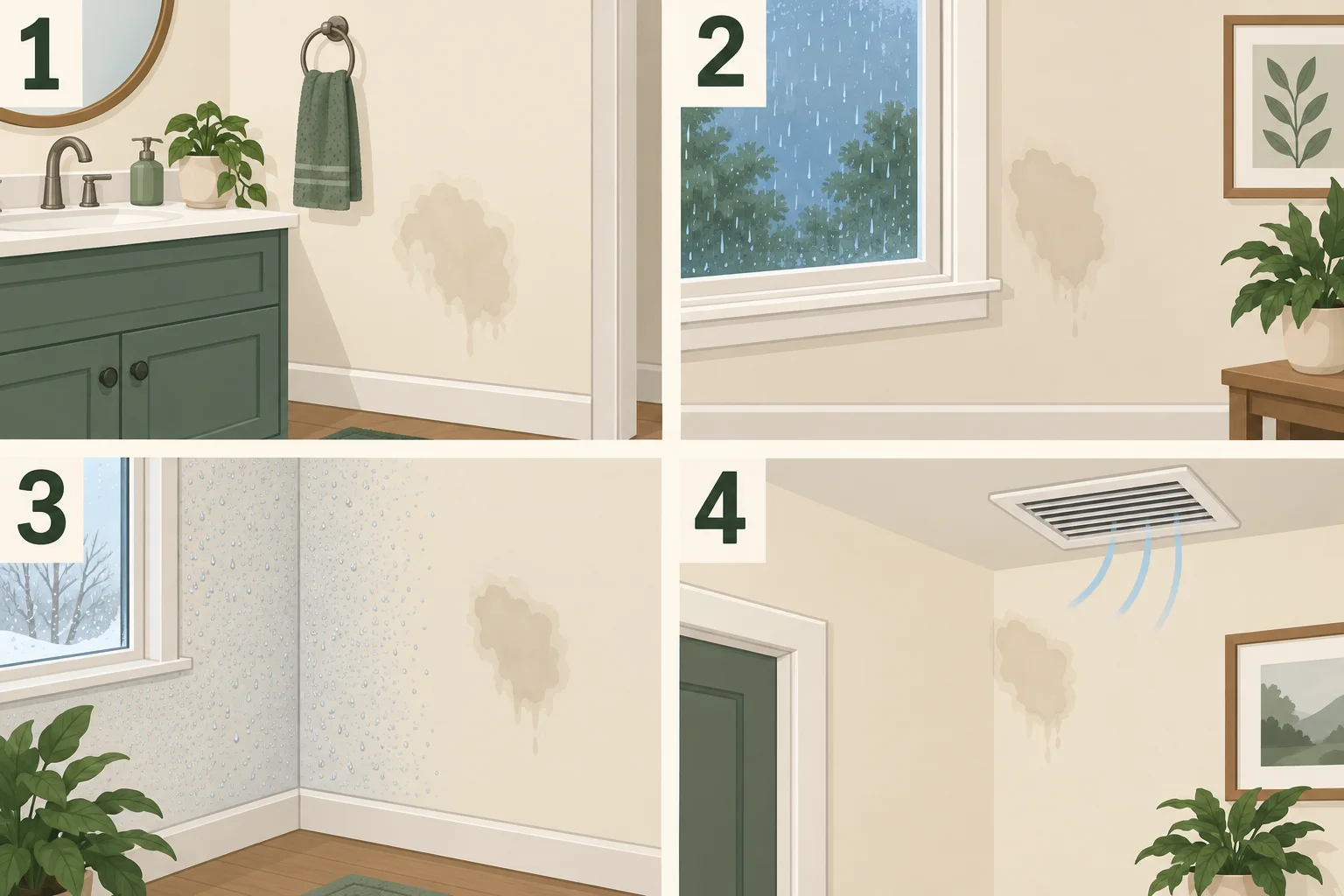
What is above, behind, or on the other side?
Think in three dimensions. A bathroom above may contain a tub, shower, toilet, sink, supply piping, and drain piping. A kitchen or laundry room on the other side may place a sink, dishwasher, washer, refrigerator water line, or drain near the wall. An attic can contain roofing, plumbing, ducts, air-handling equipment, or condensate lines depending on the home.
Write down the systems that are actually present rather than assuming a standard layout. Construction varies: not every exterior wall contains plumbing, not every attic contains HVAC equipment, and not every lower-wall spot involves a slab, basement, or crawlspace. Do not remove trim, outlets, cabinets, or drywall to confirm the first guess.
Does the spot change when you use plumbing?
A repeatable change after a shower, bath, toilet flush, sink use, dishwasher cycle, or washer fill or drain makes a plumbing-related source more plausible. The exact timing can help a plumber choose where to investigate, but it usually cannot identify a hidden component from the room side of the wall.
EPA moisture guidance distinguishes leaks in pressurized pipes from leaks in wastewater drains and fixtures. A supply line normally remains pressurized, so its leak may continue without a fixture actively draining. A drain-side leak often becomes more noticeable when water passes through that drain. These are useful patterns, not conclusive homeowner tests: small leaks can be intermittent, water use can overlap, and concealed materials can delay when dampness appears.
Does it get wet after rain?
If the spot repeatedly darkens or becomes damp during or after rainfall—especially wind-driven rain—exterior water intrusion becomes more plausible. The entry point might involve a roof, wall penetration, cladding, window, door, or another interface, but the visible patch cannot identify which one. Water can enter higher or farther sideways and become visible at a different point.
Record rain intensity, wind direction, delay, and how long the area stays damp. Inspect only from safe ground-level or indoor viewpoints. Do not climb onto a roof, lean from a window, remove exterior finishes, or apply random sealant before the pathway is understood. A future rain-specific wall guide remains the correct owner for a consistently rain-triggered symptom.
Could it be condensation instead of a hidden water source?
Condensation forms when moisture in the air reaches a surface cold enough for liquid water to form. It becomes more plausible when a broader section of an exterior wall or corner is damp, fine droplets are visible, indoor humidity is elevated, furniture limits air circulation, or several cold surfaces behave similarly. One concentrated growing patch, plumbing or rain timing, and material damage lean the investigation toward a localized source instead.
Neither pattern is proof. A cold exterior-facing wall does not automatically mean condensation, and a sharply bounded patch does not automatically mean a pipe is leaking. Compare scope, surface droplets, humidity, weather, and timing together.
For broad droplets or dampness across wall surfaces, use Why Are My Walls Sweating? for the condensation-focused diagnostic path.
If room-side window glass is wet at the same time, compare that pattern with Why Is There Condensation on the Inside of My Windows?.
When the whole home feels clammy while cooling, see Why Is My House Humid With the AC Running?.
Could the AC or ductwork be involved?
HVAC becomes relevant only when the configuration and timing support it. EPA guidance recognizes moisture from overflowing or poorly drained condensate, condensation on cold ducts or equipment surfaces, and humid-air leakage around cold HVAC surfaces. A wall spot near an air handler, condensate route, duct chase, or register that changes during cooling deserves HVAC evaluation; a summer date by itself does not blame the AC.
Look only for safely visible water around equipment, accessible drain areas, or surface condensation. Do not open the air handler, remove duct insulation, handle refrigerant components, or enter an unsafe attic.
For visible water around the indoor equipment itself, use Why Is There Water Around My Indoor AC Unit?.
For condensation on ducts in an attic, use Why Is My AC Ductwork Sweating in the Attic?.
Why the source may not be directly behind the spot
EPA moisture guidance describes several ways water moves: it can leak through openings, run downhill, travel along interfaces, move with humid air, and wick through small pores or gaps. Building America research likewise treats bulk water, airflow-carried moisture, vapor, and capillary transport as separate mechanisms. That is why the wet spot is an observation point—not a map pin for the failure.
For example, water may follow framing, a pipe or duct exterior, insulation, drywall paper, or the top or bottom of an assembly before it becomes visible. Porous materials can also draw water beyond the original contact area by capillary action. These mechanisms explain why source tracing may require instruments and access by a qualified professional; they do not justify guessing an invisible pathway or cutting exploratory holes.
What if the paint is bubbling or the drywall feels soft?
Bubbling, blistering, or peeling paint suggests the finish has been affected, but paint failure remains its own symptom and does not name the moisture source. Softness, swelling, crumbling, sagging, or bulging means moisture-sensitive material may be deteriorating. Do not press hard, puncture a bulge, or remove damaged drywall to see what is behind it.
Persistent dampness can also support mold growth. A musty odor or visible mold-like material changes the cleanup and assessment question, but color and smell cannot identify a species or prove the extent of hidden growth. Fixing the moisture source matters more than repainting or spraying cleaner over an unresolved wet area. Preserve visible wall growth, bubbling paint, and soft drywall as separate diagnostic intents.
What you can safely check yourself
Keep the first investigation non-destructive. A consumer moisture meter can sometimes compare accessible areas, but readings vary with the meter, material, fasteners, salts, and depth. It cannot identify a source, hidden mold, or structural damage, and you do not need to buy one to document the pattern.
- Photograph the same area over time and record whether the boundary, color, sheen, or wetness changes.
- Identify the room above, the space on the other side, and any actual plumbing, windows, doors, appliances, ducts, or HVAC equipment nearby.
- Compare ordinary plumbing use, rainfall, cooling operation, outdoor humidity, and indoor humidity with recurrence.
- Inspect visible accessible pipes, appliance connections, condensate areas, and window trim without dismantling anything.
- Note odor, suspected growth, bubbling paint, softness, swelling, crumbling, bulging, or active flow.
- Keep children and pets away from damaged material or suspected contaminated water.
When a wet wall needs faster attention
Arrange prompt professional help when moisture expands rapidly, water is actively flowing, drywall becomes severely soft or crumbly, a wall bulges, material appears structurally unstable, or significant mold-like growth is present. Suspected sewage or wastewater needs conservative handling; avoid contact and do not attempt ordinary DIY cleanup of contaminated porous material.
Water around an outlet, switch, light, wiring route, panel, or electrical equipment is an electrical hazard. Do not touch the wet device, remove a cover, test it, or operate switches in the affected area. Keep clear and contact qualified emergency or electrical help appropriate to the severity. Only isolate power from a known dry, safely accessible location if established safety guidance and the situation allow it—never while standing in water or touching wet equipment.
Who should you call?
Choose the trade that matches the strongest evidence. When evidence crosses systems or remains unclear, a qualified inspector or general contractor can help coordinate the next step rather than asking several trades to guess independently.
| Evidence | Reasonable first call |
|---|---|
| Wetness follows plumbing use or known piping is above/adjacent | Licensed plumber |
| The spot repeatedly changes during or after rain | Roofer or building-envelope professional appropriate to the suspected area |
| Condensate, an air handler, or duct moisture is implicated | Qualified HVAC professional |
| Water enters around a window or door during rain | Window or building-envelope professional |
| Several systems are plausible or damage is extensive | Qualified inspector or general contractor |
| Significant recurring or hidden mold-like growth is suspected | Qualified moisture or remediation professional after the water source is addressed |
Bottom line
A wet spot tells you where moisture became visible, not where it originated. Confirm whether it is active, map what is above and beside it, and record whether ordinary plumbing use, rain, humidity, or cooling changes it. Compare a single localized patch with broader condensation and watch for material deterioration.
Do not repaint an active spot, assume the nearest system has failed, or open the wall casually. Use the strongest timing and location evidence to choose a plumber, envelope professional, HVAC professional, or broader inspector, and escalate sooner for water near electricity, contamination, active flow, bulging, or severe material damage.
Sources
- Moisture Control Guidance for Building Design, Construction and MaintenanceU.S. Environmental Protection Agency
- Moisture Control Guidance for Building Design, Construction and Maintenance (PDF)U.S. Environmental Protection Agency
- Leak Detection and Flow Monitoring DevicesU.S. EPA WaterSense
- A Brief Guide to Mold, Moisture and Your HomeU.S. Environmental Protection Agency
- Moisture Management for High R-Value WallsU.S. Department of Energy Building America
- Building America Best Practices Series: Energy RenovationsU.S. Department of Energy
- Statement Regarding Hurricane Harvey Electrical SafetyU.S. Consumer Product Safety Commission
- Urban Flooding: Guidance for Homeowners and RentersFederal Emergency Management Agency