Diagnostic Guide
Why Are My Walls Sweating?
Moisture on a wall may be surface condensation or water arriving from elsewhere. Use location, timing, weather, and scope to narrow the source safely.
Short answer
What it usually means
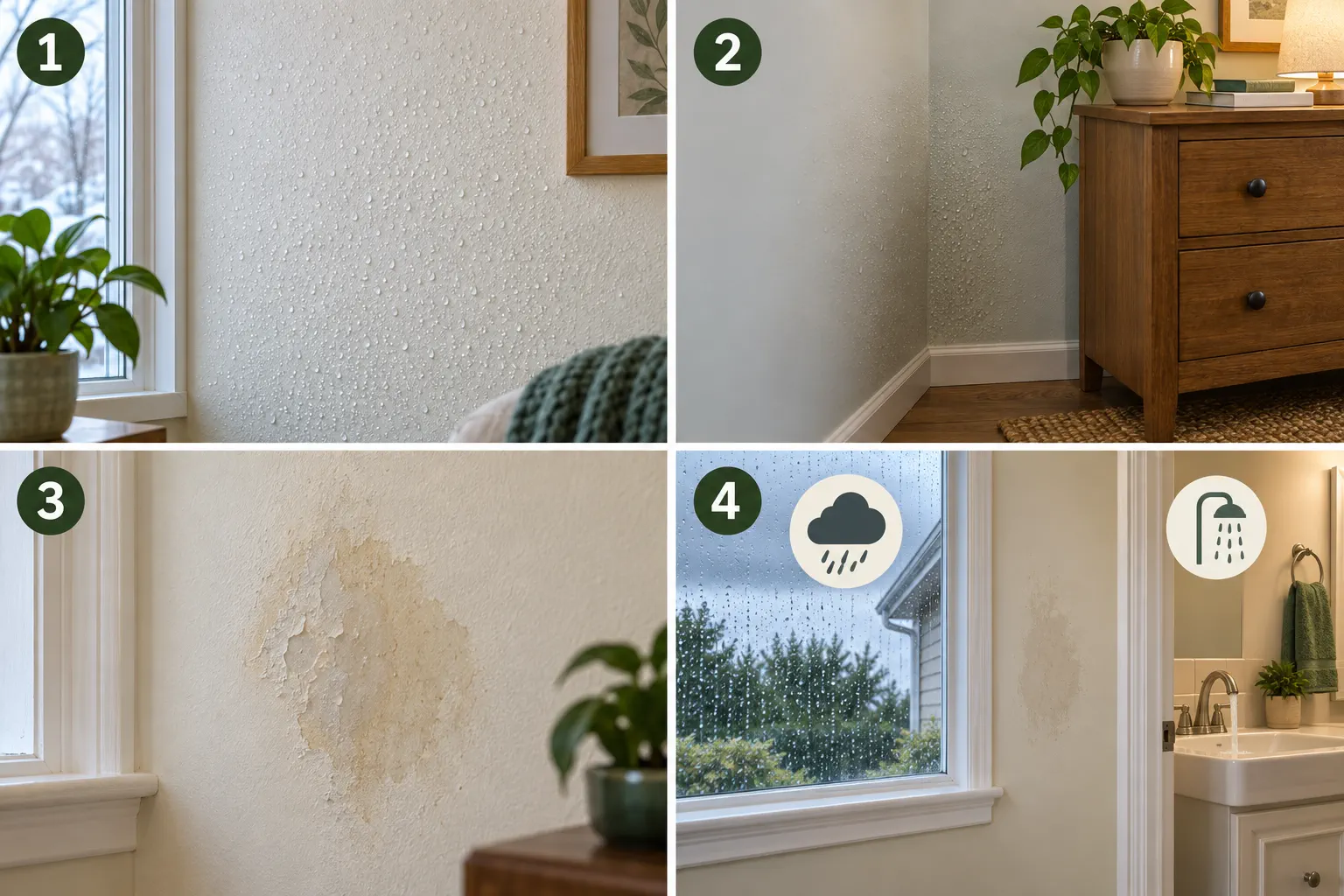
Walls can “sweat” when humid air touches a wall surface cold enough for water vapor to condense into droplets. Indoor humidity, outdoor conditions, wall temperature, insulation and framing differences, ventilation, and room activities can all affect that pattern. But a wet wall is not automatically condensation. One concentrated patch, rain timing, staining, bubbling paint, soft drywall, or nearby plumbing may mean water is entering from somewhere else. First decide whether moisture appears to be forming broadly on the exposed surface or arriving at one location; then compare where, when, and how widely it occurs.
First: is water forming on the wall or coming from somewhere else?
Homeowners use “sweating” for several different observations. True surface condensation forms where humid air meets a sufficiently cold exposed wall. A wall may instead feel damp because rain, plumbing, groundwater, an appliance, or another source is wetting the assembly. The distinction matters because lowering room humidity will not repair a leak, while opening a wall is not a sensible first response to ordinary surface droplets.
Start with pattern rather than a guessed component. Dry only an accessible exposed area, photograph it, and watch how moisture returns. Do not repeatedly wet the room or run suspect plumbing simply to make the symptom larger.
| Observation | Question it raises |
|---|---|
| Fine droplets or general dampness across a broad area | Is humid air condensing on a colder surface? |
| Several exterior walls, corners, or windows are damp together | Are indoor humidity and surface temperatures creating a widespread condensation pattern? |
| One concentrated patch, ring, track, or blister | Could water be arriving from a localized source rather than forming across the surface? |
| Moisture follows rain or wind | Is exterior water intrusion more plausible? |
| Moisture follows fixture or appliance use | Is nearby plumbing or equipment involved? |
| Material is soft, swollen, bulging, or deteriorating | Has moisture moved beyond an ordinary wipeable surface condition? |
Why condensation forms on walls
Air contains water vapor. When the air immediately next to a wall cools enough that the wall surface is below that air's dew point, some vapor becomes liquid water on the surface. The dew point changes with both temperature and moisture content, so the same wall can stay dry one day and show droplets on another.
More humid air raises condensation risk because a surface does not have to become as cold before moisture forms. Lower wall temperature also raises risk. That is why diagnosis needs both sides of the relationship: the room's moisture conditions and the surface temperature pattern. Condensation on a painted wall does not by itself identify inadequate insulation, air leakage, a bad air conditioner, or any other hidden defect.
Why exterior walls and corners may sweat first
An exterior-facing wall exchanges heat with outdoor conditions, while an interior partition usually separates similar indoor temperatures. During cold weather, the room-side surface of an exterior wall can therefore be cooler. During hot-humid weather, air-conditioned surfaces can also be cooler than humid air that reaches them.
Corners can run colder because of framing geometry, exterior exposure, and reduced room-air circulation. Framing also conducts heat differently from insulation, creating colder strips sometimes described as thermal bridges. A recurring corner pattern makes those relationships worth evaluating; it does not prove missing insulation or defective construction.
Why a wall can get damp behind furniture
Large furniture placed close to an exterior wall can reduce warm room-air circulation across the surface and slow drying. EPA guidance specifically notes that cold corners behind furniture can be locations where condensation and mold occur. Furniture does not create water, but it can hide a cooler, slower-drying surface.
If it is safe and the furniture is easy to move, compare the wall behind it with an exposed section of the same wall. Do not use an arbitrary clearance as a universal fix. The useful clues are whether droplets or dampness recur there, whether the area is colder, and whether the room also has condensation on windows or other surfaces.
Why bathrooms, kitchens, and laundry areas can make walls sweat
Showers and baths can create a short moisture spike. If cooler bathroom walls collect droplets soon afterward and clear as the room dries, surface condensation is plausible. Mirror fogging and slow clearing provide context but do not prove the exhaust fan has failed. Confirm only that accessible ventilation operates; do not open its electrical housing.
Cooking, boiling water, dishwashing, and drying clothes indoors can also add moisture. ENERGY STAR guidance supports exhausting bathroom and cooking moisture near its source. Avoid universal fan run-time claims because room size, fan performance, ducting, weather, and moisture load vary. Keep these activities as timing clues rather than turning one wet wall into a whole-house humidity diagnosis.
Why walls may sweat during hot, humid weather
In hot-humid conditions, condensation may form if moisture-laden air reaches a surface cooled below its dew point. A cold wall area, strong local cooling, or poorly controlled humidity can contribute. Humid-air movement toward cooled surfaces can also create concealed moisture risk.
Do not simplify that into “summer condensation means the vapor barrier is wrong.” Climate, wall design, pressure, materials, air leakage, and drying direction all matter. Do not alter vapor retarders or seal wall cavities based on surface droplets. Record outdoor conditions, AC timing, room humidity, and the exact locations, then use a building-performance or HVAC professional if the pattern persists.
Why walls may sweat during cold weather
Cold outdoor conditions can lower the indoor surface temperature of exterior walls, especially at corners, framing paths, and other colder details. If indoor air contains enough moisture, condensation can form even while the room feels comfortably warm. Closed coverings or furniture may further reduce circulation at a particular surface.
Window condensation at the same time can support a broader cold-surface and humidity pattern, but glass and walls do not have identical temperatures. A dry window does not rule out a colder wall corner, and a wet window does not prove that every wall mark is condensation.
If the primary symptom is water on room-side window glass, use Why Is There Condensation on the Inside of My Windows? for the separate window-surface pattern.
How indoor humidity and HVAC operation change the problem
Higher indoor relative humidity makes condensation more likely on a given cold surface. A basic hygrometer can show whether readings rise after showers, cooking, indoor clothes drying, humidifier use, or weather changes. Treat readings as trends, not a diagnosis, and avoid one universal target: appropriate humidity depends partly on climate and outdoor temperature.
Air conditioning can remove moisture while cooling, but equipment operation, fan behavior, runtime, infiltration, room airflow, and moisture sources affect actual indoor conditions. A wall that sweats does not automatically mean the AC is at fault. Likewise, lowering the thermostat may make some surfaces colder and does not necessarily solve the moisture source.
When the entire home feels clammy or measures humid while cooling, use Why Is My House Humid With the AC Running? for that broader HVAC humidity intent.
Could insulation, thermal bridging, or air leakage be involved?
Insulation moderates interior surface temperature, while framing and other solid paths conduct heat differently. Uneven coverage, wall geometry, and thermal bridges may create colder areas. Air movement through gaps can also carry heat and moisture into assemblies and change where condensation occurs.
These are relationships for evaluation, not conclusions visible through paint. Surface moisture cannot show whether insulation is missing, a vapor retarder is wrong, or a cavity is leaking air. Do not drill exploratory holes, remove receptacles, open electrical boxes, inject foam, or seal unknown cavities blindly. A building-performance professional can use appropriate instruments and climate-specific judgment without turning the first check into demolition.
Is it condensation, rainwater, or a plumbing leak?
Use several clues together. Condensation usually reflects broad surface temperature and humidity conditions. Bulk water tends to follow a path from outside, plumbing, an appliance, or another localized source. Water can travel within a wall before appearing, so the first visible patch may not sit directly over the failure.
Do not diagnose failed flashing, siding, pipes, drains, or foundation waterproofing from the wall appearance alone. Preserve a localized unexplained wet spot and rain-correlated wall wetness for their own diagnostic paths.
| Pattern | More relevant investigation |
|---|---|
| Broad fine droplets on colder walls or corners | Surface condensation, room humidity, temperature, and airflow |
| One wet spot, ring, track, blister, or soft area | A localized leak or hidden moisture source |
| Wetness begins during or after rain, especially with wind | Roof, wall, window, door, or exterior water management |
| Wetness follows a shower, sink, toilet, washer, or other fixture | Nearby plumbing, drainage, seals, or appliance connections |
| Lower-level wall dampness relates to soil or foundation conditions | Foundation, drainage, or groundwater moisture rather than ordinary room-surface condensation |
Can sweating walls cause mold or damage?
Repeated dampness can support mold growth and damage moisture-sensitive paint, paper-faced drywall, trim, insulation, and framing. Condensation does not guarantee mold, and dark or fuzzy material cannot be identified to species by appearance. Peeling, bubbling, staining, swelling, softness, or recurring odor means the problem has moved beyond a harmless-looking temporary film.
Fix the moisture source and dry affected materials rather than repeatedly repainting. If visible growth is the defining symptom, preserve it as a separate mold investigation. Extensive growth, damaged porous material, contaminated water, or hidden moisture may require experienced remediation or restoration help.
For visible growth concentrated around a window, see Why Is Mold Growing Around My Windows?.
For visible or suspected growth on a ceiling, use Why Is My Ceiling Getting Moldy? instead.
What you can safely check yourself
Keep the investigation observational and record the pattern before making changes.
A consumer moisture meter may compare accessible areas, but readings vary with meter type, material, fasteners, salts, and depth. One number cannot identify a leak, hidden mold, or structural damage.
- Dry an accessible exposed area and note whether droplets reform broadly or water returns at one point.
- Mark whether the wall is exterior-facing, an interior partition, a corner, behind furniture, or beside plumbing.
- Record rain, outdoor temperature, humid weather, HVAC operation, showers, cooking, laundry, and plumbing use.
- Compare one room with others and check whether windows condense at the same time.
- Use a hygrometer for humidity trends and photograph recurring patterns from the same position.
- Look for staining, bubbling paint, swelling, softness, or deterioration without pressing or puncturing the wall.
- Move ordinary furniture only when safe and easy, then inspect the exposed surface without disturbing suspect material.
When to call a professional
Use the pattern to choose the trade. An HVAC or building-performance professional is appropriate for persistent widespread condensation, broader humidity, or suspected enclosure-airflow interactions. A building-envelope contractor can evaluate rain-related wetness. Call a plumber when moisture follows fixture use or occurs beside known piping. A qualified inspector or moisture professional can help when the source remains hidden or several systems are plausible.
Get prompt help and keep clear when water is near an outlet, switch, wiring, panel, or other electrical equipment; when wall material is bulging, severely softened, or rapidly deteriorating; when an active leak is significant; or when sewage, contaminated water, or major storm damage is involved. Do not touch wet electrical devices, puncture a bulge, or continue experiments that worsen the damage.
Bottom line
A wet wall is not automatically a leak, and it is not automatically condensation. First decide whether moisture appears to form across the exposed surface or arrive at one localized area. Then compare location, timing, weather, indoor humidity, and how widespread the pattern is.
Broad droplets on cold walls or bathroom surfaces support a condensation investigation. One patch tied to rain or plumbing points toward a different moisture path. Keep checks non-invasive and escalate electrical exposure, damaged material, contaminated water, or an active leak promptly.
Sources
- A Brief Guide to Mold, Moisture and Your HomeU.S. Environmental Protection Agency
- What are the main ways to control moisture in your home?U.S. Environmental Protection Agency
- Moisture Control Guidance for Building Design, Construction and MaintenanceU.S. Environmental Protection Agency
- Interactive Mold House TourU.S. Environmental Protection Agency
- Mold Course Chapter 2U.S. Environmental Protection Agency
- Building America Best Practices Series: Energy RenovationsU.S. Department of Energy
- Volume 9: Building America Best Practices SeriesU.S. Department of Energy
- Indoor Air Quality FeaturesENERGY STAR
- Homeowner's Guide to RetrofittingFederal Emergency Management Agency