Diagnostic Guide
Why Is My Wall Wet After It Rains?
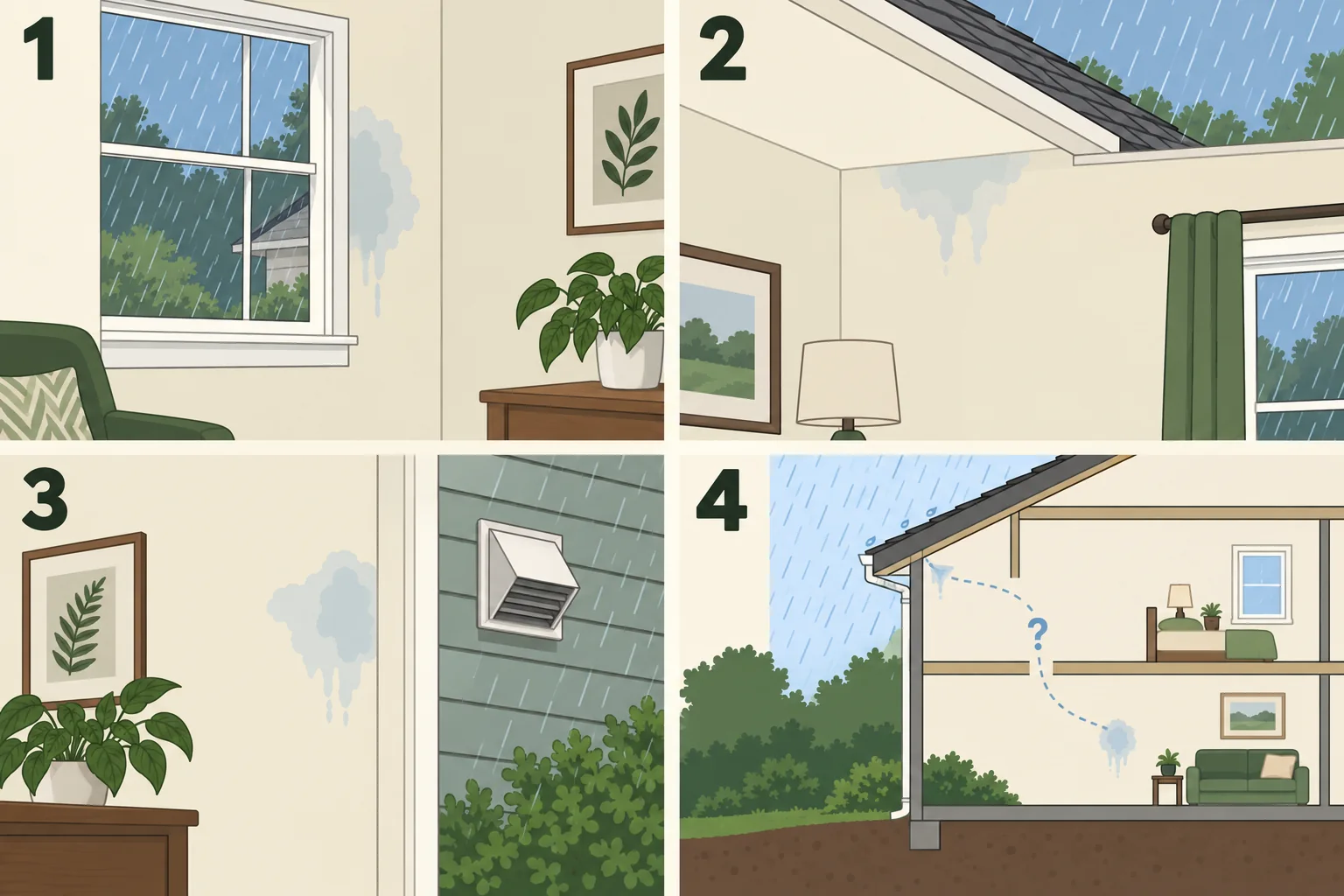
If an interior wall gets wet after rain, compare storm timing, wall location, and nearby exterior details without assuming the visible spot marks where water entered.
Short answer
What it usually means
If an interior wall repeatedly becomes wet or darker during or after rain, exterior water intrusion becomes more plausible. The visible spot still does not identify where rain entered: water may pass through a roof-to-wall intersection, window or door opening, exterior penetration, cladding or flashing interface, then travel along materials before appearing indoors. Record whether every storm triggers it, whether heavy or wind-driven rain matters, how long the delay is, and what exterior details lie above, beside, or uphill from the spot. Compare plumbing use, air-conditioning operation, and broad condensation before assigning the cause.
First: does the wall get wet every time it rains?
Start with the storm pattern rather than the stain shape. A patch that darkens during nearly every rain presents different evidence from one that appears only after hours of heavy rain or after wind strikes one side of the house. A delayed response can also be meaningful because water may need time to pass through or collect within an assembly before it reaches the visible finish.
Record ordinary weather rather than trying to reproduce the leak. Note when rain starts, when the wall changes, storm duration, approximate wind direction, and when the wall dries. Wind direction narrows which surfaces were exposed; it does not identify the failed detail.
| Rain pattern | What it adds to the investigation |
|---|---|
| Nearly every rain | A consistently exposed exterior pathway becomes more plausible. |
| Only heavy or prolonged rain | The assembly may manage smaller loads but be overwhelmed or wet through under longer exposure. |
| Only wind-driven rain | Pay attention to the wall face, openings, and intersections exposed to that wind. |
| Hours after rain begins or ends | Travel, storage, and delayed release within materials may be involved. |
| No repeatable rain relationship | Keep condensation, plumbing, and HVAC sources actively in the comparison. |
Why the wet spot may not be where the rain entered
An interior patch is an observation point, not an exterior leak locator. EPA moisture guidance describes bulk water moving through openings and along interfaces, while porous materials can draw water beyond the first wet location by capillary action. Water may follow framing, sheathing, fasteners, pipes, insulation, drywall paper, or the edge of another component before it becomes visible.
This is why a stain beside a window does not prove the window unit failed, and an upper-wall patch does not prove the roof directly above is leaking. Source tracing has to connect the storm pattern with the actual construction and the continuous water-management layers.
Where on the wall is the moisture appearing?
Map the spot vertically and horizontally. Upper-wall moisture makes roof edges, roof-to-wall transitions, higher openings, and penetrations worth comparing. A patch beside a window or door points attention to that opening and the surrounding wall interface, but water can still arrive from above. A lower-wall patch may be the endpoint of downward travel or, depending on construction, moisture entering nearer the base.
Confirm whether the wall actually faces outdoors. Moisture on an interior partition can still originate above or travel from an exterior assembly, but plumbing or HVAC routes may deserve more weight. Homes differ, so avoid assuming a particular roof, siding, foundation, attic, or wall layout.
| Where it appears | Exterior context to record |
|---|---|
| Near the ceiling or high on the wall | Roof edge, roof-to-wall area, upper opening, vent, or water arriving from above |
| Beside or below a window or door | Opening, trim, head, sill, and surrounding wall interface |
| Near a vent, pipe, cable, or exterior fixture | A penetration through the exterior water-management layers |
| Low wall or baseboard | Downward travel, wall-base drainage, adjacent exterior grade, or a non-rain source |
| Interior partition | What lies above or behind it, including exterior walls, plumbing, and HVAC routes |
Does heavy or wind-driven rain make it worse?
Wind can drive rain against walls, windows, doors, penetrations, and intersections that receive little water during calm vertical rainfall. FEMA documents water intrusion through and around windows and doors during wind-driven rain, while Building America guidance emphasizes drainage and flashing at openings and wall transitions.
A spot that appears only when rain comes from one direction makes exposure on that side more relevant. It still does not prove the nearest opening failed: gusts, roof runoff, cladding joints, and wall geometry can change where water is delivered. Heavy-rain-only behavior likewise describes the load, not the defect.
Could the water be coming from a window or door?
Windows and doors interrupt a wall's water-control layers. DOE building-science guidance explains that their flashing should be integrated with the wall's drainage plane so incidental water is directed outward. Rain-related dampness near an opening can therefore justify professional examination of the unit, flashing, trim, and adjacent wall as one system.
Do not confuse this with room-side glass condensation or fog between sealed panes. Between-pane fog does not explain rainwater soaking the surrounding drywall. Also do not remove trim, glazing, or the window itself. A future window-rain guide remains the narrower owner when water entry is clearly specific to an opening.
If moisture is on the accessible room-side glass rather than the wall, use Why Is There Condensation on the Inside of My Windows? instead.
Could it be coming from the roof or a roof-to-wall intersection?
Where a sloped roof meets a vertical wall, the roof and wall water-control layers must work together. Building America describes step or continuous flashing and kick-out flashing as details used to keep runoff out of the wall and direct it away. The applicable detail depends on the roof and wall system; not every home uses the same assembly.
An upper-wall spot below such an intersection makes that region worthy of qualified inspection, especially when heavier runoff increases the symptom. It does not prove the shingles, step flashing, kick-out, gutter, or wall membrane is the failed part. Do not climb onto the roof, lift roofing, or attempt flashing repair yourself.
If the rain-related moisture is on the ceiling rather than the wall, use Why Is My Ceiling Wet After It Rains? for that distinct symptom.
Could siding, flashing, or a wall penetration be involved?
The visible siding or cladding is often only the first rain-control layer. EPA and Building America guidance describe walls that use cladding, a drainage space or capillary break where applicable, a water-resistive drainage plane, and flashing that returns incidental water outdoors. Materials and details vary among wood, vinyl, fiber cement, masonry, stucco, metal, and other systems.
Vents, pipes, utility entries, exterior fixtures, decks, and transitions interrupt those layers. When a wet spot aligns with one of these features or lies below it, the interface deserves inspection. Do not remove siding or flashing, and do not assume that a bead of sealant is the right repair.
Could it be condensation instead?
Rainy weather can also raise outdoor humidity or coincide with indoor moisture, so timing alone is not absolute proof of bulk-water entry. Condensation becomes more plausible when fine droplets or broad dampness appear across a cold exterior wall or corner, several similar surfaces are affected, windows condense too, or the pattern tracks indoor humidity more closely than individual storms.
Rain intrusion more often presents as a localized patch that repeatedly darkens after particular storms, especially near an exposed exterior feature. These are tendencies, not a visual diagnosis.
For broad surface droplets or widespread dampness, compare Why Are My Walls Sweating?.
If the house is broadly clammy while cooling, see Why Is My House Humid With the AC Running?.
Could plumbing or the AC be mimicking a rain leak?
Plumbing use can overlap with storms by coincidence. Ask whether the wall changes during dry weather after a shower, toilet flush, sink use, dishwasher cycle, or washer operation. If it does, plumbing remains plausible. Do not repeatedly operate a suspected fixture to enlarge the patch or dismantle concealed plumbing.
Cooling equipment also removes moisture during humid weather. If the patch follows air-conditioner operation on dry humid days, or lies near an air handler, condensate route, or cold duct, HVAC deserves comparison. A rainy day by itself does not distinguish rain entry from condensate or surface condensation.
For water located around the indoor HVAC equipment or drain area, use Why Is There Water Around My Indoor AC Unit?.
Is the wall wet now, or is it an old stain?
A dry mark records previous discoloration, not necessarily active moisture. The more useful evidence is whether it becomes damp, expands, changes sheen, or darkens during a new storm and then dries afterward. Stain color and ring shape cannot identify a window, roof, flashing, or plumbing source.
Photograph the same area from the same position. Record the boundary and date without puncturing, scraping, or pressing aggressively. Do not repaint until there is reasonable confidence that the source has stopped, the material is dry, and damaged material does not require repair.
What if the paint is bubbling or the drywall feels soft?
Bubbling, blistering, or peeling paint means the finish has been affected, but it remains a separate symptom and does not identify the exterior entry point. Soft, swollen, crumbly, sagging, or bulging drywall suggests more advanced material deterioration and needs faster evaluation.
Repeated wetting can also support mold growth. A musty odor or visible mold-like material does not identify a species or prove how far moisture extends. Address the water source before cosmetic repair; do not spray bleach into an unknown wall problem or open the assembly as a first-line check.
What you can safely check yourself
Keep the investigation observational and non-destructive. Controlled water testing can be useful in professional diagnosis, but casual hose spraying can force water into unnatural locations and create a misleading result. Do not try to recreate a storm with a hose.
- Photograph the area before, during, and after natural rainfall and record when the boundary changes.
- Note rain duration, intensity, approximate wind direction, and the delay before moisture appears.
- Identify nearby windows, doors, roof-wall areas, vents, utility entries, exterior fixtures, and material transitions from a safe ground-level position.
- Compare the pattern with ordinary plumbing use, cooling operation, indoor humidity, and condensation elsewhere.
- Note bubbling paint, softness, swelling, crumbling, odor, suspected growth, or deformation.
- Share the timeline and photographs with the professional investigating the assembly.
When rain-related wall moisture needs faster attention
Arrange prompt evaluation for active flowing water, a rapidly expanding area, severe swelling or bulging, soft or crumbling material, repeated major storm intrusion, an unstable window or door assembly, significant mold-like growth, or ceiling and wall deformation above the spot. Keep away from material that appears water-loaded or structurally unstable; do not puncture a bulge.
Water near an outlet, switch, electrical panel, fixture, wiring route, or other electrical equipment is a shock and fire concern. Do not touch the wet device, remove its cover, test it, or drill nearby. Keep clear and use qualified electrical or emergency help appropriate to the severity. Suspected sewage or wastewater also requires conservative professional handling.
Who should you call?
Choose the first trade from the strongest evidence instead of calling everyone. A building-envelope or exterior specialist fits a strong rain correlation involving wall, cladding, penetration, window, or door interfaces. A roofer fits evidence centered on a roof edge, roof penetration, or roof-to-wall transition; a window or door professional fits a tightly opening-specific pattern.
Use a plumber when the spot occurs during dry weather or follows fixture use, and an HVAC professional when it follows condensate or cooling operation. When the origin crosses systems, remains unclear, or material damage is substantial, a qualified inspector or general contractor can coordinate the investigation.
Bottom line
Rain timing makes exterior water intrusion more plausible, but the interior wet spot does not identify the exterior entry point. Compare every-rain versus certain-storm behavior, heavy and wind-driven rain, delay, wall location, and nearby exterior openings, intersections, and penetrations.
Keep condensation, plumbing, and HVAC in the comparison until the pattern separates them. Document natural events, avoid roof work, destructive investigation, blind caulking, and uncontrolled hose tests, then route the evidence to the professional whose system best matches it.
If rain is not a reliable trigger and the source remains unknown, return to Why Is There a Wet Spot on My Wall? for the broader diagnostic framework.
Sources
- Moisture Control Guidance for Building Design, Construction and MaintenanceU.S. Environmental Protection Agency
- Moisture Control Guidance for Building Design, Construction and Maintenance (PDF)U.S. Environmental Protection Agency
- Flashing of Roof-Wall Intersections in Existing HomesBuilding America Solution Center
- Flashing at Bottom of Exterior WallsBuilding America Solution Center
- Windows and Doors Are Installed: Fully Flashed Window and Door OpeningsU.S. Department of Energy Building Science Education
- Reducing Water Intrusion Through Windows and DoorsFederal Emergency Management Agency
- Moisture Performance of High-R Wall SystemsU.S. Department of Energy
- Statement Regarding Hurricane Harvey Electrical SafetyU.S. Consumer Product Safety Commission