Diagnostic Guide
Why Does My Toilet Water Rise When Another Toilet Flushes?
If one toilet's water rises when another toilet flushes, a shared drain restriction, pressure change, venting issue, or broader sewer problem may be involved.
Short answer
What it usually means
Toilets in the same home ultimately connect to shared drainage and venting paths. When one toilet flushes, its wastewater displaces air and adds a short, concentrated flow to those pipes. If a shared branch or farther-downstream drain is partly restricted—or if the system is not managing air pressure normally—the second toilet's trap water may ripple, bubble, rise, or surge. A slight movement does not locate a fault, but a pronounced rise, repeated reactions, several slow drains, or water entering a tub, shower, or floor drain can signal a developing backup and deserves prompt plumbing evaluation.
Why one toilet can affect another
Each toilet has an integral trap that holds the water visible in the bowl. Its fixture drain eventually joins a branch, stack, building drain, or sewer used by other fixtures. A flush therefore changes flow and air pressure in piping that may also serve the second bathroom.
A properly functioning drainage and venting system is designed to carry wastewater while protecting trap seals from disruptive pressure differences. If the available drain capacity is reduced or the air path is ineffective, pressure can push or pull at the second toilet's water. That interaction explains the movement; it does not prove where a restriction or vent problem is located.
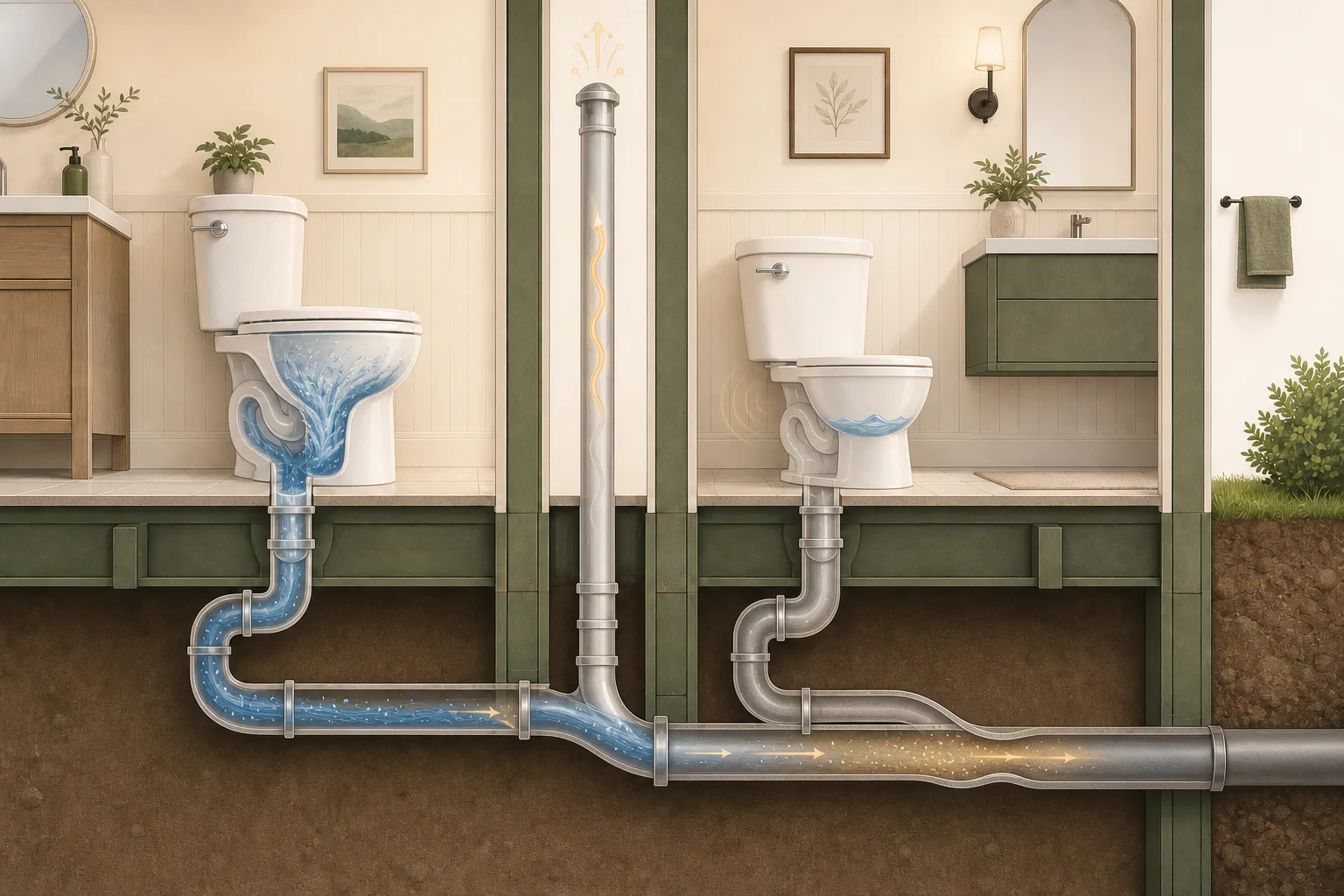
What does “the water rises” actually look like?
Avoid declaring every small ripple normal or every movement an emergency. The size of the change, whether it repeats, and what other fixtures do determine the useful response.
| What the second toilet does | How to interpret it |
|---|---|
| The surface ripples or the level shifts slightly | A modest pressure interaction; compare repetition, other drains, and whether the change is becoming stronger |
| Bubbles or gurgles rise through the bowl | Air is passing through the trap water, but the sound does not locate the underlying condition |
| The water rises noticeably, then falls | Stronger displacement or temporary downstream resistance; repeated events warrant plumbing evaluation |
| The water climbs toward the rim | A potential overflow or backup warning; minimize fixture use and call promptly |
| Dirty water or sewage enters the bowl | An active sanitation and backup concern requiring reduced water use, isolation from contact, and professional help |
| The second toilet also flushes or drains slowly | A local or shared downstream restriction becomes more plausible |
Common reasons another toilet makes the bowl rise
- 1The toilets share a partly restricted branch drain
Nearby toilets may join a common downstream branch. A partial narrowing reduces usable capacity, so the flush from Toilet A can displace water or air toward Toilet B's trap. This is plausible when two nearby bathrooms interact, but a floor plan cannot confirm concealed pipe connections.
- 2A farther-downstream drain or sewer is restricted
A restriction in the building drain or private sewer can affect toilets and other fixtures on several branches. Multiple slow drains, reactions in more than one bathroom, a low tub or floor drain taking water, repeated backups, or steadily worsening symptoms make a broader restriction more concerning. This article uses those as escalation clues rather than attempting a complete main-sewer diagnosis.
- 3The venting system is not controlling pressure normally
Plumbing vents admit or release air so trap seals are not exposed to excessive pressure differences during drainage. A restricted, damaged, undersized, or incorrectly arranged vent can contribute to toilet-water movement. Venting is not the automatic answer, and roof access or vent clearing is not a safe homeowner test.
- 4A toilet or nearby branch has a more localized problem
If only two neighboring toilets react and all other drains remain normal, a local fixture drain, shared branch, or nearby vent arrangement may deserve attention first. The exact branch cannot be diagnosed from bathroom location or bowl movement alone.
- 5The septic system is not accepting wastewater normally
On a septic property, tank or outlet trouble, pumping-component problems, an overloaded or saturated drainfield, or another downstream condition can coincide with gurgling, slow drains, odors, alarms, wet drainfield areas, or backups. One moving toilet bowl is not proof of septic failure.
- 6A public sewer condition is affecting drainage
Municipal sewer obstruction, surcharge, or maintenance activity can occasionally affect connected homes. Neighbor reports, utility work, widespread symptoms, or a utility notice are useful context, but homeowners should not assume the city is responsible before the private and public drainage paths are distinguished.
What the bathroom locations may tell you
The toilets are in nearby bathrooms
A shared branch connection may be involved, particularly if only those two fixtures react. Nearby rooms do not guarantee nearby concealed piping, so treat this as a starting clue rather than a pipe map.
An upstairs flush affects a lower-floor toilet
The fixtures necessarily connect somewhere downstream, and the lower toilet may reveal pressure or backup behavior at a lower elevation. Check other low fixtures, but do not assume the blockage sits directly below either toilet.
The lowest toilet or drain reacts first
Lower fixtures can sometimes show downstream backup symptoms before higher ones because rising wastewater reaches the lowest available opening. This is a common warning pattern, not an absolute rule for every layout.
When does the second toilet react?
Timing helps describe the sequence to a plumber; it cannot measure distance to a restriction or prove which pipe is involved.
| Timing | What it may suggest |
|---|---|
| Immediately as the first toilet flushes | A relatively direct pressure or drainage interaction between connected paths |
| A few seconds after the flush | The pressure or flow effect may be developing farther downstream |
| Only after several flushes | Available drainage capacity may be progressively exceeded |
| Only during showers, laundry, or other heavy use | A broader drainage-capacity or downstream condition becomes more plausible |
| The reaction is getting stronger over days or weeks | A developing restriction deserves earlier evaluation before a full backup occurs |
A known toilet trigger is different from random gurgling
When the second toilet reacts predictably to a specific flush, the known trigger makes this a narrower toilet-to-toilet drainage question. If the bowl gurgles with no recognized trigger, track showers, sinks, appliances, and other hidden discharge events instead.
Use Why Does My Toilet Gurgle Randomly? when the timing remains unexplained.
Washer bubbling and refill whistling are different patterns
If the bowl reacts specifically while the washing machine pumps out, use Why Does My Toilet Bubble When the Washer Drains? for that high-flow laundry trigger.
If the sound is a high-pitched whistle while a flushed toilet's tank refills, use Why Does My Toilet Whistle After Flushing? for the clean-water supply and fill-valve side.
What you can observe safely
Keep the investigation observational. Do not remove toilets, disconnect fixtures, open a cleanout that may be holding wastewater, run a large sewer snake, climb to a roof vent, enter a septic tank, or use aggressive chemical drain cleaners. Chemicals may not reach a downstream restriction and can expose anyone who later opens or services the system.
- Identify the exact triggering toilet and the exact toilet that reacts.
- Note whether the second bowl ripples, bubbles, rises slightly, rises substantially, or approaches the rim.
- Check nearby sinks, tubs, showers, floor drains, and other toilets for slow drainage or gurgling without deliberately adding large volumes of water.
- Record whether the fixtures are adjacent, on different floors, or near the home's lowest drain.
- Note whether several flushes or heavy household water use makes the reaction stronger.
- Record sewer odor, recent heavy rain, utility work, and whether neighboring homes report drainage trouble.
- For septic homes, note alarms, recent service history, odors, slow drains, or wet drainfield areas without opening the tank.
If the shower drain reacts instead of another toilet
A toilet flush can also disturb the water seal in a connected shower or tub trap. That fixture-to-fixture pattern uses different observations than a second toilet's bowl rising, especially when the shower makes sound without visible water backup.
Use Why Does My Shower Drain Gurgle When the Toilet Flushes? when the shower or tub drain is the reacting fixture.
When to stop or minimize fixture use
Continued flushing, showering, laundry, and dishwashing adds wastewater to a path that may already be restricted. Minimize or stop those uses and call a plumber promptly when a toilet approaches the rim, another fixture backs up, several drains slow at once, multiple toilets react, or symptoms worsen quickly.
If the symptom has spread beyond the two toilets, use Why Do Multiple Drains Back Up at the Same Time? to compare one branch with a broader building-drain pattern.
Who to call
Plumber or drain professional
Start here for repeated toilet interaction, suspected branch or private-sewer restrictions, multiple affected fixtures, worsening bowl rise, backups, or an uncertain drainage pattern. A professional can evaluate accessible cleanouts, venting, branches, and the private building sewer without guessing from the bathroom layout.
Septic professional
For septic homes, involve a qualified septic provider when alarms, surfacing wastewater, drainfield saturation, service history, or the plumber's findings point beyond the building drain. Never enter or open a septic tank as a homeowner diagnostic step.
Sewer utility or municipality
Contact the utility when neighbors are affected, public work is underway, a plumber locates the problem beyond the private lateral, or the utility instructs residents to report symptoms. Do not assume responsibility lies with the municipality without evidence.
Sources
- Chapter 9: Vents, 2024 International Plumbing CodeInternational Code Council
- Chapter 7: Sanitary Drainage, 2021 International Plumbing CodeInternational Code Council
- Resolving Septic System MalfunctionsU.S. Environmental Protection Agency
- Call Us First: Sewer Backup Warning SignsCity of Roseville Environmental Utilities
- If You Have a Plumbing BlockageTown of Simsbury Water Pollution Control