Diagnostic Guide
Why Do Multiple Drains Back Up at the Same Time?
When several drains slow, gurgle, or back up together, a shared branch, building drain, sewer line, or septic problem may be restricting wastewater flow.
Short answer
What it usually means
When several drains become slow, gurgle, rise, or back up at roughly the same time, the problem is more likely to be in drainage piping those fixtures share than in several unrelated fixtures. A partial shared-branch restriction can affect one zone, while symptoms across rooms or floors make a building drain, private sewer, septic system, or outside sewer condition more concerning. Multiple drains do not prove the main sewer is clogged, but wastewater rising in a low fixture or sewage entering the home means you should stop unnecessary water use and arrange prompt professional evaluation.
What counts as several drains backing up?
These observations have different urgency. Two sinks draining a little slowly are not the same as wastewater entering a basement shower. Focus on whether water is merely slow, whether another fixture triggers movement, and whether dirty water is coming back into the home.
| What you notice | How to treat the pattern |
|---|---|
| Several drains are slow | Shared drainage resistance is possible, but wastewater is not necessarily moving backward |
| Several fixtures gurgle | Air and water pressure are changing in connected drainage; the sounds do not locate the problem |
| Water rises in one fixture when another is used | A shared downstream path may not be carrying the added flow normally |
| Wastewater appears in a lower fixture | A more concerning downstream restriction may be pushing water toward a lower opening |
| Sewage enters tubs, showers, toilets, or floor drains | An active sanitation and drainage problem requiring stopped water use and prompt help |
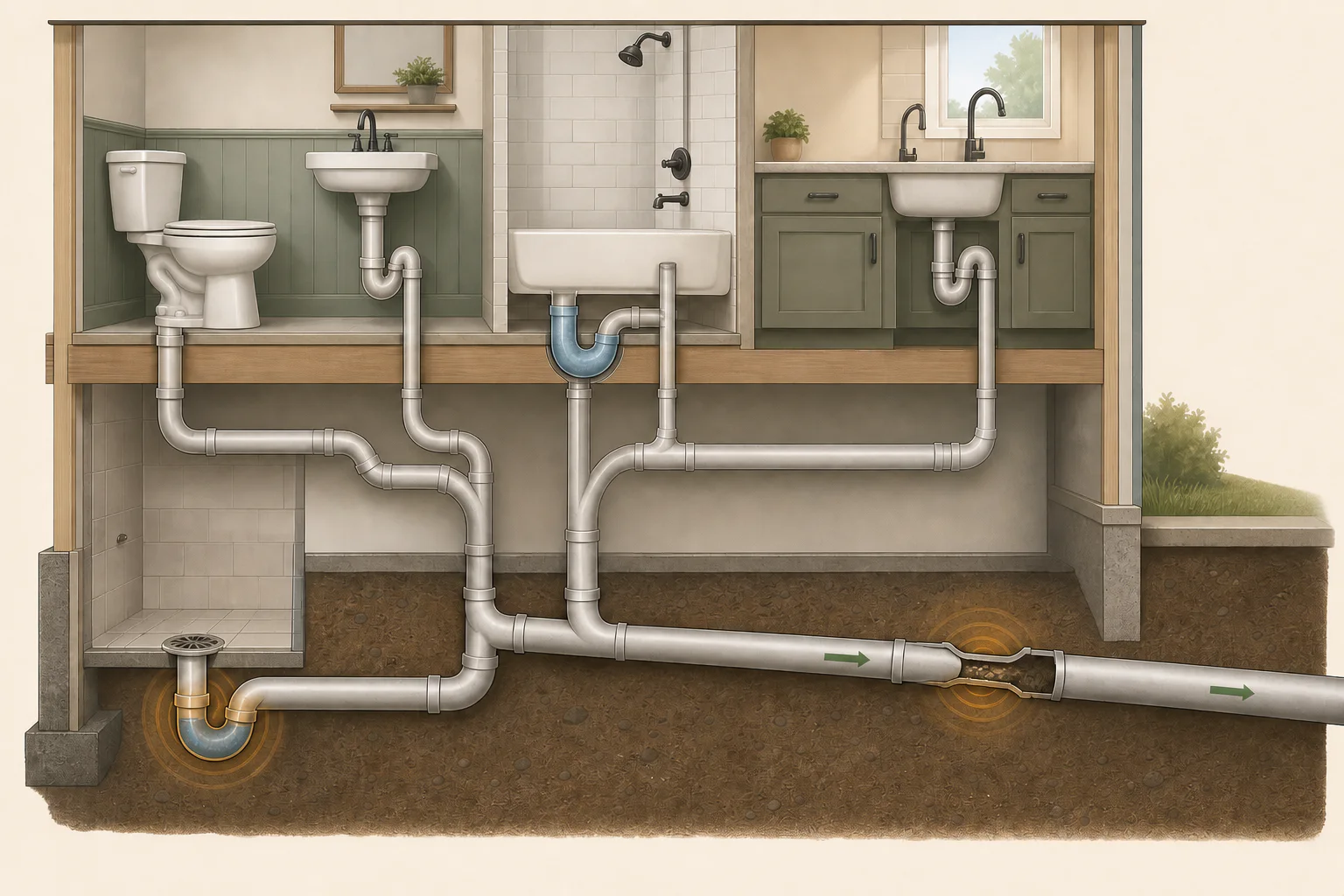
Why several fixtures can react together
Each fixture begins with its own drain connection, but those paths join branch drains, stacks, the building drain, and eventually a private sewer or septic system. A restriction after two or more fixture drains join can affect every upstream fixture that depends on that section.
The same pattern can be produced at different scales. Two nearby fixtures may share a restricted bathroom branch, while fixtures across several rooms or floors may share only a farther-downstream building drain or sewer. The number and location of affected fixtures narrow the possibilities; they do not reveal the hidden pipe layout or exact obstruction by themselves.
Common reasons multiple drains have problems together
- 1A shared branch drain is partly restricted
Fixtures in one bathroom, kitchen area, or laundry zone may connect before joining the rest of the building drainage. A narrowing in that shared branch can make only the nearby group slow, gurgle, or interact while fixtures elsewhere remain normal. Room proximity is useful context, not proof of the pipe arrangement.
- 2The building drain or private sewer is restricted
When several branches lose capacity together, a restriction farther downstream becomes more plausible. Clues include problems in different rooms, more than one floor, lower fixtures receiving water, symptoms during heavy use, or repeated backups. This establishes concern for a shared downstream path without attempting to diagnose every possible main-sewer defect.
- 3A lower fixture is revealing the backup first
Rising wastewater can appear at a low shower, tub, toilet, laundry sink, or floor drain before it reaches higher fixtures. Elevation can make a low opening the first visible outlet, but pumping arrangements, backwater protection, and actual piping layouts create exceptions.
- 4The septic system is not accepting wastewater normally
On septic properties, tank or outlet trouble, pumping-component issues, a restriction, hydraulic overload, saturated soil, or drainfield malfunction can coincide with slow drains, gurgling, odors, alarms, wet drainfield areas, and indoor backups. Multiple slow drains are a warning pattern, not proof of which septic component is responsible.
- 5A public sewer condition is affecting the property
A municipal main obstruction, surcharge, or maintenance event can sometimes affect connected homes. Similar neighbor reports, utility alerts, or a plumber locating the restriction beyond the private lateral strengthen this possibility. Local ownership and responsibility boundaries vary.
- 6Venting is contributing to pressure symptoms
Plumbing vents provide an air path that protects fixture trap seals while wastewater moves. Ineffective venting can contribute to gurgling and trap-water movement, but actual wastewater rising in several fixtures puts a shared drainage restriction higher on the practical concern list. Gurgling alone cannot separate the two, and roof access is not a homeowner test.
- 7More than one localized issue is present
Coincidental local clogs can happen, especially when different fixtures have had separate problems for some time. That explanation becomes less convincing when symptoms begin together, one fixture use affects another, or wastewater appears at a low drain.
Which fixtures are affected together?
Only one bathroom or one zone
A shared branch serving that area may deserve attention before assuming a whole-house sewer problem. Check whether every other room truly drains normally, but do not deliberately stress the system with repeated tests.
Kitchen and bathroom fixtures
Different rooms reacting together makes a farther-downstream shared drain more relevant because their local branches eventually join. The joining point still cannot be located from room names alone.
Multiple bathrooms
A building drain, private sewer, or septic-side condition becomes more plausible, especially when toilets, tubs, and sinks all show changes or the pattern spans floors.
Fixtures on several floors
A shared vertical stack or downstream building drainage path deserves prompt evaluation. Note whether the lowest fixture reacts first, but remember that pumps and protective devices can change the visible pattern.
A low shower or floor drain receives wastewater
Treat this as a backup rather than a routine slow-drain problem. Stop adding wastewater, avoid contact, and arrange prompt help.
When do the problems appear?
Record the sequence rather than repeatedly reproducing it. A short timeline of which fixture ran, which drain reacted, and whether water rose can be more useful than another test flush.
| Timing pattern | What it may suggest |
|---|---|
| Only during laundry, several showers, dishwashing, or repeated flushing | A restricted path may cope with light flow but lose capacity during concentrated use |
| Even one ordinary fixture use affects another drain | The available drainage path may be more substantially restricted |
| Symptoms come and go | A partial restriction, changing septic load, or outside sewer condition can behave inconsistently; intermittent does not mean harmless |
| Symptoms are becoming more frequent or severe | The problem deserves earlier evaluation before a full backup occurs |
Use the narrower guide when the trigger is specific
This page fits when several fixtures share a broader slow-drain or backup pattern. A repeatable trigger involving one reacting fixture has a more focused explanation.
If washing-machine discharge makes a toilet bubble, use Why Does My Toilet Bubble When the Washer Drains? for that laundry-to-toilet interaction.
If one toilet flush changes the water level in another toilet, use Why Does My Toilet Water Rise When Another Toilet Flushes? for the toilet-to-toilet pattern.
If a toilet flush makes a shower or tub trap gurgle, use Why Does My Shower Drain Gurgle When the Toilet Flushes? for that known trigger.
If one toilet gurgles without an obvious trigger, use Why Does My Toilet Gurgle Randomly? to look for hidden fixture activity.
What you can observe safely
Keep the investigation observational. Do not remove toilets, open a cleanout that may be holding wastewater under pressure, snake the building sewer, climb to roof vents, enter a septic tank, dismantle multiple traps, or use aggressive chemical drain cleaners. A product poured into one fixture may not reach a shared restriction and cannot repair venting, sewer, or septic problems; mixing products creates additional exposure risk.
- Make a list of every affected toilet, sink, tub, shower, floor drain, appliance drain, and the floor or room where it sits.
- Note which fixture reacts first and whether it is only slow, gurgles, changes level, or receives dirty water.
- Record whether laundry, dishwashing, showers, or repeated flushing makes another fixture react.
- Compare one zone with other rooms without intentionally sending a large test volume into the drains.
- Note sewer odors, recent heavy rain or utility work, and whether nearby properties report similar sewer symptoms.
- For septic homes, note alarms, service history, wet drainfield areas, or odors without opening or entering the tank.
- Photograph visible water from a safe, dry location and record whether the pattern is worsening.
When to stop using water
Reduce or stop toilet flushing, showers, sinks, laundry, and dishwashing when wastewater rises in fixtures, sewage appears, the lowest drain overflows, several fixtures back up, or using one fixture visibly worsens another. Continuing to send water into a restricted system increases the volume of wastewater that has nowhere to go.
Who to call
Plumber or drain professional
Start here when multiple fixtures are slow or backing up, rooms or floors are affected together, a lower drain takes wastewater, backups repeat, or the source is unclear. A professional can evaluate branches, accessible cleanouts, the building drain, and the private sewer without guessing from a single symptom.
Septic professional
For septic homes, involve a qualified provider when alarms, surfacing wastewater, saturated drainfield conditions, service history, or plumbing findings point beyond the building drain. Do not open or enter the tank.
Sewer utility or municipality
Contact the utility when neighbors report similar problems, an official alert or public work is relevant, a plumber locates the issue beyond the private lateral, or local instructions direct residents to report backups. Responsibility limits differ by jurisdiction, so do not assume the public system is responsible without evidence.
Sources
- Chapter 7: Sanitary Drainage, 2021 International Plumbing CodeInternational Code Council
- Chapter 9: Vents, 2024 International Plumbing CodeInternational Code Council
- Resolving Septic System MalfunctionsU.S. Environmental Protection Agency
- Sewer Backup Warning SignsCity of Roseville Environmental Utilities
- Side Sewer BackupsSeattle Public Utilities
- Signs of Septic System FailureWashington State Department of Health