Diagnostic Guide
Why Is My Ceiling Getting Moldy?
Mold-like spots on a ceiling point to recurring moisture. Use location, timing, and moisture clues to distinguish condensation, leaks, attic, plumbing, and HVAC sources.
Short answer
What it usually means
Mold-like growth on a ceiling means the surface has probably stayed damp long enough to support growth, but the spots do not identify the moisture source or mold species. Location and timing are the best first clues. A bathroom ceiling may stay damp after showers; an exterior corner may be colder and collect condensation; a localized patch below plumbing or an attic may follow a leak; and widespread spotting may accompany broader humidity or ventilation problems. Find and correct the moisture source before expecting cleanup to last.
Start with location, timing, and moisture source
Do not begin with the color of the spots or a guess about the species. Begin with the ceiling location, the conditions that precede the change, and the nearest credible source of moisture. The same-looking patch can follow shower condensation, a roof leak, plumbing above, damp attic conditions, or an HVAC moisture problem.
Photograph the area before cleaning and make a short timeline. Note whether the first change follows bathing, rain, cold weather, cooling operation, or use of plumbing on the floor above. These observations are evidence, not a component diagnosis.
| Pattern | Most useful next question |
|---|---|
| Bathroom ceiling, especially above the shower | Does moisture linger after bathing, and does the exhaust fan actually move air outdoors? |
| Exterior ceiling corner | Is the surface cold or damp during cold or humid weather, suggesting condensation or uneven insulation? |
| Localized patch below an attic or roof | Does it change after rain, snowmelt, or HVAC operation? |
| Patch below upstairs plumbing | Does dampness follow use of a tub, shower, toilet, sink, or supply line above? |
| Several rooms or broad ceiling areas | Is there a wider humidity, ventilation, or building-envelope problem? |
| Growth returns after cleaning | What moisture condition was left unresolved? |
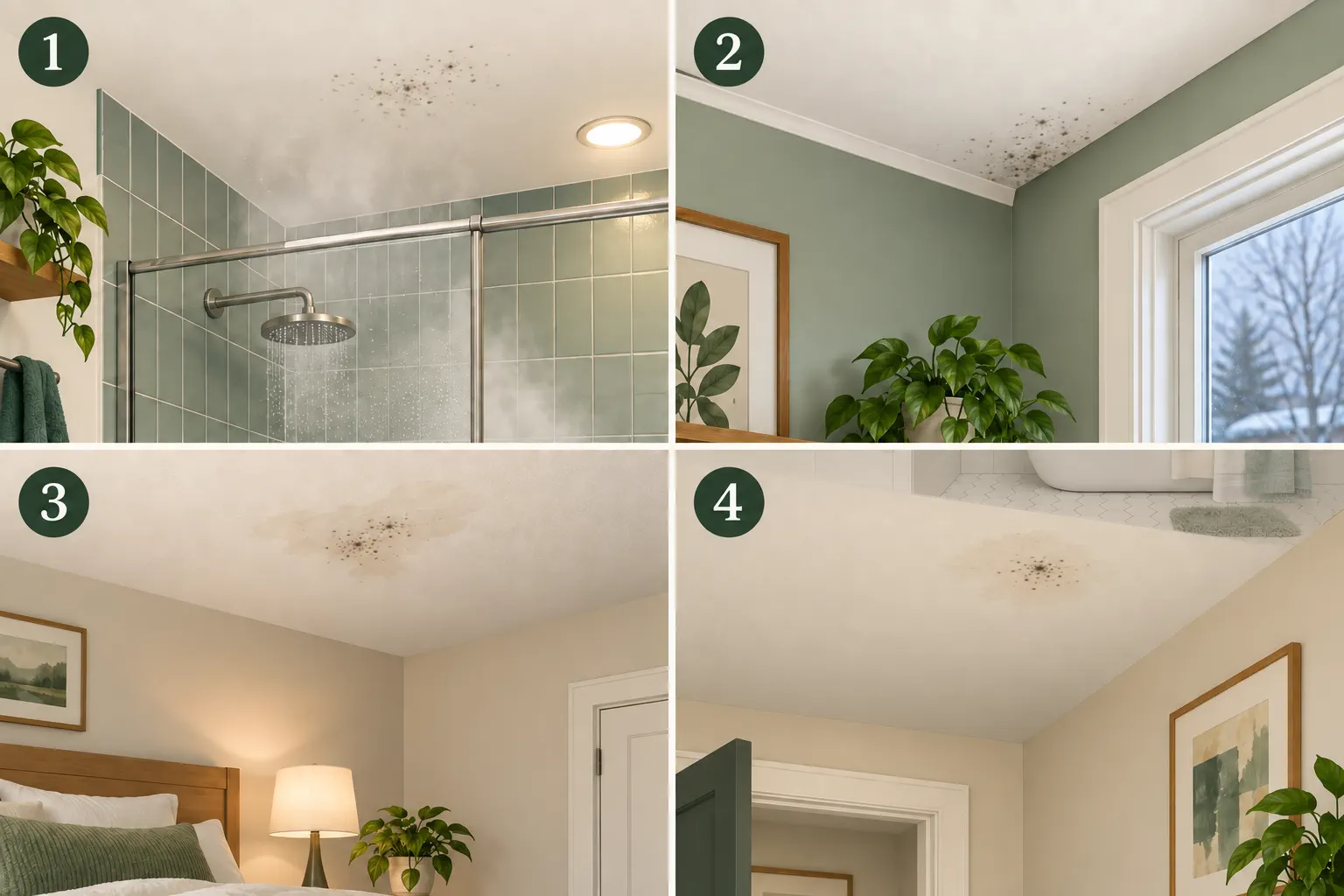
Mold-like spots on a bathroom ceiling
A bathroom ceiling can be repeatedly exposed to moisture when warm shower air meets a cooler surface and the room does not dry promptly. A pattern concentrated above the shower, strongest after bathing, and worse when the door stays closed or the exhaust is weak makes recurring humidity and condensation more relevant.
That pattern does not prove the fan is defective or that condensation is the only source. A plumbing leak from above or exterior water entry can occur in a bathroom too. Confirm that the fan runs, observe whether steam clears, and follow the fan and home manufacturer guidance. Do not remove the fan grille, enter wiring, or assume a fan that makes noise is exhausting outdoors.
Growth in an exterior ceiling corner
An exterior corner can have a lower indoor surface temperature than the middle of the room. Uneven insulation, air leakage, framing that conducts heat more readily, or limited air movement may leave that surface colder. When moist indoor air contacts a surface below its dew point, water can condense there and support recurring dampness.
This is sometimes called a thermal bridge, but a corner pattern alone cannot prove missing insulation or an air leak. Compare whether the area worsens during cold weather, whether nearby walls or windows also condense, and whether the patch is broad and diffuse rather than tied to rain. A building-performance or insulation professional can evaluate the assembly without destructive guesswork.
A ceiling patch below an attic or roof
Water above a ceiling can come from roof intrusion, attic condensation, plumbing, or HVAC equipment and ducts. The visible spot may not be directly below the source because water can follow framing, insulation, pipes, or the back of drywall before appearing. Rain timing makes exterior water entry more plausible; cooling-operation timing makes HVAC condensation more relevant; cold-weather attic dampness can suggest an enclosure moisture problem.
Do not enter an attic without a proper access route, stable walking surface, safe temperature, and clear electrical conditions. Do not walk on drywall, probe insulation, cut the ceiling, or climb onto the roof. Record the weather and equipment timing from the living space and let the appropriate professional trace the path.
If the known symptom is condensation on the outside of attic ductwork, use Why Is My AC Ductwork Sweating in the Attic? for that separate HVAC-specific moisture pattern.
A ceiling patch below upstairs plumbing
A localized area beneath a bathroom, laundry, kitchen, or known plumbing route deserves a timing comparison. Dampness that appears after a particular fixture is used may be consistent with a supply, drain, overflow, seal, or appliance connection problem. Continuous dampness can fit a pressurized supply leak, but it can also have another source.
Do not repeatedly run water to enlarge the stain, open the ceiling, or diagnose the exact fitting from the room below. Stop using the suspected fixture if the ceiling is actively wet or worsening, protect the area below, and call a plumber. Water near a light, fan, smoke alarm, or other electrical equipment needs prompt electrical safety evaluation as well.
What if it gets worse after rain?
A ceiling area that darkens, spreads, or feels damp during or shortly after rain shifts attention toward roof, flashing, wall, window, or other exterior water paths. Wind direction and delayed appearance can matter because water may travel within the assembly. The first indoor stain is not necessarily below the failed exterior detail.
Rain timing is still not proof of a specific roof defect. Avoid caulking random interior gaps or sending an unqualified person onto the roof. A roofing or building-envelope professional can examine exterior drainage and trace the path. This article does not replace the separate intent for a ceiling that is wet or stained after rain.
What if several ceilings or rooms are affected?
Growth-like spotting in several rooms makes simultaneous independent leaks less likely, though not impossible. Broader indoor humidity, ventilation, air-conditioning performance, repeated condensation on cold surfaces, or a building-envelope moisture problem becomes more relevant. Compare rooms, seasons, humidity trends, window condensation, and whether the home feels persistently clammy.
One hygrometer reading does not diagnose the house, and no single humidity target fits every climate and outdoor temperature. Look for trends and corroborating moisture. Do not simply lower the thermostat or buy a dehumidifier before understanding why the ceilings stay damp.
If the home feels broadly humid while the cooling system runs, use Why Is My House Humid With the AC Running? for the separate whole-home HVAC humidity problem.
Is it condensation or a leak?
Condensation tends to follow a cold surface plus humid air. A leak follows a path from a roof, pipe, fixture, drain, or equipment source. Both can be intermittent, and both may feed growth, so use several clues together rather than one visual feature.
| More consistent with surface condensation | More consistent with a leak or bulk-water path |
|---|---|
| Diffuse spotting at a cold corner or broad bathroom area | A localized stain, ring, track, blister, or spreading wet patch |
| Worse after showers, overnight humidity, or cold weather | Worse after rain or use of plumbing above |
| Several similar cold surfaces are affected | One area changes independently of room humidity |
| Surface dampness clears as the room dries or warms | Material stays wet, softens, sags, or continues to discolor |
Is it mold, a water stain, or another mark?
Dark, green, white, orange, or fuzzy-looking spots may be visible mold, but color and texture cannot reliably identify a species. Soot, dirt, insect marks, old water stains, rust from a fastener, paint failure, and other discoloration can resemble growth. A photograph or consumer test cannot turn appearance into a certain identification.
Do not call dark material “toxic black mold” or use the ceiling color to name Stachybotrys, Aspergillus, Penicillium, or another organism. CDC guidance emphasizes correcting moisture and removing growth rather than identifying a type by sight. Health effects vary; symptoms do not prove what is on the ceiling. Consult a healthcare professional about individual medical concerns.
If the visible growth is actually concentrated around a window, use Why Is Mold Growing Around My Windows? for the window-specific condensation and rain-entry pattern.
Why ceiling mold keeps coming back after cleaning
Recurring spots usually mean the surface is being wetted again, remained damp inside, or contains porous material that was not successfully cleaned. Painting over discoloration, applying a stronger chemical, or wiping the same area does not correct a shower-moisture pattern, roof path, plumbing leak, cold surface, wet insulation, or HVAC condensation source.
EPA guidance is direct: if the moisture problem is not fixed, mold is likely to return. After any limited cleanup, watch the ceiling during the exact conditions that used to trigger the problem. Recurrence is evidence to reopen the moisture investigation, not a reason to guess a more dangerous species.
What you can safely check yourself
Keep the investigation visible and non-invasive. Your most useful contribution is a record that connects the ceiling location with weather, room use, plumbing, and HVAC timing.
- Photograph the same area over time and note the first edge that changes.
- Record showers, cooking, humidifier use, rain, snowmelt, cooling operation, and plumbing use above.
- Compare the affected room with other ceilings, windows, and exterior corners.
- From the floor, look for rings, tracks, bubbling paint, peeling, softness, swelling, or sagging without pressing the material.
- Confirm accessible exhaust fans operate and use a hygrometer to record trends.
- Move belongings away from active drips and dry safe, exposed surface moisture promptly.
- Share dated photos and timing notes with the trade that matches the strongest evidence.
Cleanup and testing: fix moisture first
EPA says many limited mold areas under about 10 square feet can often be handled by a homeowner, but that is only a general cleanup-planning threshold. A ceiling adds overhead exposure, ladder risk, porous drywall or tile, hidden wet material, and the possibility of water or electricity above. If you cannot reach and contain the work safely, use an experienced professional.
Hard, accessible surfaces may be cleaned with detergent and water and dried completely under EPA guidance. Porous ceiling tile, insulation, or significantly affected drywall can be difficult or impossible to clean fully and may need professional removal or replacement after the source is fixed. Do not paint or caulk over active growth, and do not treat bleach as a universal requirement. Follow product labels and never mix cleaners.
Routine sampling is generally unnecessary when visible growth and a moisture problem are already present. Testing may have specialized uses when a qualified professional defines the question and sampling plan, but a kit does not locate the leak, identify hidden extent, or replace moisture correction.
When to call a professional
Match the professional to the evidence: a plumber for fixture- or pipe-timed wetness; a roofer or building-envelope professional for rain-related patterns; an HVAC professional for equipment or duct condensation; and a building-performance or insulation professional for recurring cold-surface condensation. Experienced mold/moisture remediation help is appropriate for extensive or hidden growth, damaged porous material, contaminated water, repeated recurrence, or work that cannot be contained safely.
Get prompt help and stay clear if the ceiling sags, bulges, holds water, sheds material, or is wet near a light, fan, detector, wiring, or other electrical equipment. The same applies when sewage or another contaminated source may be involved, structural damage is suspected, or the water source remains active. Do not wait for species testing before addressing an obvious moisture hazard.
Bottom line
A moldy-looking ceiling is a moisture investigation, not a species diagnosis. Use location, timing, and the nearest plausible moisture source to separate bathroom condensation, cold corners, rain entry, attic or HVAC moisture, and plumbing above.
Fix the source before cleanup, keep observations non-invasive, and treat sagging material or water near electricity as a prompt safety issue. If the pattern is extensive, recurring, hidden, or tied to damaged porous materials, bring in the professional whose specialty matches the evidence.
Sources
- A Brief Guide to Mold, Moisture and Your HomeU.S. Environmental Protection Agency
- Mold Cleanup in Your HomeU.S. Environmental Protection Agency
- Is Sampling/Testing for Mold Necessary?U.S. Environmental Protection Agency
- Mold Course Chapter 7U.S. Environmental Protection Agency
- Moisture Control Guidance for Building Design, Construction and MaintenanceU.S. Environmental Protection Agency
- MoldCenters for Disease Control and Prevention
- Air Barriers in Ventilated AtticsU.S. Department of Energy Building Science Education
- Building America Best Practices Series: Energy RenovationsU.S. Department of Energy
- Tips for Returning Home Safely After a DisasterFederal Emergency Management Agency