Diagnostic Guide
Why Do My Lights Flicker When an Appliance Turns On?
A brief light dip can follow appliance startup, but severe or repeated flickering may signal a circuit, connection, neutral, service, or utility problem.
Short answer
What it usually means
A slight, very brief dimming can occur when some motor-driven appliances start because their startup current is temporarily higher than their normal running current. It is not a blanket explanation for every flicker. Repeated, severe, prolonged, worsening, room-wide, or house-wide fluctuations deserve electrical evaluation—especially when lights also brighten or the symptom comes with buzzing, burning odor, hot outlets or switches, breaker trips, sparking, discoloration, or partial power loss.
A brief startup dip is different from repeated flickering
The trigger, duration, severity, and number of affected lights matter more than the word “flicker.” A refrigerator compressor, central air conditioner, heat pump, or well-pump motor may briefly demand more current as it starts. That can create a small, momentary voltage dip that a light makes visible. It does not prove the circuit or appliance is healthy, and there is no useful universal brightness threshold a homeowner can judge by eye.
A light that repeatedly pulses while the appliance runs, dims dramatically, changes for several seconds, affects several rooms, or has worsened over time no longer fits the simple one-time-startup pattern. CPSC and ESFI both treat recurring dimming or flickering—especially with heat, odor, noise, damage, or breaker trouble—as a reason for qualified electrical inspection.
If the flicker has no repeatable appliance trigger, use Why Do My Lights Flicker Randomly? to classify the symptom by one bulb, one fixture, one room, or a broader part of the house.
| What you notice | How to treat the pattern |
|---|---|
| One slight, fraction-of-a-moment dip as a motor or compressor starts | Startup demand may be involved; observe whether the pattern stays slight, brief, and stable |
| Lights pulse or flicker repeatedly while the appliance runs | This is not explained by a single startup event; arrange evaluation if it recurs |
| Dimming is severe, prolonged, or getting worse | Do not dismiss it as normal appliance load |
| Several rooms or the whole house changes brightness | A feeder, neutral, service, panel, or utility issue becomes more relevant |
| Some lights brighten while others dim | Seek prompt electrical evaluation for possible neutral or broader voltage trouble |
| Flicker comes with heat, buzzing, burning odor, trips, sparking, or partial power | Stop testing the load and use prompt or emergency help appropriate to the hazard |
Why an appliance can briefly dim the lights
Motors and compressors can draw substantially more current during the instant they start than after they reach normal speed. That short demand can produce a temporary voltage drop that a light reveals as a momentary brightness change.
The effect depends on the appliance, circuit, wiring length and condition, service, utility supply, and the lamp or dimmer. A small startup dip therefore explains a mechanism, not a diagnosis. Flicker that continues after startup, appears at ordinary loads, or suddenly becomes stronger needs a different question: what has changed in the appliance or electrical system?
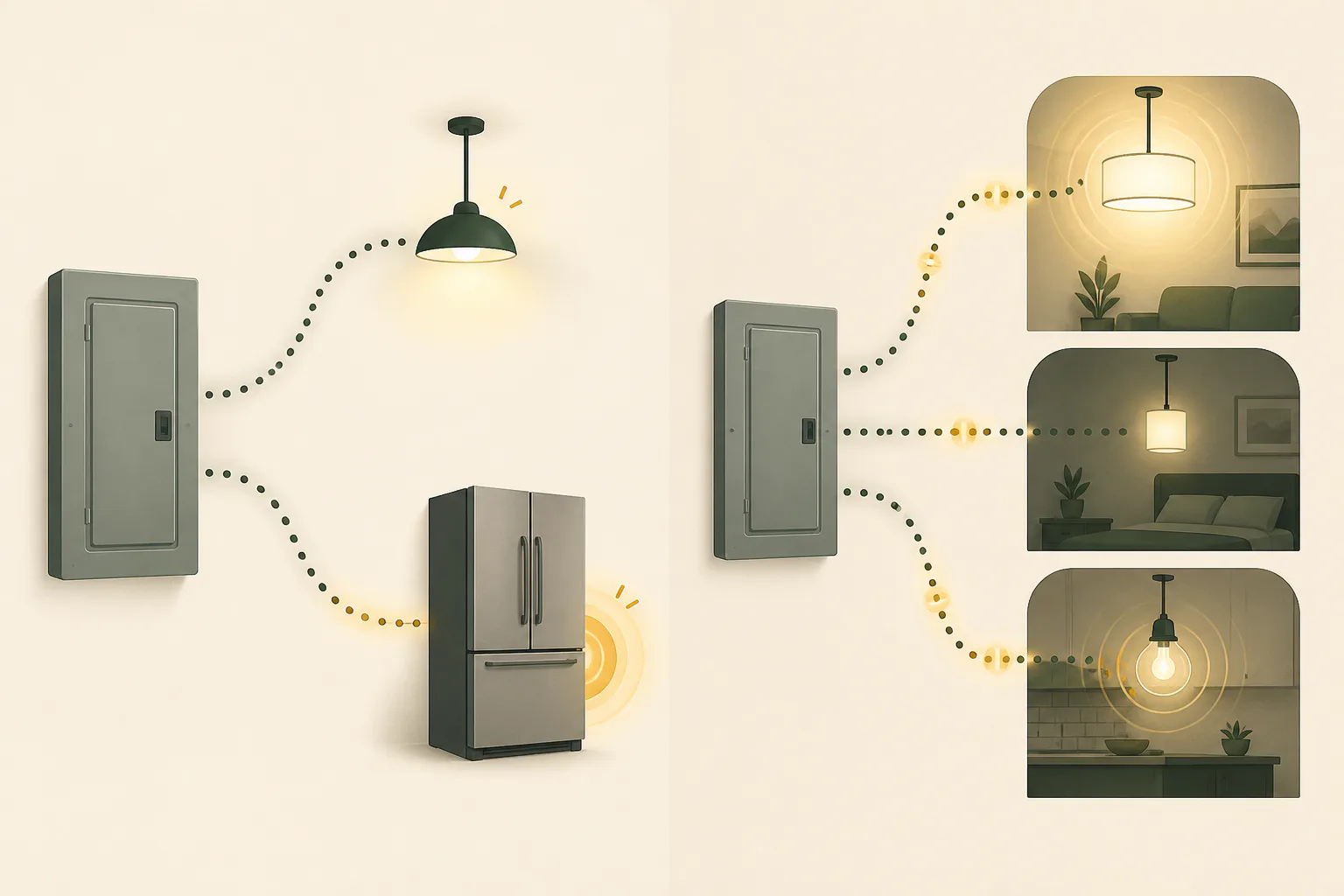
What can make appliance-triggered flickering more noticeable?
- 1The motor or compressor is drawing startup current
Refrigerators, air conditioners, heat pumps, well pumps, disposals, and some washer loads use motors or compressors. A single slight dip at startup can follow this short inrush. Repeated starts, a long struggling start, new noises, trips, or worsening dimming make appliance condition or the electrical supply more important.
- 2The appliance and lights share a branch circuit
An appliance may share a branch circuit with nearby lighting, making voltage drop on that branch more visible. That does not justify moving the load randomly or installing a larger breaker. Breaker size must match the conductors and circuit design.
- 3The circuit is heavily loaded
Flicker that grows when several devices operate can indicate limited remaining circuit capacity. A breaker trip adds useful evidence, but no trip does not prove the circuit or its connections are sound. A qualified electrician can determine actual load, voltage drop, and required circuit arrangement.
- 4A connection is loose or deteriorated
A poor connection at a receptacle, switch, junction, appliance connection, panel, or service point can create unstable voltage, heat, or arcing. Intermittent flicker, crackling, buzzing, warmth, odor, discoloration, or a response when a cord or device moves makes this more urgent. Locating it is not a homeowner live-wiring task.
- 5The neutral connection is not stable
A loose or failing neutral can produce abnormal voltage relationships. A concerning pattern is substantial change across multiple circuits, especially when some lights become brighter while others dim. Do not test, tighten, or trace a neutral yourself; service and panel conductors can remain hazardous even when branch breakers are off.
- 6The appliance has an electrical or mechanical problem
A failing motor, compressor, start component, cord, plug, or internal connection can change startup demand. Suspect the appliance more strongly when only that machine triggers the problem and it also hums, struggles, starts slowly, trips a breaker, smells hot, or performs differently. Flicker alone cannot identify the failed part.
- 7A feeder, panel, or service condition is involved
Several rooms reacting to one large load can point beyond a single branch circuit. Service capacity, connections, feeders, or panel components may be relevant, but service age alone does not prove replacement is needed.
- 8The voltage disturbance is utility-side
Whole-house changes, symptoms independent of one appliance, or similar reports from neighbors can indicate an upstream supply issue. A licensed electrician can help separate property wiring from supply behavior; the utility can investigate conditions on its side. Never approach meter, service-drop, or service-entrance conductors.
What appliance causes the flicker?
| Appliance or equipment | Useful clues—not a diagnosis |
|---|---|
| Central AC or heat pump | A slight startup dip may follow compressor inrush; severe, repeated, strained, worsening, or trip-related starts need HVAC and electrical evaluation |
| Refrigerator | A brief change may coincide with compressor startup; repeated hard starts, abnormal sounds, heat, or trips make appliance condition more relevant |
| Microwave | Kitchen-light dimming can expose shared or heavily loaded branch wiring; a hot receptacle, odor, or persistent voltage change is more concerning |
| Washer | Motor and cycle changes alter load; repeated heavy flicker, a struggling drum, heat, or breaker trips deserve inspection |
| Dryer | An electric dryer is a large dedicated load, but dramatic house-light flicker should not be excused merely because the dryer uses substantial power |
| Vacuum or space heater | These portable loads can reveal voltage drop or a loaded circuit shared with lighting; stop if a plug or outlet becomes hot |
| Well pump or garbage disposal | Motor startup can create a brief dip; long starts, rapid cycling, humming, or worsening flicker can indicate equipment or supply trouble |
One light, one circuit, or the whole house?
The affected area helps set the scope but cannot locate a fault. A dimmer, LED driver, fixture connection, or loose bulb can make one light react.
| Affected area | What becomes more relevant |
|---|---|
| One light only | Bulb seating, fixture, LED driver, dimmer compatibility, or a local connection; the timing may be coincidental |
| One room or circuit | Shared branch loading, local voltage drop, or a branch-circuit connection problem |
| Several rooms or circuits | Panel, feeder, neutral, service, or a larger supply disturbance |
| Whole house | Service or utility-side voltage behavior becomes more plausible and warrants prompt evaluation |
Dimming, flickering, and brightening are different clues
A brief dim
A single slight drop exactly as a motor starts can fit temporary startup demand. Track whether it remains brief and unchanged rather than deciding that every future dip is normal.
Repeated flicker or pulsing
Irregular or repeated changes while the appliance runs can point to a connection, appliance, circuit, control, or supply problem rather than one startup event.
Lights brighten as well as dim
Substantial opposing brightness changes across circuits are a stronger warning pattern because abnormal neutral or supply voltage can expose some loads to higher voltage while others receive less. Arrange prompt electrical evaluation and avoid continued load testing.
What you can observe without opening electrical equipment
- Write down which appliance triggers the change and whether it happens at startup, throughout operation, or when the appliance cycles off.
- Record whether the change is a single dip, repeated pulse, prolonged dim, or a mix of brightening and dimming.
- Identify whether one lamp, one room, several rooms, or the entire house is affected.
- Note breaker trips, partial power loss, appliance humming or struggling, or a performance change.
- Listen from a safe distance for buzzing or crackling and note any burning or hot-plastic odor.
- Look at accessible cords and plugs for darkening, cuts, deformation, or melting without moving damaged equipment.
- Check whether a wall plate seems unusually warm only when it is safe to approach; do not repeatedly touch a suspect device.
- Ask whether neighbors have similar voltage symptoms when a broader utility issue seems possible.
- Record a short video from a safe location for an electrician when the behavior is intermittent.
If the receptacle, faceplate, or plug is also hot, use the stop conditions in Why Is My Outlet Warm? and leave the connection unused until it is evaluated.
When flickering lights are an electrical warning sign
- The flicker is severe, prolonged, repeated, or getting worse.
- Several rooms or the whole house is affected.
- Some lights become unusually bright while others dim.
- An outlet, switch, plug, cord, panel, or appliance is hot, discolored, melted, buzzing, or crackling.
- There is a burning or hot-plastic odor, recurring breaker trip, partial power loss, sparking, or visible arcing.
- The behavior occurs without the appliance trigger or continues after the appliance stops.
Who should investigate the flicker?
Licensed electrician
Start here for repeated or severe flicker, several affected rooms, brightening and dimming, hot or noisy devices, damaged connections, breaker trips, partial power, or an uncertain boundary between the appliance and building wiring. An electrician can evaluate branch voltage drop, connections, neutral, feeders, panel, and service without unsafe guesswork.
Appliance or HVAC technician
Add equipment service when one refrigerator, washer, dryer, pump, air conditioner, or heat pump alone triggers the symptom and also starts slowly, hums, cycles abnormally, trips protection, smells hot, or performs differently. Building wiring may still need separate evaluation.
Electric utility
Contact the utility when the electrician or the pattern points upstream—such as whole-house fluctuation, neighborhood reports, or voltage changes unrelated to one circuit. Responsibility boundaries vary, so do not assume the problem is on either side before it is assessed.
Sources
- Guide to Home Wiring HazardsU.S. Consumer Product Safety Commission
- Electrical SafetyU.S. Consumer Product Safety Commission
- Don't Overload Your HomeElectrical Safety Foundation International
- Switch to SafetyElectrical Safety Foundation International
- Power Quality Reference GuideHydro One