Diagnostic Guide
Why Does My Circuit Breaker Keep Tripping?
Does your circuit breaker keep tripping? Use the timing, connected loads, appliance pattern, and breaker type to narrow the problem and know when to call an electrician.
Short answer
What it usually means
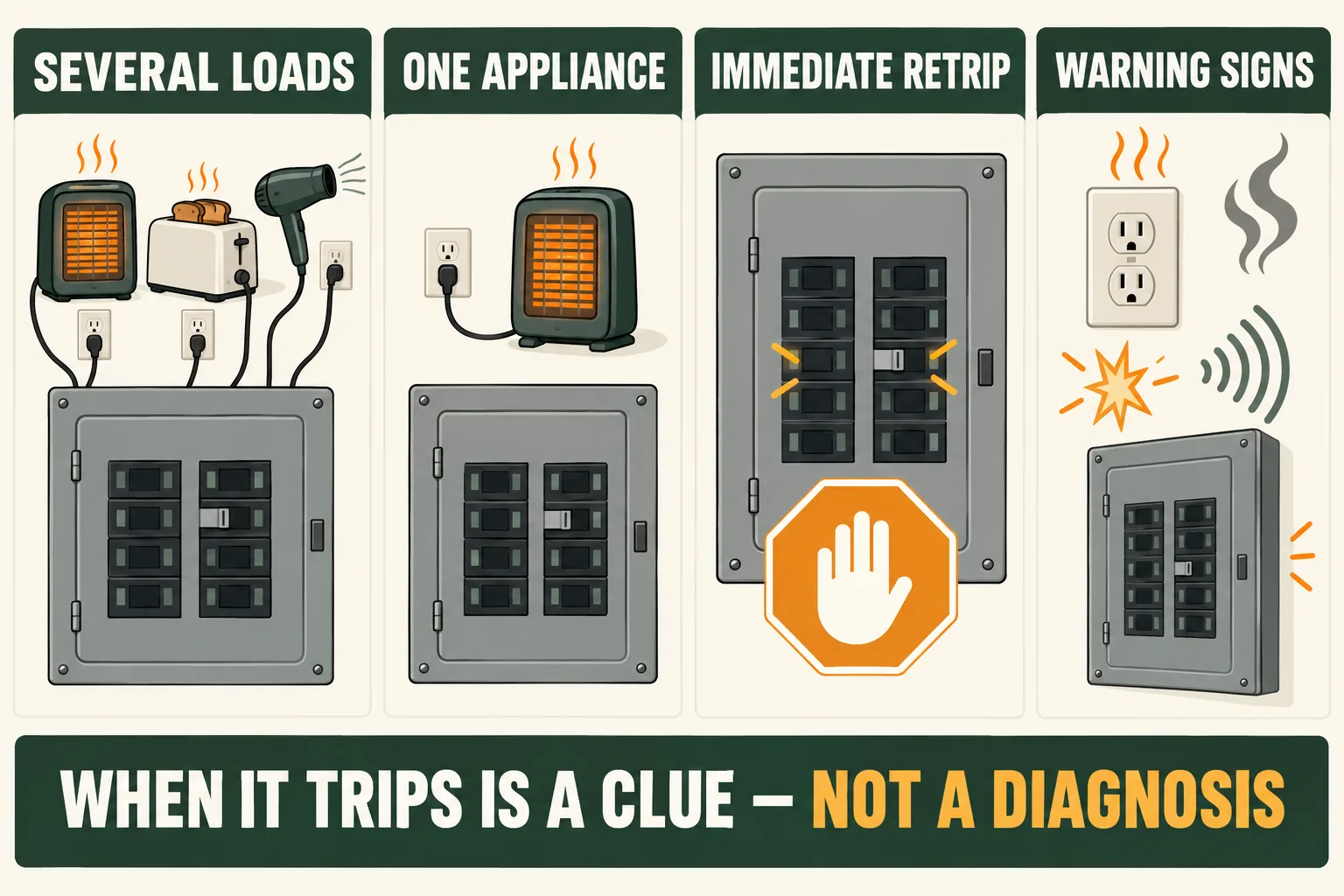
A circuit breaker that keeps tripping is responding to a condition that requires investigation, or there may be a problem involving the circuit, connected equipment, protective device, or installation. Several loads operating together makes overload more plausible; one repeatable appliance trigger focuses attention on that appliance-and-circuit relationship; and an immediate retrip calls for stopping rather than resetting again. GFCI and AFCI breakers can also respond to ground-fault or arc-fault conditions, not just excessive load. The pattern narrows the possibilities, but it does not identify the exact fault.
First: when does the breaker trip?
Begin with timing, not a guess about the hidden fault. A standard circuit breaker protects branch-circuit wiring from overcurrent caused by overload or short-circuit conditions. Breakers that also provide ground-fault or arc-fault protection can open for additional reasons. That is why the same visible result—a handle in the tripped position—can follow different physical conditions.
Identify the affected breaker only from its accessible face. Note which rooms and devices lose power, what was operating, and whether the trip is immediate or delayed. Do not remove the panel cover, inspect internal components, or deliberately repeat a trip to collect more evidence.
| Trip pattern | What it makes more relevant |
|---|---|
| Several loads run together before the trip | Combined circuit load becomes more plausible |
| One appliance repeatedly precedes the trip | The appliance, receptacle, and circuit relationship needs evaluation |
| Breaker trips immediately after one reset | An active fault or serious circuit/device problem may remain; stop resetting |
| Breaker trips after minutes or hours | Operating load, heat, intermittent equipment behavior, and protection type need context |
| Trip appears random | A written log may reveal a hidden load, moisture, or recurring condition |
| Heat, odor, buzzing, sparking, smoke, or water accompanies it | Stop troubleshooting and escalate according to the hazard |
What kind of breaker is tripping?
A plain thermal-magnetic breaker provides overcurrent protection. An AFCI breaker also looks for hazardous arcing patterns, a GFCI breaker also detects certain current imbalance associated with a ground fault, and a dual-function breaker combines AFCI and GFCI protection. Those functions matter because a trip may occur even when the connected load does not look unusually large.
Visible words such as AFCI, arc fault, GFCI, ground fault, or dual function—and an accessible TEST button—may help identify the device. Button colors, indicator lights, and trip codes vary by manufacturer and model, so use the label and the manufacturer's instructions rather than a universal color rule. A GFCI receptacle on a wall is a different device from a GFCI breaker in the panel.
If the breaker trips when several things are running
When each device runs alone but the breaker trips after several loads operate together, an overloaded branch circuit becomes more plausible. Portable heaters, hair dryers, cooking appliances, irons, and other high-demand equipment can be significant contributors, but the appliances you can see may not be the only loads on that circuit.
Reducing the immediate load may stop the trip, but it does not prove the circuit is adequate or resolve recurring capacity problems. Do not use extension cords or daisy-chained power strips as a permanent workaround, and do not move a high-demand appliance randomly between outlets; nearby outlets may share the same circuit. An electrician can identify the circuit, evaluate demand, and determine whether the installation needs correction or additional capacity.
If one appliance keeps tripping the breaker
A repeatable appliance trigger is important, but it does not prove the appliance is defective. The trip could involve the appliance, its cord or plug, the receptacle, the branch circuit, startup current, moisture, or the specific AFCI/GFCI response. Leave a suspect portable appliance unplugged and unused when you can do so safely; do not open or repair it from this symptom alone.
If lights also dip or flicker when the appliance starts, that is a related but separate observation. Use the appliance-start flicker guide to classify the lighting response, while treating the breaker trip as the stronger stop-and-investigate signal.
Do not keep moving the same appliance among outlets to find one that does not trip. Outlets in different rooms can share a circuit, and a device with an internal fault remains unsafe simply because another protective device has not opened yet. For a portable device, leaving it unplugged is an observation boundary—not a diagnosis or repair. Hardwired equipment should be left off and evaluated by the appropriate qualified technician and electrician.
For that companion symptom, see Why Do My Lights Flicker When an Appliance Turns On?.
If the breaker trips immediately after you reset it
An immediate or nearly immediate retrip deserves a conservative response. A fault or abnormal circuit/device condition may still be present. Do not keep cycling the handle, hold it on, tape it in position, or try to defeat the mechanism. Leave the circuit off and arrange qualified electrical evaluation.
This article does not provide a reset loop. A single normal reset after an understood temporary overload has been removed is different from repeatedly energizing a circuit that will not stay on. If the breaker trips again or the cause is unclear, stop there.
What delayed or seemingly random trips can tell you
A breaker that stays on for minutes or hours before tripping may be responding after load accumulates or equipment enters a later operating stage. Delayed timing does not automatically prove an overload; intermittent appliance behavior, wiring faults, ground-fault leakage, arc-fault detection, heat, and moisture can also be relevant depending on the circuit and protection.
Write down the breaker label, affected area, time, operating devices, weather or moisture context, and any sound, odor, or heat. Look for a naturally occurring pattern rather than repeatedly turning loads on to force a trip. A log gives an electrician better evidence without exposing you to live parts.
Overload, short circuit, ground fault, and arc fault are not interchangeable
A dual-function breaker combines AFCI and GFCI functions along with applicable overcurrent protection. On some products, visible indicators or a manufacturer-defined reset sequence can help a qualified person distinguish the recorded trip category. That information is model-specific: a button color, flash pattern, or handle position should not be generalized across brands. Record the visible label and model information only when safely readable; do not remove the dead front to find it.
Overload
Combined demand exceeds what the protected circuit is intended to carry. Several loads together are a useful clue, but one trip does not prove this diagnosis.
Short circuit or wiring fault
An unintended low-resistance connection or another wiring fault can create high current and operate overcurrent protection. Locating it requires de-energized professional testing, not opening receptacles, switches, junction boxes, or the panel.
Ground fault
Current takes an unintended path. GFCI protection monitors for a small imbalance and interrupts power to reduce shock risk. Moisture or damaged equipment may be relevant, but the trip does not reveal the location by itself.
Arc fault
AFCI protection is designed to recognize hazardous arcing patterns that an ordinary overload-only explanation may miss. Do not dismiss an AFCI trip as a nuisance or replace the device with ordinary protection merely to keep power on.
Could the breaker itself be bad?
A protective device can fail or be incompatible with the panel or circuit, but a bad breaker is not the default explanation for repeated trips. Replacement requires the correct type, rating, listing, and compatibility, plus an investigation of why the original device operated.
Do not swap breakers, remove the panel dead front, touch terminals or bus bars, or use a meter inside the panel. Manufacturer-specific indicator lights or diagnostic sequences can help a qualified electrician, but their meanings are not universal.
Why a larger breaker is not a generic fix
A breaker must be appropriate for the conductors, equipment, and circuit it protects. Installing a higher-amperage breaker merely because the existing one trips can allow wiring to carry more current than intended and defeat the protection against overheating.
There is no safe one-size-fits-all breaker-sizing chart for this symptom. Circuit conductor size, termination ratings, equipment instructions, code requirements, and installation conditions must be verified. Leave sizing and replacement to a qualified electrician.
Should you keep resetting a breaker that trips?
No. CPSC advises finding the cause rather than simply resetting a tripped breaker. After an understood temporary overload has been removed and there are no heat, odor, noise, damage, moisture, or fire indicators, one normal reset using only the accessible handle may restore the circuit. The handle on many breakers must first move fully to OFF before returning to ON, but the product instructions govern.
That limited action is not permission to retry an unexplained problem. If the breaker opens again, trips immediately, feels abnormal, will not latch normally, or you cannot identify a harmless temporary condition, leave it off and call an electrician. Do not stand in water, use wet hands, touch a wet panel, or approach equipment with smoke, sparking, severe heat, or visible damage. A breaker that will not reset at all is a narrower future intent; here, the safety boundary is the same—do not force it.
What you can safely check yourself
- Identify the tripped handle and read only visible labels or TEST-button markings.
- List the rooms, lights, outlets, and devices that lost power.
- Record whether several loads together or one device consistently precedes the trip.
- Distinguish an immediate retrip from a trip after minutes or hours.
- Note whether the device is a standard, AFCI, GFCI, or dual-function breaker when the accessible label makes that clear.
- Visually inspect accessible appliance cords and plugs for damage without handling hot, wet, melted, sparking, or smoking equipment.
- Leave a suspect portable appliance unplugged and unused until it is evaluated.
- Document heat, odor, buzzing, crackling, sparking, smoke, discoloration, water, or panel damage from a safe distance.
Warning signs that mean stop troubleshooting
Stop using the affected circuit and obtain prompt qualified help if trips accompany abnormal heat, a burning or melting odor, buzzing or crackling, discoloration, damaged insulation, visible sparking, moisture, or repeated loss of power. A warm receptacle or noise at an outlet is its own observable symptom and should remain unused rather than being tested again.
For smoke, flame, active arcing, rapidly melting material, or signs of an electrical fire, move away and call emergency services. Do not use water. Shut power off only if a normal disconnect can be reached without entering the hazard area; never approach a wet, smoking, sparking, or damaged panel.
If heat is the primary companion symptom, use Why Is My Outlet Warm? for its stop-use boundary.
If sound appears to come from a receptacle, use Why Does My Outlet Buzz? without opening the electrical box.
When to call an electrician
Arrange a qualified electrician for repeated trips, an immediate retrip, a breaker that will not remain on, a recurring one-appliance trigger, an AFCI or GFCI breaker that repeatedly opens without an obvious safely removable load, suspected wiring trouble, recurring overload, water exposure, or abnormal panel behavior. Reducing load may restore power temporarily, but it does not prove that recurring trips need no evaluation.
Give the electrician your trip log, the accessible breaker label and type, the affected rooms, and the device or load sequence. They can evaluate the circuit load, connected equipment, receptacles and wiring, breaker compatibility and condition, and manufacturer-specific trip information using de-energized and energized procedures appropriate to the work.
Bottom line
A circuit breaker that keeps tripping is doing something that requires investigation. Several simultaneous loads make overload more plausible; one repeatable device narrows the appliance-and-circuit relationship; an immediate retrip means stop resetting; and AFCI or GFCI protection can respond to conditions beyond ordinary overload.
Those patterns guide the next step but do not diagnose the exact electrical fault. Keep the panel closed, never upsize or bypass protection, avoid deliberate retripping, and escalate promptly when heat, odor, buzzing, sparking, smoke, water, damage, or repeated unexplained trips are present.
Sources
- Commission Closes Investigation of FPE Circuit Breakers and Provides Safety Information for ConsumersU.S. Consumer Product Safety Commission
- Guide to Home Wiring HazardsU.S. Consumer Product Safety Commission
- Understanding Your Home Electrical SystemElectrical Safety Foundation International
- Fuse and Breaker BreakdownElectrical Safety Foundation International
- Appliance Safety TipsElectrical Safety Foundation International
- How to Use GFCIsElectrical Safety Foundation International
- Arc Faults and Electrical SafetyElectrical Safety Foundation International
- Water-Damaged Electrical EquipmentElectrical Safety Foundation International
- Appliance and Electrical Fire SafetyU.S. Fire Administration
- QO Circuit Breaker Protection FAQsSchneider Electric