Diagnostic Guide
Why Do My Lights Flicker Randomly?
Random light flickering may be local to a bulb or fixture, or involve a room, service, or utility issue. Learn which scope and warning signs matter.
Short answer
What it usually means
Random light flickering can come from something as localized as a loose or failing bulb, a fixture or socket problem, or an incompatible LED and dimmer. Flickering across several lights, multiple rooms, or much of the house raises concern for a circuit connection, broader electrical-service condition, voltage disturbance, or utility-side problem. Start by recording where the flicker occurs, when it happens, and what else happens at the same time. Burning odor, smoke, sparking, crackling, hot electrical devices, repeated breaker trips, partial power loss, or dramatic bright-and-dim changes need prompt professional or emergency attention.
Start with one question: what lights are flickering?
The number and location of affected lights is the most useful first sorting clue. It cannot identify a failed wire or component, but it separates a lamp-level problem from patterns that may involve shared wiring or the incoming electrical supply.
| What flickers | What becomes more relevant |
|---|---|
| One bulb | The lamp itself, how it sits in the socket, lamp electronics, or compatibility with the control |
| One fixture | Its bulb or integrated LED, socket, fixture electronics, switch or dimmer, or a local connection |
| Several lights in one room | A shared switch or dimmer, branch-circuit load, or connection serving that area |
| Lights in several rooms | A broader branch, feeder, panel, neutral, service, or supply disturbance |
| Most or all of the house | Service-level or utility-side voltage behavior becomes more plausible and deserves prompt evaluation |
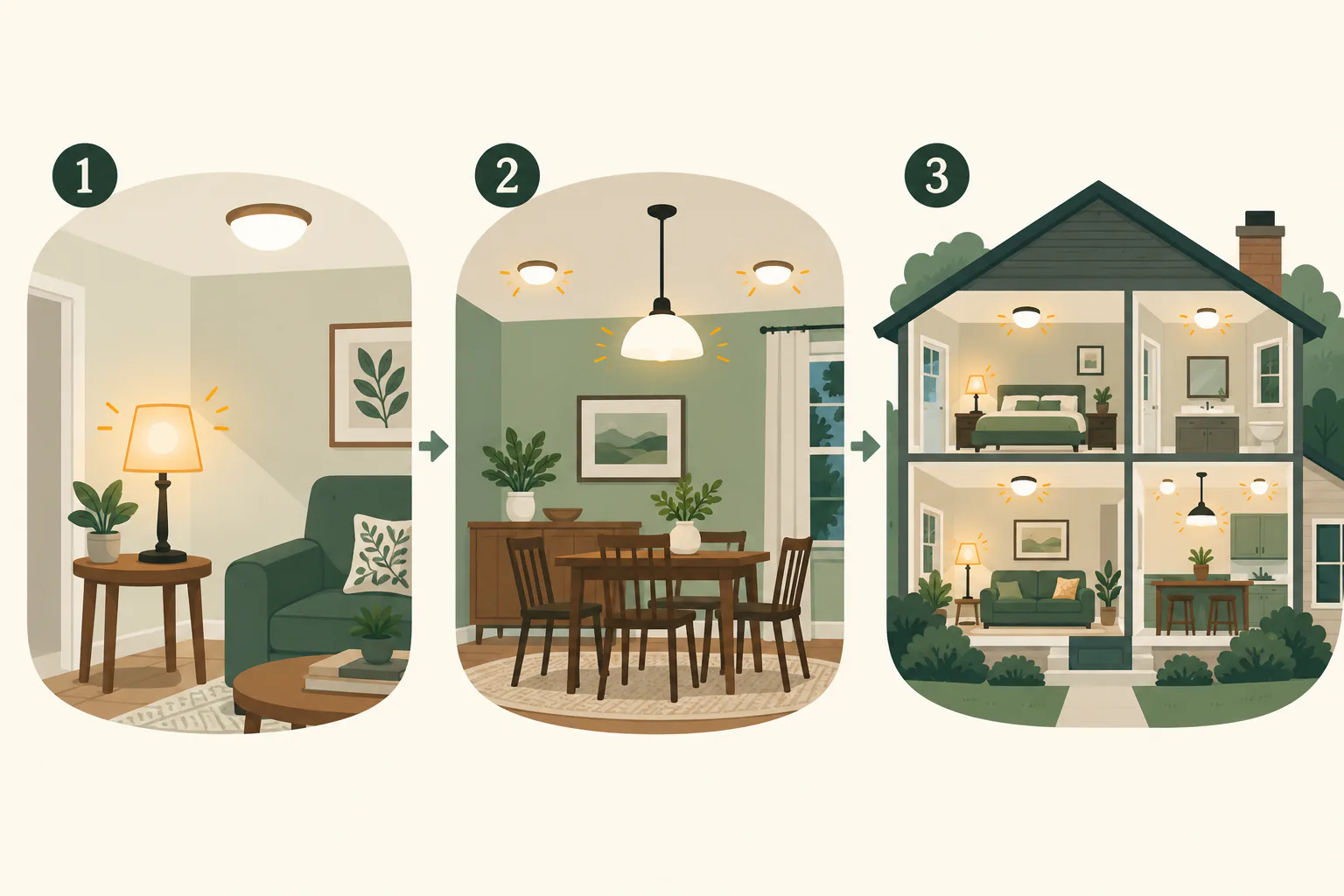
One bulb or one fixture is the narrowest pattern
When only one replaceable bulb flickers while every other light stays steady, begin with the lamp rather than the whole electrical service. A loose or failing lamp, damaged contact, or electronic driver can interrupt light output. With the switch off and the lamp cool, follow the fixture and bulb manufacturers' instructions for seating or replacing that user-serviceable lamp. Do not reach into a socket, bend contacts, or work on fixture wiring.
If every lamp in one fixture flickers together, or an integrated LED fixture flickers, the fixture, its driver, switch, dimmer, or connection becomes more relevant. A new lamp that begins flickering immediately after installation also makes lamp type, wattage, dimmability, and control compatibility worth checking. Persistent fixture-level flicker without a clear lamp explanation belongs with a licensed electrician rather than a live-socket experiment.
A bulb that changes when the fixture is bumped
Movement-related flicker can be consistent with poor contact, but do not keep tapping or twisting an energized lamp to reproduce it. Switch it off, avoid the fixture if there is heat, damage, odor, or crackling, and arrange service when a normal manufacturer-approved lamp check does not resolve the symptom.
An integrated LED that flickers
There may be no replaceable bulb. The LED driver, fixture, control compatibility, or supply to the fixture may be involved. Do not open an integrated fixture or its junction box for diagnosis.
Several affected lights change the diagnostic picture
When multiple lights flicker together, a single bad bulb becomes a weaker explanation. Lights in one room may share a switch, dimmer, branch circuit, or connection. Note whether all lights respond together or one fixture behaves independently.
Several rooms—or lights on different circuits—raise the scope. Feeders, panel or service connections, a neutral problem, larger loads, and utility voltage disturbances may become relevant. The homeowner cannot safely distinguish those possibilities by opening the panel, and room location alone does not reveal the wiring layout.
Substantial opposing changes deserve particular attention: if some lights become unusually bright while others dim, stop treating the symptom as ordinary lamp flicker. A neutral or broader supply-voltage problem is one possible explanation, and prompt licensed evaluation is appropriate.
When does the flickering happen?
A symptom that feels random may have a trigger you have not identified yet. Keep a short log of the time, affected rooms, duration, weather, dimmer setting, and appliances operating. Correlation is a clue, not proof of causation.
| Timing pattern | Useful direction |
|---|---|
| Completely unpredictable | Record scope and companion symptoms; intermittent connections, controls, lamps, and supply events remain possible |
| After a light has been on for a while | Lamp or fixture temperature, driver behavior, a dimmer, or a connection may become more relevant |
| At a low dimmer setting | LED/dimmer compatibility or the control's supported dimming range deserves attention |
| When HVAC or another appliance starts | The pattern is no longer random; route it to the appliance-triggered guide |
| During wind or storms | A utility or service connection may be involved, but do not inspect exterior electrical equipment |
| At similar times of day | Look for repeated household loads or utility patterns without assuming the clock proves a cause |
| Becoming more frequent | Escalate sooner, especially when several lights or warning symptoms are involved |
Could it actually be an appliance or AC starting?
Central air conditioners, heat pumps, refrigerators, well pumps, dryers, microwaves, and other loads can cycle without attracting attention. Compare the flicker time with a compressor starting, a motor engaging, or a high-draw appliance operating.
If the same appliance repeatedly coincides with the brightness change, you have found a trigger—not necessarily a diagnosis. The size, duration, severity, affected area, and equipment behavior still matter. A tiny momentary startup dip is different from severe, repeated, prolonged, or house-wide fluctuation.
When AC, a refrigerator, dryer, microwave, pump, or another load reliably triggers the symptom, use Why Do My Lights Flicker When an Appliance Turns On? for the load-specific explanation and escalation signs.
Can LED bulbs or dimmers cause intermittent flicker?
Yes. Manufacturer guidance documents flicker when a non-dimmable LED is used with a dimmer, when a dimmable lamp and control are not compatible, or when some combinations operate near the low end of their supported range. A problem that began after changing bulbs or dimmers, affects only LEDs, or appears at one dimmer position supports this path.
Check the lamp packaging, model documentation, and the dimmer manufacturer's compatibility list. Do not assume the word “dimmable” guarantees compatibility with every control. Also do not use compatibility as a blanket explanation when multiple non-dimmed fixtures or several rooms flicker together.
A failing lamp or fixture can also flicker. If a correctly specified replacement behaves normally in a safely user-serviceable fixture, that is useful evidence. Do not swap lamps when the fixture is hot, damaged, crackling, sparking, or producing odor.
What else happens at the same time?
Accompanying symptoms determine urgency. Treat them as a pattern rather than trying to name the internal fault.
| Companion symptom | Why it matters |
|---|---|
| Buzzing or crackling at a fixture, switch, or receptacle | May indicate a stressed device, poor contact, or arcing; stop using the affected equipment and arrange evaluation |
| Warm or hot electrical device | Heat with flicker makes a connection or equipment problem more concerning |
| Burning or hot-plastic odor, discoloration, or melting | Stop use; these are electrical damage and fire-warning signs |
| Breaker trips repeatedly | Do not keep resetting it or substitute a larger breaker |
| Partial power loss | A broader circuit, service, or utility condition may be involved |
| Some lights brighten while others dim | Promptly evaluate possible neutral or supply-voltage trouble |
| Visible sparking, arcing, smoke, or fire | Move away and use emergency services; do not continue troubleshooting |
What you can safely check yourself
- Map the symptom: one bulb, one fixture, one room, several rooms, or most of the house.
- Record when it happens, how long it lasts, and whether the pattern is worsening.
- Note dimmer position, bulb type, recent lamp changes, and manufacturer-listed compatibility.
- With the switch off and the lamp cool, follow manufacturer instructions for a user-replaceable bulb; do not touch socket contacts.
- Watch for a repeatable AC, refrigerator, microwave, dryer, pump, heater, or other appliance trigger.
- Note breaker trips, partial power, unusual brightness, buzzing, crackling, odor, heat, or visible damage.
- Ask whether nearby neighbors noticed similar voltage behavior when the whole-house pattern suggests a supply issue.
- Record a short video from a safe location so an electrician can see an intermittent event.
When random flickering is more concerning
Arrange a licensed electrician when flicker repeats or worsens, affects multiple fixtures or rooms, cannot be explained by a user-replaceable lamp and documented control compatibility, or comes with abnormal electrical behavior. An electrician can evaluate the fixture, branch circuits, connections, neutral, panel, feeders, and service without turning observation into unsafe live testing.
Stop using affected equipment when safe to do so if flicker accompanies a hot switch, outlet, plug, fixture, or appliance; buzzing or crackling; burning odor; damage; breaker trips; or partial power. For active arcing, smoke, fire, severe burning odor, or visibly damaged energized equipment, move away and call emergency services.
If one receptacle or switch is the obvious source of heat or noise, avoid it and have that localized device evaluated. The random-flicker guide does not replace receptacle-specific diagnosis.
When the electric utility may need to be involved
Utilities recognize flickering lights, high or low voltage, and partial power as possible voltage complaints. Contacting the utility is reasonable when much of the house is affected, neighbors report similar behavior, the symptom follows storms or wind near service equipment, or a licensed electrician believes the disturbance is upstream.
Do not assume every whole-house flicker belongs to the utility. Problems in the home's service equipment or wiring can create similar symptoms, and responsibility boundaries vary. An electrician may need to evaluate the property-side system while the utility investigates its supply.
Never approach a damaged service drop, meter, mast, or exterior conductor. Stay away from downed or arcing lines and follow the utility's emergency reporting instructions.
Bottom line
Random flickering is a description, not a diagnosis. First establish scope: one lamp, one fixture, one room, several rooms, or the whole house. Then record timing and companion symptoms. A lamp or documented LED/dimmer mismatch may explain a narrow pattern; repeated multi-room changes, brightening and dimming, heat, noise, odor, trips, or partial power deserve professional attention.
If observation reveals that the same appliance or AC startup consistently triggers the flicker, use the appliance-triggered guide rather than treating the event as random. The goal is to hand an electrician or utility a reliable pattern—not to identify energized wiring from the outside.
Sources
- Guide to Home Wiring HazardsU.S. Consumer Product Safety Commission
- Electrical Safety DosElectrical Safety Foundation International
- Maestro PRO Troubleshooting GuideLutron
- Light Fixtures (Downlights)ENERGY STAR
- Why Is My LED Bulb Flickering?Philips Hue
- Report a Voltage ProblemPG&E
- About Voltage DisturbancesHydro One