Diagnostic Guide
Why Does My GFCI Outlet Keep Tripping?
GFCI outlet keeps tripping? Use the timing, connected loads, downstream outlets, moisture, and warning signs to narrow the pattern safely.
Short answer
What it usually means
If a receptacle-type GFCI resets normally but trips again later, it is responding to a condition on the protected circuit or the device itself may require evaluation. The timing matters: a trip when one appliance starts, during rain, after hours of operation, or with nothing plugged into the GFCI face points toward different parts of the protected circuit. It does not identify the exact fault. Leave suspect equipment unused, do not keep resetting the GFCI, and stop immediately for heat, odor, buzzing, sparking, smoke, damage, or moisture.
First: check for warning signs
Do not touch or reset a GFCI receptacle that is hot, wet, cracked, discolored, melted, buzzing, crackling, sparking, smoking, or giving off a burning odor. Do not operate electrical equipment while standing in water or with wet hands. Those conditions require qualified electrical evaluation rather than another reset attempt.
For active smoke, flame, or arcing, move away and call emergency services. Never use water on energized electrical equipment. If water reached a receptacle, cord, appliance, box, or wiring, a dry-looking surface does not establish that the equipment is safe to reenergize.
When does the GFCI trip?
A receptacle-type ground-fault circuit interrupter, or GFCI, compares current leaving and returning through the conductors it protects. It opens the circuit when it detects the kind of imbalance associated with current taking an unintended path. That is different from using the receptacle as an overload meter, and the trip does not reveal the exact path or component.
Write down the first condition that precedes each trip instead of deliberately recreating it. The most useful distinctions are whether RESET holds at first, whether one load is repeatable, whether weather or water use matters, whether the delay is consistent, and whether other protected outlets lose power too.
| Pattern | What becomes more relevant |
|---|---|
| RESET will not hold at all | Reset failure or an immediate continuing condition |
| One appliance precedes each trip | That appliance, cord, use conditions, and its circuit relationship |
| Trips only with a certain combination of loads | Which added load changes the pattern; not an automatic overload diagnosis |
| Trips during or after rain or water use | Moisture affecting any protected device or equipment |
| Trips with nothing in the GFCI face | Downstream loads, hardwired equipment, circuit conditions, or the device |
| Trips after minutes or hours | Equipment operating cycles, moisture, intermittent conditions, and downstream loads |
| Trips seemingly at random | A log of load, weather, and timing before qualified diagnosis |
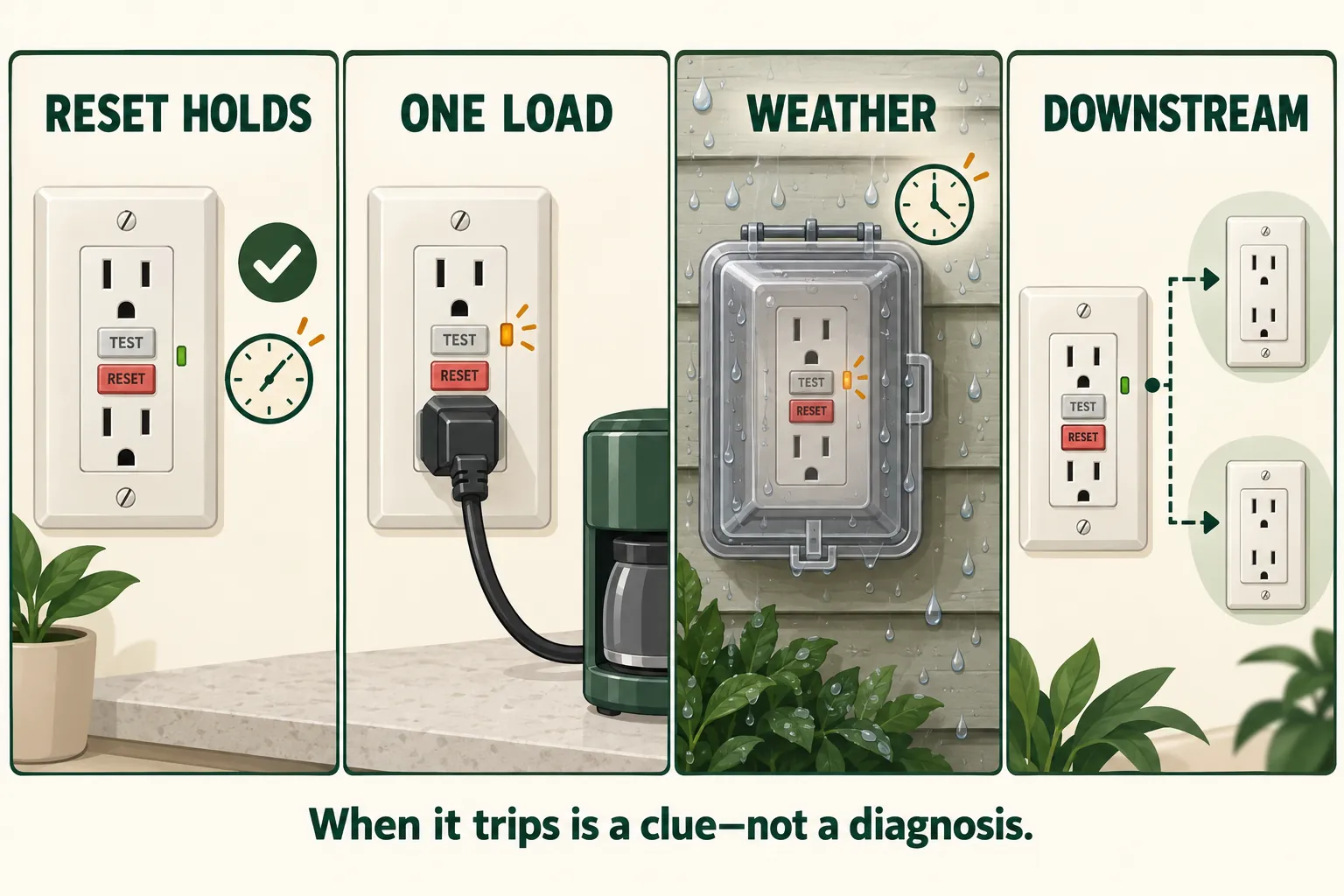
Does it reset normally before it trips again?
This guide is for a GFCI receptacle that accepts a normal reset, provides power, and then opens again later. If RESET will not engage, will not stay in, immediately releases, or the device remains dead during the reset attempt, that is a reset-failure pattern. Do not keep pressing the button to turn one symptom into the other.
The distinction matters because a later trip gives you an operating condition to record. An immediate release says only that the device cannot remain in its normal reset state under the present condition. Neither pattern identifies the hidden fault by itself.
If the button will not engage or immediately releases during the reset attempt, use Why Won’t My GFCI Outlet Reset?.
What if one appliance triggers the trip?
If the same portable appliance consistently precedes the trip, that appliance, its cord, its operating environment, and its relationship to the protected circuit become important. A damaged cord, internal equipment leakage, or moisture around the equipment can be relevant. But correlation does not prove the appliance alone is defective; the appliance may expose a circuit, receptacle, or environmental problem.
When the appliance is dry, cool, intact, and safe to handle, unplug it and leave it unused rather than repeating the trip. Do not open or repair it, move a wet appliance, or try several unprotected outlets to keep it running. Give an electrician or qualified appliance servicer the make, model, operating stage, and timing you observed.
What if it trips when several things are running?
A combination pattern is useful, but it does not automatically mean the receptacle GFCI tripped because the circuit drew too many amperes. GFCI protection responds to current imbalance; a standard branch-circuit breaker provides overcurrent protection. A GFCI circuit breaker can provide both functions, which is one reason identifying the device matters.
Record which additional device changes the pattern and whether the receptacle GFCI or the panel breaker opens. Several electronic or motor-driven loads can also make circuit diagnosis more complex, but do not label the event a harmless nuisance trip. Persistent combination-related trips deserve evaluation rather than load shuffling as a permanent solution.
If the normal breaker handle in the panel is the device that repeatedly opens, use Why Does My Circuit Breaker Keep Tripping?.
Does rain, humidity, or water use change the pattern?
GFCIs are commonly installed where electricity and moisture can meet, so a trip during rain, irrigation, cleaning, bathing, or appliance water use deserves special attention. Moisture may affect an outdoor receptacle, light, cord, pump, appliance, box, or another protected device—not necessarily the GFCI face where you press RESET.
Do not assume a weather cover makes every internal component dry, and do not open a cover or unplug equipment while the area is wet. Do not dry electrical equipment with a hair dryer or repeatedly reset after the rain stops. Water-damaged electrical equipment requires qualified evaluation before reuse.
Why can it trip with nothing plugged into the GFCI?
The two sockets on the GFCI face may be only part of what the device protects. A receptacle GFCI can protect additional receptacles connected downstream on the same branch circuit. Outdoor equipment, another room, or a load that does not appear physically close may therefore lose power or contribute to the condition.
Some protected circuits may also include equipment the homeowner should not disconnect or dismantle. Nothing plugged into the visible face does not mean there is no load and does not prove the GFCI itself is bad. Map what else lost power, but do not remove faceplates, open boxes, inspect LINE or LOAD terminals, or trace energized wiring.
If the main symptom is an ordinary receptacle that has no power, use Why Does One Outlet Have No Power?.
How do downstream outlets change the diagnosis?
Downstream describes electrical order, not physical distance. One GFCI can interrupt power to other receptacles wired from its protected side, so a fault or moisture condition elsewhere can operate the device you see. The closest outlet is not necessarily first on the circuit, and room boundaries are not circuit maps.
Note which outlets and appliances lose power with the GFCI and which remain on. That map gives an electrician useful information without exposing wiring. Do not hunt for the first downstream receptacle by pulling devices from boxes, and do not reset every GFCI in the home repeatedly in hopes that one stays on.
Check visible cords and plugs—without opening anything
Look only at accessible cords, plugs, and equipment exteriors. Cuts, crushed insulation, loose or bent plug blades, burn marks, cracked housings, missing covers, or evidence of water exposure are reasons to stop using the item. Do not wrap a damaged cord and continue testing it, and do not handle equipment that is hot, wet, sparking, smoking, or giving off an odor.
Surface appearance cannot clear an appliance or circuit. Equipment can have an internal problem with no obvious mark, while a worn-looking item may not be the cause of this trip. Visible damage strengthens the case for service or replacement; an intact exterior does not rule out a fault.
What if it trips after hours or seems random?
A delayed trip can coincide with an appliance cycle, defrost heater, pump, outdoor moisture, temperature change, or an intermittent circuit condition. It does not automatically prove overload, and it does not become safe merely because the GFCI operated normally for several hours first.
Keep a short log of the time, weather, water use, and equipment operating just before the trip. Do not create a test marathon or intentionally repeat a hazardous event. If no pattern emerges after ordinary observation, an electrician can evaluate the protected circuit and equipment with appropriate instruments rather than guessing from the button.
Could the GFCI outlet itself be failing?
Yes. A GFCI receptacle can be damaged, wear out, or reach a self-test or end-of-life state. But device failure should not be the default diagnosis because moisture, a connected load, downstream equipment, or a wiring condition can produce a similar recurring-trip pattern.
Status lights and self-test behavior vary by manufacturer and model. Read the exact instructions for the visible device; do not apply another brand’s color chart. Replacing the GFCI is not a neutral diagnostic experiment because device type, rating, listing, location, circuit protection, and LINE/LOAD installation all matter.
Is it the GFCI receptacle or the circuit breaker?
A receptacle GFCI has TEST and RESET controls at the outlet and can protect its face plus properly connected downstream loads. A GFCI circuit breaker sits behind the closed panel door and combines branch overcurrent protection with ground-fault protection. A standard breaker protects against overcurrent but does not provide GFCI protection in the same way.
Identify only what is visible without removing covers. If both a receptacle GFCI and a breaker are involved, record which device opens first rather than cycling both. If the breaker will not reset, immediately retrips, or repeatedly trips later, use the breaker-specific guide and stop restoring power.
For a breaker that will not latch or immediately retrips, use Why Won’t My Circuit Breaker Reset?.
For a breaker that resets and trips again later, use Why Does My Circuit Breaker Keep Tripping?.
What you can safely check yourself
- Confirm that the tripping device is a receptacle GFCI with accessible TEST and RESET buttons, not a breaker in the panel.
- Record whether RESET holds before the later trip and how long it stays set.
- Note which ordinary portable loads were operating and which one, if any, repeatedly precedes the trip.
- Map which other receptacles and loads lose power without opening boxes or tracing wiring.
- Compare the timing with rain, irrigation, bathing, cleaning, or appliance water use.
- Inspect only visible, accessible cords, plugs, covers, and equipment exteriors for damage.
- Read the exact manufacturer instructions for status lights and normal test/reset operation.
- Stop for heat, odor, buzzing, crackling, sparking, smoke, discoloration, damage, or moisture.
What not to do
- Do not keep resetting a GFCI that repeatedly trips.
- Do not hold, tape, wedge, or otherwise force RESET to stay engaged.
- Do not replace GFCI protection with an ordinary receptacle or bypass protected downstream wiring.
- Do not move a suspect wet or damaged load to another circuit just to keep it operating.
- Do not remove covers, pull receptacles from boxes, inspect terminals, or repair wiring from this guide.
- Do not treat every recurring trip as overload or as harmless nuisance tripping.
- Do not handle wet equipment or approach a panel while standing in water.
When to call an electrician
Arrange qualified electrical evaluation when the GFCI trips repeatedly; the trigger is unclear; a hardwired or downstream load may be involved; the trip follows rain or water use; the protected area cannot be mapped safely; the device shows an unfamiliar persistent indication; or receptacle, wiring, or device failure is possible. A persistent trip remains worth investigating even if disconnecting one load temporarily stops it.
Use faster escalation for abnormal heat, burning odor, buzzing, crackling, discoloration, melting, visible sparking, smoke, physical damage, or water exposure. For active fire, smoke, or arcing, move away and call emergency services. Shut power off only if a normal disconnect can be reached without entering the hazard area.
If the receptacle is abnormally warm, follow Why Is My Outlet Warm?.
If it buzzes, hums, sizzles, or crackles, use Why Does My Outlet Buzz? without opening the box.
Bottom line
A GFCI outlet that resets and then trips again is reporting a recurring protected-circuit condition or a device problem that needs investigation. Use timing, connected loads, downstream scope, rain or water correlation, and visible warning signs to narrow the pattern. Those observations do not identify the exact electrical fault.
Leave suspect equipment unused, preserve GFCI protection, and keep all checks outside boxes and panels. If the trip repeats, moisture may be involved, the protected circuit is unclear, or any heat, odor, noise, sparking, smoke, or damage appears, stop troubleshooting and call a qualified electrician.
Sources
- GFCI Fact SheetU.S. Consumer Product Safety Commission
- How to Use GFCIsElectrical Safety Foundation International
- Ground Fault Circuit InterruptersElectrical Safety Foundation International
- Water-Damaged Electrical EquipmentElectrical Safety Foundation International
- GFCI Personal Protection Devices Testing and CertificationUL Solutions
- What to Do When Your GFCI Trips: A Homeowner’s GuideLeviton
- Self-Test GFCI Receptacle Installing and Testing InstructionsEaton
- Appliance and Electrical Fire SafetyU.S. Fire Administration