Diagnostic Guide
Why Is There No Power in One Room?
One room has no power but the rest of the house does? Map what stopped working, check the breaker and accessible GFCIs, and know when to call an electrician.
Short answer
What it usually means
If one room appears to have no power while the rest of the home still does, first map exactly which lights, receptacles, and built-in loads stopped working. A tripped breaker or GFCI may have interrupted the branch circuit, but a room can be served by more than one circuit and one circuit can serve outlets in more than one room. If only part of the room is out, a switched receptacle, downstream GFCI protection, or a circuit or connection problem may be involved. Check only accessible controls and labels; stop for heat, burning odor, buzzing, sparking, smoke, water, or a breaker that trips again.
First: what exactly lost power?
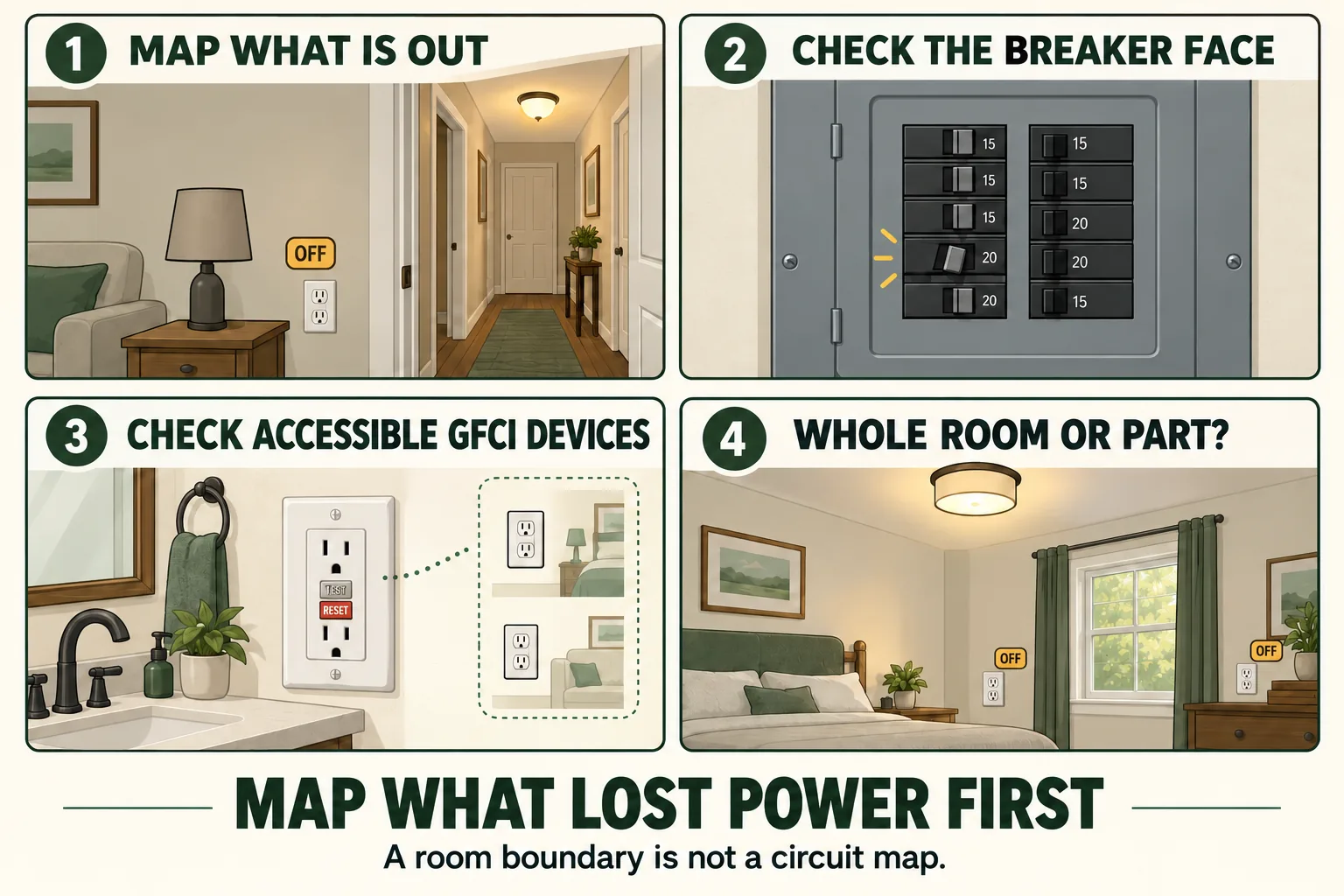
Start by making a simple map. Check which ceiling lights, lamps, receptacles, hardwired fans, and built-in equipment have stopped working, and which still operate. Include the hallway or adjacent room. The useful unit is the set of affected electrical loads—not the name of the room.
A branch circuit is the protected wiring between the final overcurrent device and the outlets it serves. General-purpose circuits can supply multiple lighting or receptacle outlets, so wall boundaries do not reliably show circuit boundaries. One room may use two or more circuits, while one circuit may continue into another room.
| What you observe | What it makes worth checking |
|---|---|
| Every light and receptacle in the room is out | A breaker, GFCI, or shared circuit interruption becomes more relevant |
| Lights work but receptacles do not | Separate circuits, a switched receptacle, or downstream protection may explain the split |
| Some receptacles work and others do not | Map the exact group; do not assume the whole room is on one circuit |
| The hall or another room also lost selected loads | The affected circuit may cross room boundaries |
| Only one receptacle is dead | That is a narrower one-outlet symptom, not necessarily a room outage |
Stop before checking if there are electrical warning signs
Do not touch the panel, receptacles, switches, plugs, or appliances if you see smoke or sparking, smell burning or melting material, hear crackling or abnormal buzzing, notice unusual heat or discoloration, or find water on or near electrical equipment. Move away from active fire, smoke, or arcing and call emergency services. Never use water on an electrical fire.
If electrical equipment is wet, or you would have to stand in water to reach a breaker or GFCI, do not approach it. Have the hazard made safe by the appropriate emergency responder, utility, or qualified electrician.
Is the whole room out—or only part of it?
If the ceiling light works but several receptacles do not, or one wall of receptacles is out while another still works, the room is not experiencing one uniform outage. That pattern may simply reflect more than one branch circuit, a switched load, GFCI feed-through protection, or a fault affecting only one portion of a circuit.
Do not use a working receptacle as proof that the room's wiring is healthy. It may be on a different circuit. Likewise, a dead receptacle beside a working one does not reveal where the interruption is. Record the pattern for an electrician instead of opening devices to trace it.
Confirm that the outage is actually limited to one area
Check a few known loads elsewhere in the home before treating this as a room-level problem. If an entire home is dark, the service, utility supply, main disconnect, or another broad condition belongs to a different diagnostic path. If roughly half the home, major 240-volt equipment, or seemingly unrelated groups of circuits are affected, do not force that pattern into a one-room explanation; contact the utility or an electrician according to local guidance and the observed hazard.
A true localized pattern usually leaves most of the home operating while a specific group of lights, receptacles, or built-in loads is out. Even then, compare adjacent spaces. A hallway light, closet receptacle, or bathroom outlet may share the affected branch circuit, while a ceiling light inside the dark room may remain on because it is supplied separately.
In a multifamily building, also distinguish a problem inside the unit from a building outage. Check only normal indicators available to you and contact building management when appropriate. Do not enter electrical rooms, utility spaces, meter enclosures, or panels you are not authorized to access.
Why several loads can go dead together
Receptacles and lights are connected as parts of branch circuits, not as independent utility feeds. When a breaker or protective device opens, every load supplied through that protected path can lose power together. A GFCI receptacle wired for feed-through protection can similarly interrupt its face and downstream receptacles, which is why the reset device may be outside the room that looks dead.
A connection or device problem can also interrupt power beyond that point in a circuit. This is sometimes described as an open circuit, but the outage map cannot reveal whether the interruption is at a receptacle, switch, splice, fixture, conductor, breaker, or another component. Which loads remain energized depends on the actual wiring layout, not their physical distance from the panel or doorway.
That is why claims such as ‘the first dead outlet is the bad one’ or ‘the closest outlet to the panel must be upstream’ are not reliable homeowner rules. Locating an open connection requires the circuit to be made safe and tested by a qualified person. Do not open boxes in search of a loose wire.
Check the accessible breaker face
From the normal accessible front of the panel, read the directory and look for a branch-breaker handle that is in OFF or between ON and OFF. A tripped breaker may not look fully off. Panel labels can be incomplete or inaccurate, so compare the affected loads rather than trusting a room name alone.
If there are no warning signs, the panel is dry and undamaged, and the manufacturer permits normal homeowner operation, a tripped breaker generally must be moved fully to OFF before it can return to ON. Use only the handle. Do not remove the dead front, touch internal components, or stand on a wet surface.
If the breaker repeatedly trips after power is restored, use Why Does My Circuit Breaker Keep Tripping? to classify the trigger.
If the handle will not return to and stay in the normal ON position, use Why Won’t My Circuit Breaker Reset? and stop rather than forcing it.
Could a GFCI elsewhere have shut off the room?
Yes, depending on how the circuit was wired. A GFCI receptacle can protect its own face and receptacles connected downstream on its load side. Manufacturer instructions explicitly note that those protected receptacles can be in different rooms. A GFCI breaker can protect the entire branch circuit.
Look only at accessible GFCI devices in bathrooms, kitchens, garages, basements, laundry areas, outdoors, or other locations where protection may be installed. The relevant device may not be in the dark room. Follow the marked or manufacturer-provided normal reset instructions only when the device is dry, intact, cool, and free of odor, noise, discoloration, or damage.
If a GFCI will not reset, trips again, has no power, or shows an unfamiliar status indication, leave it alone. Its behavior varies by model, and a downstream outage does not prove the GFCI itself is defective. Do not remove the receptacle, swap line and load conductors, or bypass the protection.
Could a wall switch control the apparently dead outlet?
Some homes use wall switches to control a receptacle or one half of a duplex receptacle, often for a lamp. If one outlet or one half appears dead while the rest of the room works, try the room's ordinary wall switches with a known-working lamp only when the outlet and plug show no warning signs.
This is a simple configuration check, not electrical diagnosis. Do not remove the switch or receptacle cover. If multiple loads have unexpectedly lost power, continue mapping the affected group rather than assuming a switch explains the whole outage.
What happened just before the power went out?
Timing can narrow the categories. Note whether the outage followed use of a portable heater, vacuum, hair dryer, window air conditioner, or several loads together; a storm or water leak; moving furniture; renovation; a fastener driven into a wall; receptacle or lighting work; or electrical service. These clues do not identify the fault, but they help a qualified electrician decide where to start.
If one appliance was running when power was lost, leave that portable appliance unplugged and unused when you can do so without touching anything hot, wet, damaged, smoking, or sparking. Do not repeatedly reconnect it to different outlets to reproduce the outage.
What if every breaker appears to be on?
First, remember that a tripped handle can rest near the middle and that panel directories may be wrong. Then check accessible GFCIs and the whole-versus-part pattern. If those observations do not explain the outage, an open connection, damaged device, branch-circuit problem, protective-device problem, or another installation condition may require professional diagnosis.
A connection can interrupt power to more than one downstream load, but the visible outage cannot identify which connection or conductor is involved. Do not search for it by opening receptacles, switches, fixtures, junction boxes, or the panel. A breaker itself can malfunction, but it is not the default explanation and replacement is panel work for a qualified electrician.
What if only one outlet has no power?
A single dead receptacle is narrower than the symptom this page owns. First confirm that lights and other receptacles in the room work, check whether a wall switch controls it, and note whether an accessible GFCI has tripped. Do not insert tools, remove the cover plate, or open the box.
If just one receptacle remains dead, is loose, warm, discolored, damaged, or makes noise, leave it unused and have it evaluated. A future one-outlet guide can own that narrower search intent; this page remains focused on multiple loads in one perceived room or area.
Do not power the room with extension cords
Running extension cords from another room does not repair or diagnose the outage. It can create trip hazards, overload a different circuit, place cords where they can be pinched or covered, and encourage continued use before the electrical problem is understood. Extension cords are temporary products, not substitutes for permanent household wiring.
Do not backfeed the room through receptacles, use male-to-male cords, daisy-chain power strips, or connect major appliances through ordinary extension cords. Preserve essential needs through a safe alternative plan while a qualified person evaluates the circuit.
What you can safely check yourself
- Map every working and nonworking light, receptacle, and built-in load in the room.
- Check whether selected loads in the hall or adjacent room are also out.
- Read visible panel labels and observe accessible breaker handles without removing the dead front.
- Check accessible, dry, intact GFCI receptacles and follow only their normal manufacturer reset instructions.
- Try ordinary wall switches that may control a receptacle or light.
- Note what equipment was running and whether recent work, a storm, moisture, or physical damage preceded the outage.
- Document heat, burning odor, buzzing, crackling, sparking, smoke, discoloration, melting, or water from a safe distance.
When to call an electrician
Arrange qualified electrical evaluation when no accessible breaker, GFCI, or switch explains the outage; a breaker or GFCI will not reset; power returns and fails again; several loads remain dead while other loads in the room work; recent electrical work or physical damage preceded the loss; or the affected circuit map is unclear. An electrician can de-energize and test the circuit, verify protective devices, and locate an open or damaged connection without guessing from room boundaries.
Seek prompt help and leave the affected circuit off for abnormal heat, burning odor, buzzing or crackling, discoloration, melted material, water exposure, or panel damage. For active smoke, flame, or arcing, move away and call emergency services. Shut off power only if a normal disconnect can be reached without entering the hazard area.
If heat is centered at a receptacle, follow the stop-use guidance in Why Is My Outlet Warm?.
If a receptacle buzzes, hums, sizzles, or crackles, use Why Does My Outlet Buzz? without opening the box.
Bottom line
When one room appears to have no power, map the affected loads before assigning a cause. Whole-room versus partial-room loss, the breaker position, accessible GFCI status, switch-controlled loads, and recent events can narrow the problem, but they do not identify a hidden fault.
Room boundaries are not circuit boundaries. If normal accessible checks do not restore power once, if protection will not reset or opens again, or if any heat, odor, noise, sparking, smoke, damage, or moisture is present, stop and call a qualified electrician.
Sources
- CPSC Guide to Home Wiring HazardsU.S. Consumer Product Safety Commission
- Commission Closes Investigation of FPE Circuit Breakers and Provides Safety Information for ConsumersU.S. Consumer Product Safety Commission
- Understanding Your Home Electrical SystemElectrical Safety Foundation International
- Fuse and Breaker BreakdownElectrical Safety Foundation International
- How to Use GFCIsElectrical Safety Foundation International
- Branch Circuit DefinitionNational Fire Protection Association
- GFCI Line/Load ReversalLeviton
- Appliance and Electrical Fire SafetyU.S. Fire Administration