Comparison Explanation Guide
Can Replacing HVAC Registers Improve Airflow?
New HVAC registers can improve airflow only when the outlet is a meaningful restriction. Learn how to separate a register problem from duct, return, filter, or blower limits.
Short answer
What it usually means
Replacing an HVAC register can improve airflow when the existing outlet is partly closed, damaged, heavily obstructed, or measurably more restrictive than an appropriate replacement. But the register is only the last part of the air path. A new or larger face cannot create airflow that the blower, filter, return path, trunk, branch duct, boot, or balancing setup is not delivering. First determine whether the outlet itself is restricting air, whether the problem affects one outlet or many, and whether the apparent change is actual air volume or only a different throw, spread, noise level, or draft sensation.
First: is the register itself restricting airflow?
Start at the visible outlet, but do not stop there. A supply register can add resistance because air must pass through its neck, blades, face pattern, and any integral damper. If those parts are partly closed, bent, clogged with heavy paint or debris, or poorly matched to the intended airflow, replacing the outlet may reduce that local restriction.
Age by itself is not evidence. An old register that is open, intact, appropriately selected, and clean at the face may perform acceptably. A new decorative register can be more restrictive than a plain older one. The useful question is not whether it looks dated; it is whether the outlet is materially limiting the air the branch can deliver.
| Observation | What it can support |
|---|---|
| Louvers or the integral damper are visibly closed | The outlet may be an immediate restriction; open only the normal room-side control |
| Blades are bent, painted together, or the face is heavily obstructed | Replacement may help if the rest of the path is delivering air |
| Air is weak at one outlet but normal at comparable outlets | Inspect the outlet, boot, branch, and room return path before assuming a system-wide limit |
| Several outlets are weak | A filter, return, blower, duct, zone, or broader distribution issue becomes more plausible |
| A new face changes the draft or noise but not room comfort | Distribution may have changed without a meaningful increase in delivered air |
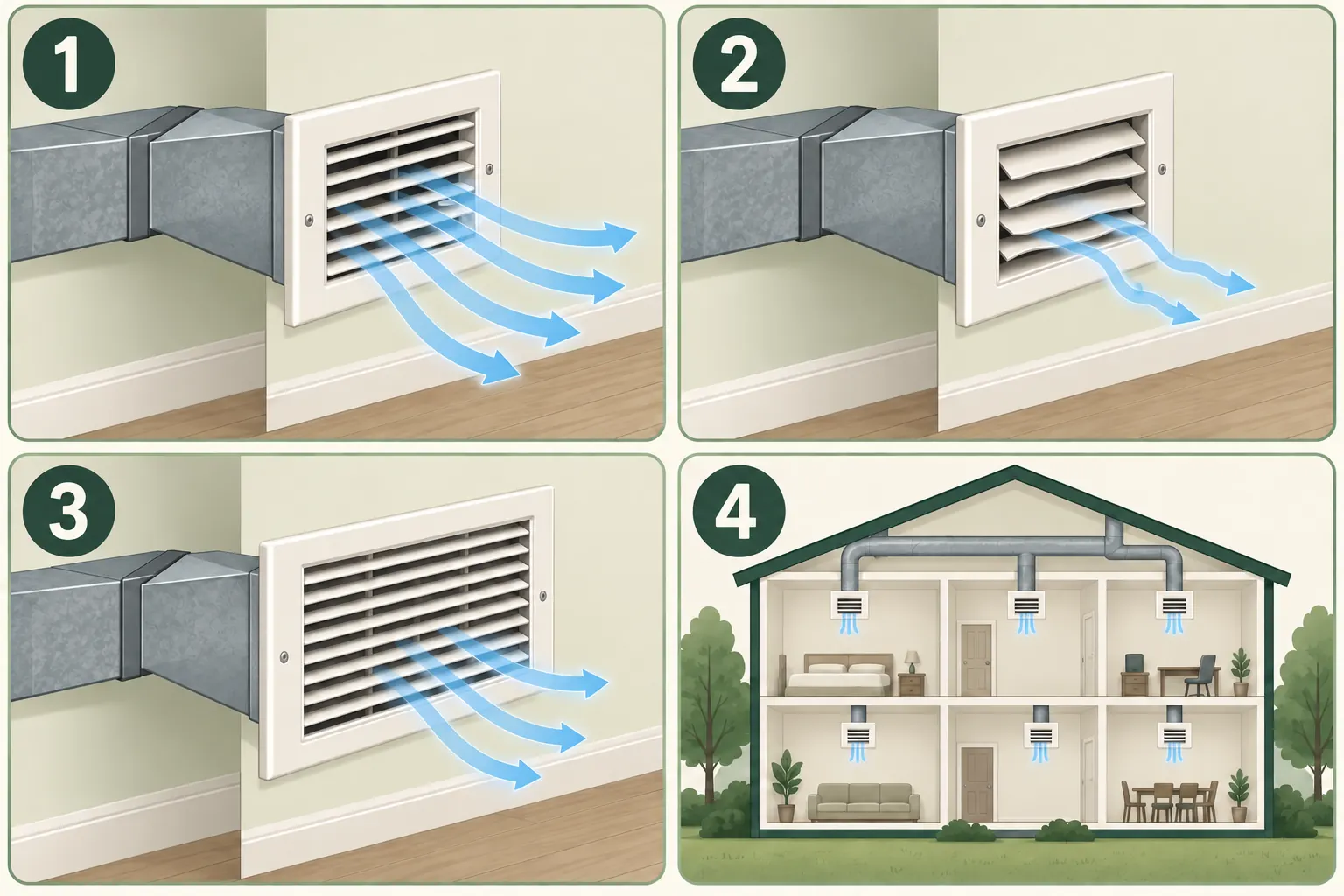
Register, grille, diffuser, or return: name the part first
Homeowners often call every louvered cover a vent, but the parts do different jobs. A supply grille directs air into a room. A register is a grille with an integral volume-control damper. A diffuser is a supply outlet designed to distribute air in one or more patterns. A return grille admits room air back toward the air handler and is not an interchangeable supply upgrade.
This article is mainly about supply outlets. Altering a return grille can affect the entire system rather than one room, and a filter may sit behind some return grilles. Do not replace, cover, or reduce a return opening based on advice for a supply register.
Follow the whole airflow path
A register does not pull extra air out of a duct on its own. The blower moves air through a connected system: return openings and ducts, filter, equipment components, supply trunk, branch duct, boot, and finally the room outlet. Each part contributes resistance, and the blower operates against the combined system.
That is why a less restrictive outlet can help when the terminal is the bottleneck, yet do very little when the limiting point is upstream. A dirty or overly restrictive filter, inadequate return path, crushed or disconnected branch, excessive duct leakage, closed balancing damper, undersized duct, dirty coil, zoning condition, or blower limitation can all reduce delivered air before it reaches the register. A register swap cannot repair those conditions.
Is it one outlet, one room, or several rooms?
One visibly restrictive outlet
When one register is damaged, partly closed, unusually dense, or blocked while similar nearby outlets perform normally, the terminal becomes a reasonable candidate. The nearby boot and branch still matter, so replacement is a possibility—not proof of the fix.
One room with several weak outlets
A room-level pattern can involve branch layout, balancing, closed-door return pressure, load, or distribution. Replacing every face in that room may change air direction without solving the amount of air supplied or the path back to the system.
Several weak outlets throughout the home
A common register-age explanation becomes less persuasive when different outlets weaken together. Look upstream toward filter condition, return capacity, blower operation, zoning, coils, and the duct system. A sudden widespread change deserves earlier service than a long-standing cosmetic concern.
Will a bigger register push more air?
Not automatically. The visible frame size is not the same as the open area available for air, and neither measurement tells you what the connected boot and branch can supply. Installing a larger face over the same small neck or branch may lower face velocity or change noise and direction, but it does not enlarge the concealed duct.
Product performance depends on model, size, geometry, neck connection, inlet conditions, and airflow. Manufacturers publish pressure-drop, throw, spread, and noise data for specific outlets. Compare rated performance at the required airflow instead of assuming that a larger outside dimension, wider slots, or a more open-looking face guarantees more delivered volume.
More air can feel different from better air distribution
A replacement can make the room feel different even when total airflow changes little. Blade angle and outlet geometry affect throw—the distance the air jet travels—along with spread, mixing, drop, and the draft felt at a chair or bed. Redirecting an uncomfortable jet may improve comfort without increasing the volume delivered through the branch.
Noise can also mislead. A small or restrictive face may create higher local velocity, turbulence, or whistle. A larger, lower-resistance outlet of the same product family may be quieter at the same airflow. Quieter air is not proof that volume increased, and a stronger draft at one spot is not a flow measurement.
Can decorative registers restrict airflow?
Some decorative patterns leave less effective opening or impose more pressure drop than other designs, but appearance alone cannot rank them. Two products with the same nominal face size may have different cores, blade angles, dampers, necks, pressure loss, sound, and air patterns.
Use manufacturer performance data for the exact model when available. If data are missing, do not accept a percentage improvement claim from looks or marketing. An HVAC professional can select an outlet for the needed airflow and room pattern rather than treating the most open-looking design as universally best.
Register damper versus balancing damper
A register may have a room-side lever that moves an integral damper. That control can fine-tune the outlet, but it is not necessarily the system's primary balancing device. A separate balancing damper may be installed in the branch near its connection to a trunk, sometimes in an inaccessible location.
Do not assume that an open register means every upstream damper is open. Also do not close registers in other rooms to force air toward a weak room. Excessive closure can raise resistance, increase noise, change leakage and room pressures, and reduce airflow through equipment. Balancing should preserve the system's required total airflow, not trade one complaint for another.
What you can safely check yourself
- Identify whether the suspect opening supplies air to the room or returns air to the system.
- Move furniture, rugs, curtains, or stored items away from the face without removing the outlet.
- Set the normal room-side register control fully open and compare it with similar outlets during the same operating cycle.
- Look for bent blades, a stuck control, thick paint, or heavy surface debris that visibly blocks the face.
- Compare one outlet, all outlets in the room, and several rooms; record whether the change is local or widespread.
- Note whether closing the room door changes comfort, sound, or the apparent flow, which can support a return-path question without proving one.
- Describe the complaint precisely: weak volume, short throw, poor direction, whistle, vibration, or an uncomfortable draft.
- Check the filter only through the normal homeowner access described by the equipment or filter manufacturer; never run the system without it.
How a professional can tell whether the register is the bottleneck
Useful diagnosis compares evidence instead of guessing from hand feel. Depending on the problem, a qualified technician may measure delivered flow with an appropriate hood or instrument, compare room pressure with the door open and closed, inspect accessible duct and damper conditions, and measure pressure effects across filters, coils, equipment, or the distribution system.
Airflow numbers need context: outlet size, correction or area factors, instrument method, system operating mode, blower data, and design requirements all matter. A phone app, tissue, or handheld feel test cannot establish the register's pressure drop or the room's required airflow. Ask what was measured and whether the proposed outlet is supported by manufacturer performance data at the intended operating point.
When replacement makes sense—and when it does not
Call an HVAC professional when the scope is broader than one visibly obstructed face, the source cannot be isolated, a return opening may be involved, or the replacement would require altering the boot or duct. Bring photographs, the one-versus-many comparison, door-position observations, filter history, and any product information you can read safely.
If the register is wet rather than airflow-limited, that is a different symptom. Use the AC vent sweating guide to distinguish surface condensation from dripping or moisture originating elsewhere.
For moisture forming on a room-side supply register, use Why Is My AC Vent Sweating? instead of treating a wet outlet as an airflow-upgrade question.
| Pattern | Reasonable next step |
|---|---|
| One outlet is damaged, cannot open, or has verified excessive pressure loss | Select a compatible supply outlet using the needed airflow, pattern, pressure-drop, and sound data |
| A decorative face performs poorly compared with product data for an appropriate alternative | Consider an outlet change while keeping the existing boot and branch limits in view |
| The complaint is direction, throw, spread, or local draft | Select and aim the correct terminal; do not promise more air volume |
| Several outlets are weak or the problem appeared suddenly | Evaluate the filter, return, blower, controls, coils, ducts, leakage, and dampers before buying covers |
| One room stays uncomfortable with normal measured supply flow | Investigate room load, return path, air mixing, and building conditions rather than assuming the register is too small |
Bottom line
Replacing HVAC registers can improve airflow only when the existing outlet is a meaningful restriction and the upstream system can deliver more air. Old does not mean restrictive, larger does not mean higher volume, and a changed draft or sound does not prove a flow increase.
First identify the terminal, check its normal control and visible face, and compare one outlet with the room and the rest of the house. Then separate terminal performance from boot, branch, return, filter, blower, duct, and balancing limits. Measure before promising—and fix the bottleneck that the evidence actually supports.
Sources
- Manual T: Air Distribution BasicsAir Conditioning Contractors of America
- Manual D: Residential Duct DesignAir Conditioning Contractors of America
- HVAC Duct Terminal SizingU.S. Department of Energy Building Science Education
- Ducted ReturnsBuilding America Solution Center
- Pressure Balancing Supply and Return Ducts in Existing HomesBuilding America Solution Center
- Understanding Grille, Register and Diffuser PerformanceGreenheck
- Air Distribution Engineering GuidePrice Industries
- Grilles, Registers & Diffusers Product GuidePrice Industries