Safety Reference
Why Does My Dryer Smell Like It’s Burning?
A burning dryer smell can point to lint, restricted exhaust, friction, a contaminated load, or electrical trouble. Learn when to stop using it.
Short answer
What it usually means
If a dryer smells strongly burned, electrical, smoky, or unusually hot, stop the cycle and do not keep running it to see whether the odor clears. A loaded lint path or restricted exhaust can trap heat, but friction at a belt or rotating part, an overheating motor, a heater or burner-area problem, damaged wiring or a power connection, and an unsuitable or contaminated item can produce similar odors. Visible smoke, sparking, flame, rapidly increasing heat, scorching, or a tripped breaker accompanied by burning odor calls for distance and emergency or qualified electrical help—not another test cycle.
Stop first when the odor is strong, electrical, or smoky
A dryer should not produce a persistent burning odor. End the cycle and leave the appliance off when the smell is strong, resembles hot plastic or wiring, comes with smoke, or the cabinet, cord, plug, or receptacle is unusually hot. Do not repeatedly restart it to reproduce the symptom.
For visible flame, active smoke, or sparking, get everyone out and call emergency services. Do not open or move the dryer, reach behind it, use water on energized equipment, or keep resetting a tripped breaker.
What kind of burning smell is it?
Odor descriptions are subjective, and several problems can smell alike. The pattern can still help a technician decide whether to begin with airflow, the load, moving parts, heating, or the electrical supply.
| What it smells or feels like | What the pattern may point toward |
|---|---|
| Hot lint, dust, or a dry scorched odor | Loaded lint path, restricted exhaust, dust after long inactivity, or debris in a hot area |
| Burning rubber | A slipping belt, rubbing seal or roller, stalled rotating part, or a rubber/plastic item in the load |
| Electrical, melting-plastic, or acrid odor | Cord, plug, receptacle, motor, control, or wiring overheating; treat promptly |
| Chemical or fabric odor from one load | Oil, solvent, gasoline residue, adhesive, foam, rubber backing, or another item not suitable for tumble drying |
| Mild oily odor only on the first uses of a new dryer | Residue or dust may be transient; persistent, smoky, or electrical odor is not |
| Odor plus squealing, scraping, thumping, or a struggling drum | Friction or a motor, belt, roller, idler, bearing, or foreign-object problem |
| Odor plus long drying and an unusually hot cabinet or room | Restricted airflow becomes more plausible, though it is not the only possible cause |
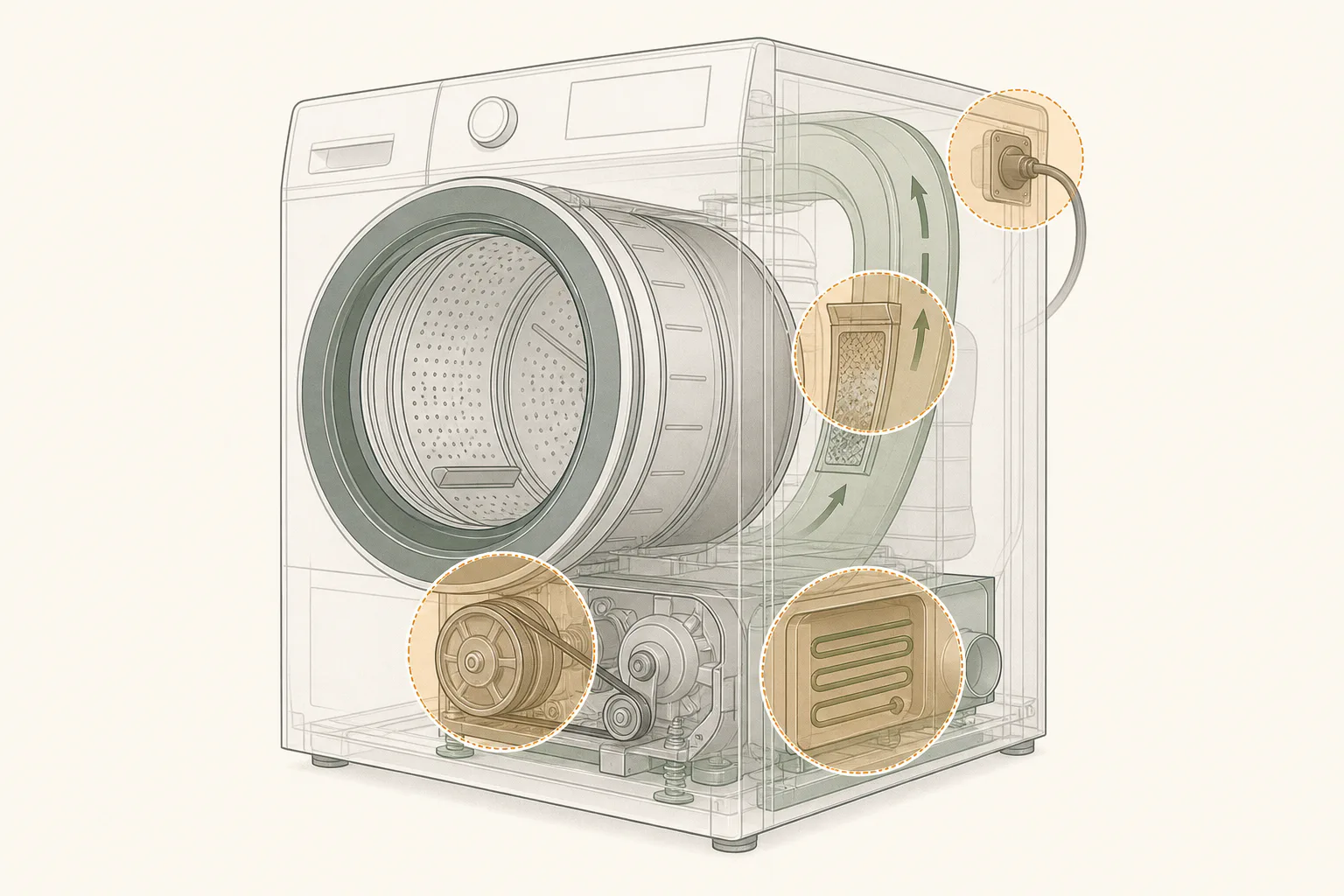
Common sources of a dryer burning smell
The smell alone cannot identify the failed part. Dryer designs vary, and gas and electric models create heat differently. Use the surrounding clues to choose a safe next step rather than opening the cabinet.
- 1Lint is restricting airflow or collecting where it should not
Lint can accumulate at the screen, inside the dryer, in the transition duct, or in the house exhaust. CPSC and USFA warn that restrictions can reduce airflow, increase heat, and contribute to fires. Clean the screen routinely; internal chassis cleaning belongs to qualified service.
- 2The exhaust path is crushed, blocked, or overly restrictive
A kinked connector, obstructed outdoor hood, lint in the building duct, or a long route can retain heat and moisture. Long drying, an unusually hot cabinet or room, and weak exterior airflow support this path. The separate two-cycle guide covers drying performance in more detail.
- 3A foreign object or escaped material reached a hot area
Pocket debris, a small fabric item, packaging, or lint can lodge where normal heat creates an odor. Check only the visible drum and lint-screen area after the dryer cools. Do not reach beyond homeowner-access areas or open a heater housing.
- 4A belt or moving component is rubbing
A deteriorating drum belt, idler, roller, bearing, felt seal, or another moving part can generate friction and a rubbery odor. Squealing, scraping, thumping, delayed drum movement, or a drum that struggles to start strengthens this path, but odor does not prove which component is responsible.
- 5The motor is overheating
A motor facing mechanical resistance or an electrical fault may smell hot, buzz, struggle to start, or restart after cooling. Keep the dryer off; motor and drive-system diagnosis requires appliance service.
- 6The heating or burner area has a problem
Electric heating components, thermostats, airflow safety controls, and nearby debris can create excessive heat or odor when something fails. Gas dryers use a burner and ignition system instead. Neither system is a homeowner repair area: do not handle high-voltage parts, adjust a burner, manipulate gas valves, or bypass a thermal control.
- 7A cord, receptacle, terminal, wire, or control is overheating
Loose or damaged electrical connections can concentrate heat and produce an acrid or melting-plastic smell. Darkened blades, a deformed plug, a warm wall plate, sparking, intermittent power, or breaker trips make electrical evaluation more urgent. If heat is centered at the wall connection, the guide to a warm outlet explains why the receptacle and branch circuit need separate attention.
- 8The load contains oil, solvent, foam, rubber, or plastic
CPSC and dryer manuals warn that textiles exposed to cooking oil, gasoline, solvents, or finishing oils can remain hazardous after washing. Rubber-backed rugs, foam, plastics, and adhesives may also be unsuitable for tumble heat. Stop the cycle and follow the item and dryer instructions.
- 9A new or recently serviced dryer is heating residual dust or coatings
Manufacturers note that a mild oily or semi-burning odor can occur briefly during first use as residue or dust heats. That narrow explanation fits a new appliance with a mild fading odor—not smoke, sparking, intense heat, persistent electrical smell, or an odor that grows stronger. When in doubt, stop and use model-specific support.
When the smell appears changes the next question
If the dryer stops unexpectedly but no burning odor is present, use Why Does My Dryer Keep Shutting Off? to separate heat, power, door, load, sensor, and motor clues.
| Timing or companion symptom | Useful direction |
|---|---|
| Odor begins immediately after Start | Power connection, motor start, foreign material, or the load itself deserves attention |
| Odor develops after 15 to 30 minutes | Heat retention, vent restriction, motor temperature, or friction becomes more relevant |
| Only high-heat cycles produce the smell | Heat-related components, airflow, or an unsuitable fabric/item may be involved |
| Only one load smells | Check the contents, care labels, rubber/foam/plastic parts, oils, solvents, and pocket debris |
| Smell remains after the cycle stops | Retained heat, hot lint, or an overheated component may still be present; leave the unit off |
| Dryer shuts off, then works after cooling | Motor overheating, restricted airflow, or a heat-control problem needs appliance evaluation |
| Breaker trips or the plug/outlet is hot | Stop use and involve a licensed electrician as well as appliance service when appropriate |
What you can check without opening the dryer
- Stop the cycle and allow the appliance to cool; do not touch a surface that is smoking, sparking, melted, or severely hot.
- Clean the lint screen and check it for heavy loading, waxy residue, darkening, scorch marks, or damage.
- Identify whether the odor is strongest at the drum opening, lint-screen area, rear vent, power connection, wall outlet, or a particular item in the load.
- Look at the cord, plug, and receptacle for darkening, deformation, looseness, or melting without removing covers or probing the outlet.
- Look for an obvious crushed transition duct without moving the appliance or straining its connections.
- Check the exterior vent termination from ground level for a stuck cover or visible obstruction; do not climb onto a roof or reach into a running vent.
- Note whether clothes have also begun taking longer to dry, whether the room feels unusually hot, and whether the dryer reports a check-vent alert.
- Listen for squealing, scraping, buzzing, thumping, or a drum that does not turn normally, then leave internal inspection to a technician.
- Review the load and care labels for rubber, foam, plastic, oil, solvent, gasoline, or other heat-sensitive material.
- Record when the smell begins, which cycle and load were involved, any shutdowns or breaker trips, and whether the odor returned after cooling.
Why the exhaust path deserves early attention
A vented dryer needs a continuous path through the transition duct and house duct to the exterior. A restriction can lengthen drying, retain heat, and collect lint. USFA recommends a clean filter, an undamaged connector, and an outdoor cover that opens during operation.
Those checks do not clear a dryer with a burning odor. If the route is inaccessible, airflow stays weak, or internal lint is suspected, keep it off and arrange vent or appliance service.
If long drying is the main symptom and no stop-use odor or electrical warning is present, compare the airflow, washer, load, sensor, and heat paths in Why Is My Dryer Taking Two Cycles?.
When to stop using the dryer immediately
- Visible smoke, flame, sparking, or glowing where it should not occur
- Strong electrical, burning-plastic, or smoky odor
- Scorch marks, melted plastic, or a damaged cord, plug, or receptacle
- Severe cabinet heat or rapidly increasing heat around the appliance
- Repeated breaker trips, especially with odor or heat
- A burning smell that returns immediately after Start
- Suspected gas odor, burner problem, or abnormal combustion
- Signs that lint or material inside the appliance may be burning
Who should inspect a dryer that smells burned?
Appliance repair technician
Use appliance service for friction, abnormal drum motion, motor overheating, internal lint, heating or control components, internal wiring, or an odor whose source remains unclear.
Dryer-vent professional
Use an appropriate qualified vent provider when exterior airflow is weak, the route is long or inaccessible, the transition duct is damaged, or a building-duct restriction is suspected. Vent service does not replace appliance inspection when the smell appears to originate inside the machine.
Licensed electrician
Use an electrician when the receptacle, plug, cord, branch wiring, or breaker shows heat, damage, sparking, intermittent power, or repeated trips. Do not use an adapter or extension cord.
Qualified gas-appliance professional
For a gas dryer, use qualified appliance or gas service for burner, ignition, combustion, connector, or gas-supply concerns. If you smell gas, leave the area and follow the gas utility or emergency instructions; do not operate switches or test the dryer.
Sources
- Clothes Dryer Fire SafetyU.S. Fire Administration
- Overheated Clothes Dryers Can Cause FiresU.S. Consumer Product Safety Commission
- Hidden Hazard in the Home: Cloths Heavily Soiled With Vegetable Oil Can Start FiresU.S. Consumer Product Safety Commission
- Appliance and Electrical Fire SafetyU.S. Fire Administration
- Dryer OdorGE Appliances
- Dryer Owner’s Manual and Fire-Hazard WarningsWhirlpool